Equations and Properties of Ellipses
CSCA Equations and Properties of Ellipses study guide organized around the publicly available CSCA syllabus. Practice Mathematics questions on aicsca.com.
Before planning this topic, check the CSCA Exam Guide 2026 for exam dates, registration, fees, and subject requirements.
Syllabus Alignment
This study guide is organized around the publicly available CSCA syllabus for international undergraduate applicants.
Who It Is For
International students preparing for CSCA Math, Physics, Chemistry, or Chinese exams.
Related Practice
CSCA Practice · Go to questions
Past papers and worked video solutions · Timed mock exams · All subject video lessons
Practice by Topic
Jump from this tutorial to filtered practice questions for the same knowledge point.
Related formulas, concepts, and glossary terms
Mathematics Formula & Concept Reference
- Parametric Equations of an Ellipse
- Standard Equation of an Ellipse (Foci on x-axis)
- Area of an Ellipse
- Eccentricity of an Ellipse
- Relationship between Focal Distance and Semi-axes of an Ellipse
- Standard Equation of an Ellipse (Center at Origin, Foci on y-axis)
- Relationship between Focal Distance and Semi-axis Lengths
- Standard Equation of an Ellipse (Center at Origin, Foci on x-axis)
Mathematics Exam Glossary
Tutorial Content
Equations and Properties of Ellipses
Ellipses are a focal point of the Analytic Geometry section in the CSCA exam. The key to mastering ellipses lies in **"Positioning"** (determining which axis the foci lie on) and **"Quantifying"** (understanding the relationship between $a, b, c$).
1. Definition
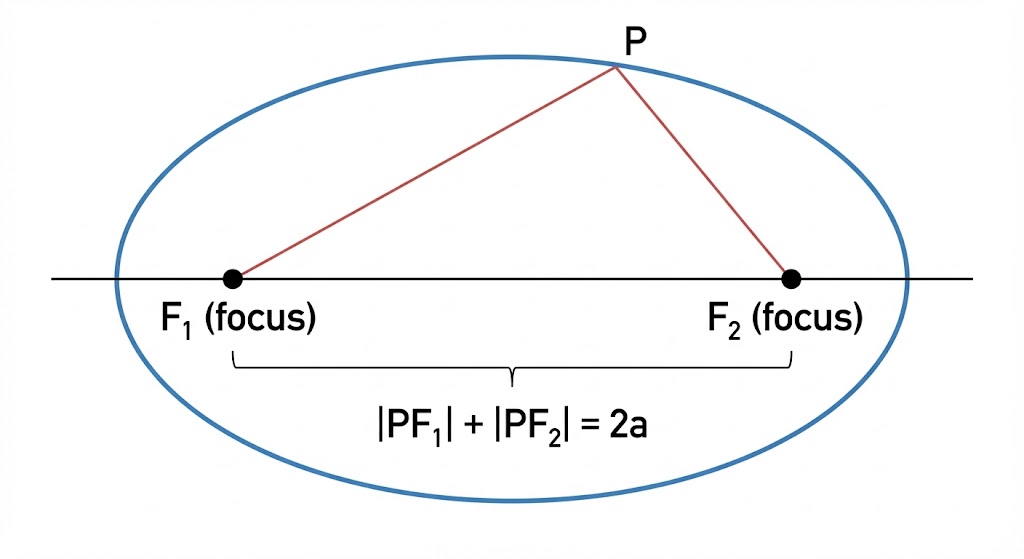
An ellipse is the locus of points in a plane such that the sum of the distances to two fixed points $F_1, F_2$ (**Foci**) is a constant $2a$.
* Condition: $2a > |F_1F_2|$ (The constant must be greater than the focal distance).
* Focal Length: $|F_1F_2| = 2c$.
* Mathematical Expression: $|PF_1| + |PF_2| = 2a$.
2. Standard Equations
The equation of an ellipse depends on the coordinate axis where the foci are located. Regardless of the location, the following relationship always holds:
$$a^2 = b^2 + c^2 \quad (a > b > 0, a > c > 0)$$
**Note**: In an ellipse, $a$ (semi-major axis) is the longest segment, which differs from a hyperbola.
| Type | **Foci on x-axis (Horizontal)** | **Foci on y-axis (Vertical)** |
| :--- | :---: | :---: |
| **Graph** | 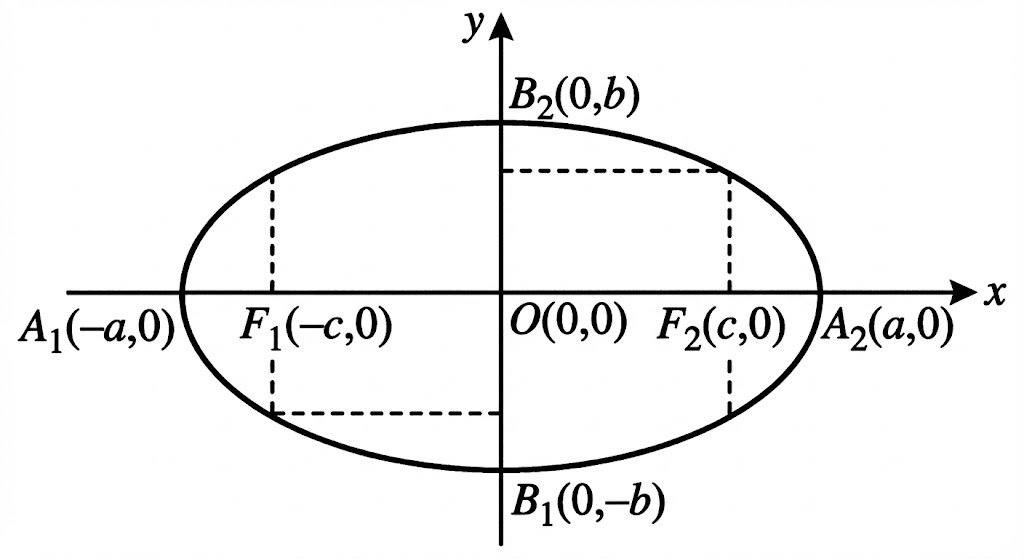 | (Similar, but major axis is vertical) |
| **Standard Equation** | $$\frac{x^2}{a^2} + \frac{y^2}{b^2} = 1$$ | $$\frac{y^2}{a^2} + \frac{x^2}{b^2} = 1$$ |
| **Foci Coordinates** | $F(\pm c, 0)$ | $F(0, \pm c)$ |
| **Vertices** | $(\pm a, 0), (0, \pm b)$ | $(0, \pm a), (\pm b, 0)$ |
| **How to Identify** | **Denominator of $x^2$ is larger** | **Denominator of $y^2$ is larger** |
3. Geometric Properties
Taking the horizontal ellipse $\frac{x^2}{a^2} + \frac{y^2}{b^2} = 1$ as an example:
1. **Range**: $-a \le x \le a$, $-b \le y \le b$. The ellipse is bounded within a rectangle.
2. **Symmetry**: Symmetric about the x-axis, y-axis, and the origin.
3. **Eccentricity ($e$)**:
$$e = \frac{c}{a} \quad (0 < e < 1)$$
* $e$ describes the "flatness" of the ellipse.
* $e \to 0$: The ellipse approaches a **circle**.
* $e \to 1$: The ellipse becomes **flatter**.
4. **Major and Minor Axes**:
* Length of Major Axis = $2a$, Length of Minor Axis = $2b$.
4. Examples
**Example 1**: Given the ellipse equation $25x^2 + 9y^2 = 225$, find the coordinates of the foci and the eccentricity.
**Solution**:
1. **Standard Form**: Divide both sides by 225 to get $\frac{x^2}{9} + \frac{y^2}{25} = 1$.
2. **Identify Focus**: Since $25 > 9$ and 25 is under $y^2$, the foci are on the **y-axis**.
3. **Determine Parameters**: $a^2=25 \Rightarrow a=5$, $b^2=9 \Rightarrow b=3$.
4. **Calculate c**: $c = \sqrt{a^2 - b^2} = \sqrt{25-9} = 4$.
5. **Conclusion**: Foci are $(0, \pm 4)$, Eccentricity $e = \frac{c}{a} = \frac{4}{5} = 0.8$.
**Example 2**: The eccentricity of an ellipse is $\frac{1}{2}$ and the length of the major axis is 4. Find the standard equation.
**Solution**:
From the problem, $2a = 4 \Rightarrow a = 2$.
Since $e = \frac{c}{a} = \frac{1}{2}$, we get $c = 1$.
Then $b^2 = a^2 - c^2 = 4 - 1 = 3$.
Since the focus location is not specified, consider two cases:
* Foci on x-axis: $\frac{x^2}{4} + \frac{y^2}{3} = 1$
* Foci on y-axis: $\frac{y^2}{4} + \frac{x^2}{3} = 1$
5. Study Tips
* **Analyze the Equation First**: Always check which denominator is larger to determine the axis of the foci.
* **Memorize the Relationship**: For ellipses, $a^2 = b^2 + c^2$ ($a$ is the hypotenuse/longest).
* **Distinguish from Hyperbola**: For hyperbolas, $c^2 = a^2 + b^2$ ($c$ is the hypotenuse). Do not confuse them.