Exponential Functions
CSCA Exponential Functions study guide organized around the publicly available CSCA syllabus. Practice Mathematics questions on aicsca.com.
Before planning this topic, check the CSCA Exam Guide 2026 for exam dates, registration, fees, and subject requirements.
Syllabus Alignment
This study guide is organized around the publicly available CSCA syllabus for international undergraduate applicants.
Who It Is For
International students preparing for CSCA Math, Physics, Chemistry, or Chinese exams.
Related Practice
CSCA Practice · Go to questions
Past papers and worked video solutions · Timed mock exams · All subject video lessons
Practice by Topic
Jump from this tutorial to filtered practice questions for the same knowledge point.
Related formulas, concepts, and glossary terms
Mathematics Formula & Concept Reference
- Exponential Function Graph and Properties: Monotonicity
- Exponential Function Operation Rule: Division
- Property of Exponential Functions: Division of Powers with Same Base
- Natural Exponential Function
- Exponential Function Operation Rule: Power of a Power
- Property of Exponential Functions: Multiplication of Powers with Same Base
- Property of Exponential Functions: Power of a Power
- General Form of Exponential Function
Mathematics Exam Glossary
Tutorial Content
Exponential Functions
1. Core Concepts
**Definition**: A function $y = a^x$, where $x$ is the variable, base $a$ is a constant, $a > 0, a \neq 1$.
**Why limit the base?**
* If $a < 0$, values like $a^{1/2}$ are undefined in real numbers.
* If $a = 1$, $y=1$ is just a constant line.
---
2. Graphs and Properties
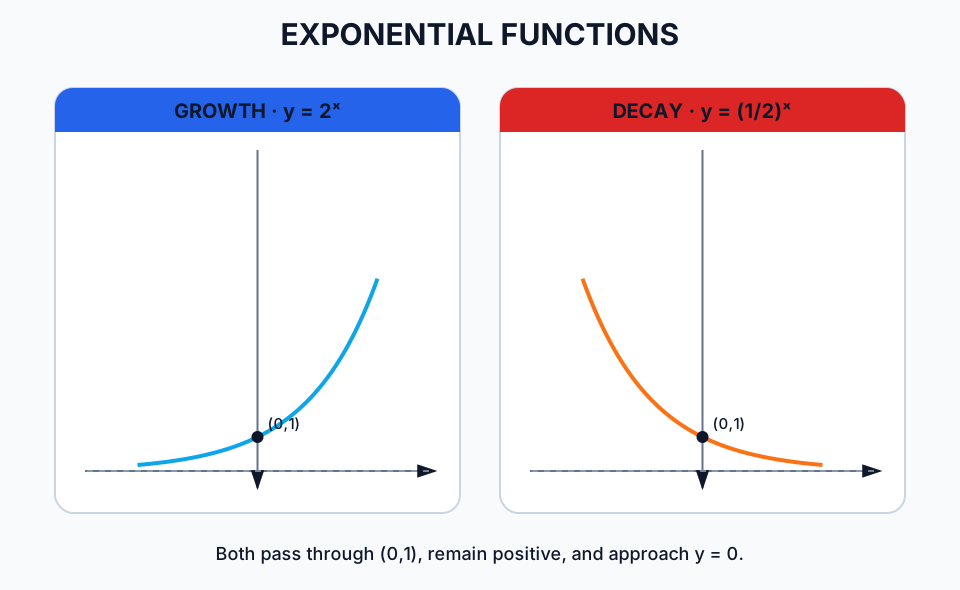
Properties depend entirely on the range of base $a$: "Growth" ($a>1$) vs. "Decay" ($0<a<1$).
| Feature | **$a > 1$ (e.g., $y=2^x$)** | **$0 < a < 1$ (e.g., $y=0.5^x$)** |
| :--- | :--- | :--- |
| **Shape** | Rising Curve | Falling Curve |
| **Monotonicity** | **Increasing** on $\mathbb{R}$ | **Decreasing** on $\mathbb{R}$ |
| **Fixed Point** | Passes $(0, 1)$ | Passes $(0, 1)$ |
| **Range** | $(0, +\infty)$ | $(0, +\infty)$ |
| **Asymptote** | x-axis ($y=0$) | x-axis ($y=0$) |
| **Trend** | $x \to +\infty, y \to +\infty$ | $x \to +\infty, y \to 0$ |
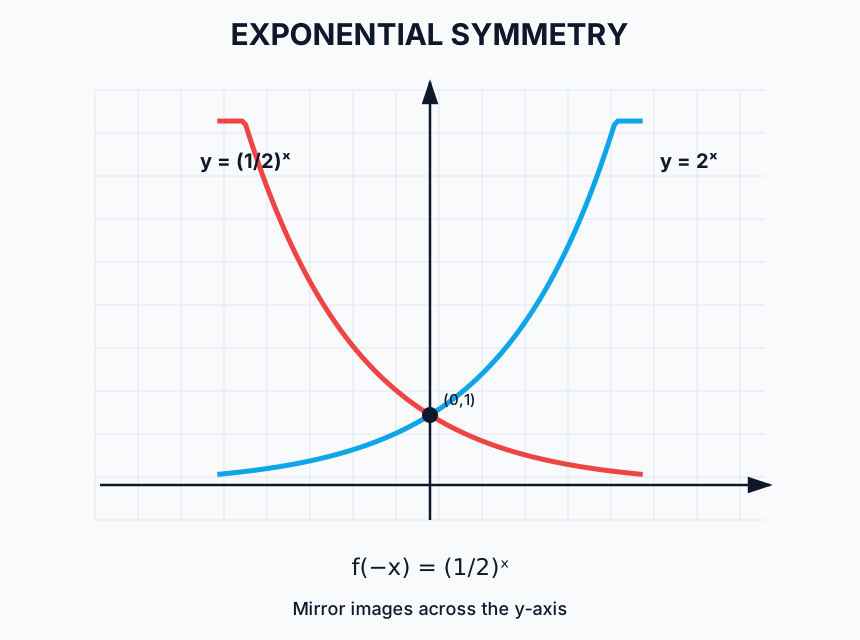
**Symmetry Rule**:
The graphs of $y=a^x$ and $y=(\frac{1}{a})^x$ are symmetric about the **y-axis**.
(e.g., $y=2^x$ and $y=0.5^x$ are mirror images).
---
3. Key Operational Rules
Assume $a, b > 0$ and $r, s \in \mathbb{R}$:
1. $a^r \cdot a^s = a^{r+s}$
2. $\frac{a^r}{a^s} = a^{r-s}$
3. $(a^r)^s = a^{rs}$
4. $(ab)^r = a^r b^r$
---
4. Typical Examples
**Example 1: Monotonicity Comparison**
Compare (1) $1.7^{2.5}$ vs $1.7^3$; (2) $0.8^{-0.2}$ vs $0.8^{-0.1}$.
**Solution**:
(1) Base $1.7 > 1$ (Increasing). Since $2.5 < 3$, then $1.7^{2.5} < 1.7^3$.
(2) Base $0.8 < 1$ (Decreasing). Since $-0.2 < -0.1$, the inequality flips: $0.8^{-0.2} > 0.8^{-0.1}$.
**Example 2: Substitution Method**
Solve: $4^x - 3 \cdot 2^x + 2 = 0$.
**Solution**:
Note that $4^x = (2^x)^2$. Let $t = 2^x$ (**Condition: $t > 0$**).
Equation becomes $t^2 - 3t + 2 = 0 \Rightarrow (t-1)(t-2)=0$.
* $t=1 \Rightarrow 2^x = 1 \Rightarrow x=0$.
* $t=2 \Rightarrow 2^x = 2 \Rightarrow x=1$.
**Answer**: $x=0, x=1$.
**Example 3: Domain and Inequality**
Find domain of $y = \sqrt{1 - (\frac{1}{2})^{x-1}}$.
**Solution**:
Radicand $\ge 0$: $1 - (\frac{1}{2})^{x-1} \ge 0 \Rightarrow (\frac{1}{2})^{x-1} \le 1$.
Rewrite 1 as $(\frac{1}{2})^0$: $(\frac{1}{2})^{x-1} \le (\frac{1}{2})^0$.
**Crucial Step**: Base $0.5 < 1$, so flip the inequality sign.
$\therefore x - 1 \ge 0 \Rightarrow x \ge 1$.
**Answer**: $[1, +\infty)$.
---
5. Common Pitfalls
* **Forgetting to flip sign**: When solving inequalities with base $0 < a < 1$, the direction must reverse.
* **Substitution Range**: When setting $t = a^x$, always remember $t$ must be positive.
* **Graph Confusion**: Don't confuse $y=2^x$ (Exponential) with $y=x^2$ (Power).