Trigonometric Functions
CSCA Trigonometric Functions study guide organized around the publicly available CSCA syllabus. Practice Mathematics questions on aicsca.com.
Before planning this topic, check the CSCA Exam Guide 2026 for exam dates, registration, fees, and subject requirements.
Syllabus Alignment
This study guide is organized around the publicly available CSCA syllabus for international undergraduate applicants.
Who It Is For
International students preparing for CSCA Math, Physics, Chemistry, or Chinese exams.
Related Practice
CSCA Practice · Go to questions
Past papers and worked video solutions · Timed mock exams · All subject video lessons
Practice by Topic
Jump from this tutorial to filtered practice questions for the same knowledge point.
Related formulas, concepts, and glossary terms
Mathematics Formula & Concept Reference
- Reduction Formula (Complementary Angles)
- Sine of Sum of Two Angles Formula
- Definition of Tangent Function
- Definition of Cosine Function
- Reduction Formulas (Odd-Even Rule, Sign Determined by Quadrant)
- Cosine Values of Special Angles
- Relationship between Tangent, Sine, and Cosine
- Sine Values of Special Angles
Mathematics Exam Glossary
Tutorial Content
Trigonometric Functions
1. Core Concepts
**Trigonometric Functions** relate angles to side ratios in right triangles and coordinates on the unit circle. CSCA focuses on Sine ($\sin$), Cosine ($\cos$), and Tangent ($\tan$).
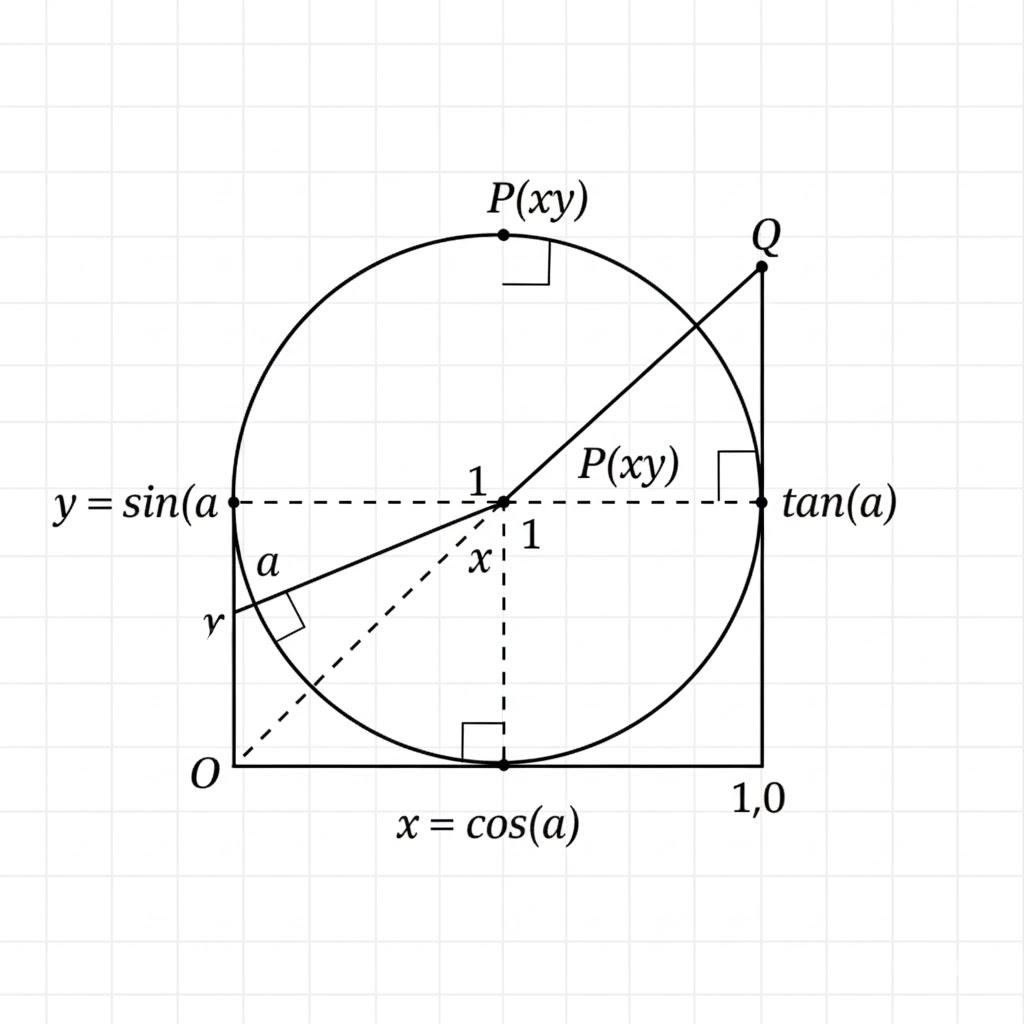
**Unit Circle Definition**:
For a point $P(x, y)$ on the unit circle corresponding to angle $\alpha$:
* $\sin \alpha = y$ (y-coordinate)
* $\cos \alpha = x$ (x-coordinate)
* $\tan \alpha = \frac{y}{x}$ (Slope, $x\neq 0$)
**Radian Measure**:
Calculus uses radians by default. $180^{\circ} = \pi \text{ rad}$.
---
2. Graphs and Properties
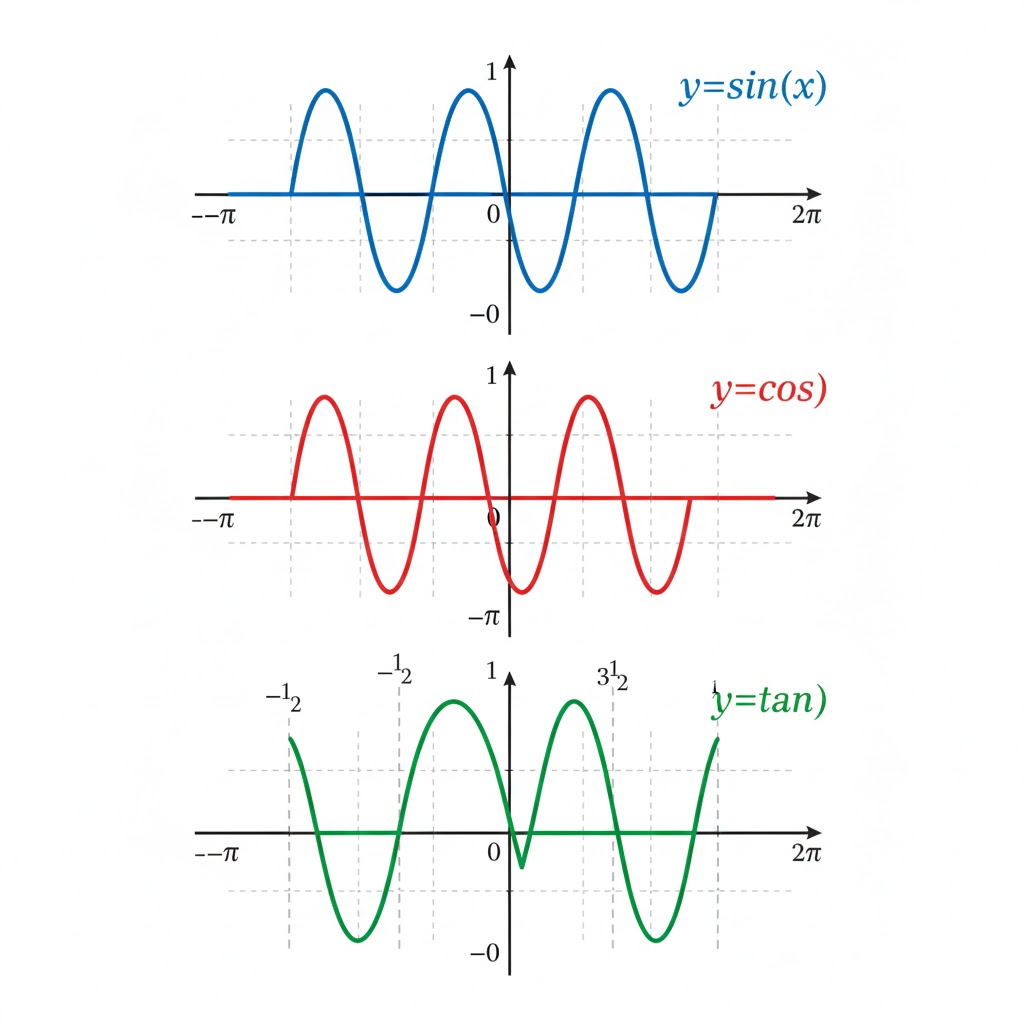
| Function | $y=\sin x$ | $y=\cos x$ | $y=\tan x$ |
| :--- | :--- | :--- | :--- |
| **Domain** | $\mathbb{R}$ | $\mathbb{R}$ | $\{x \mid x \neq k\pi + \frac{\pi}{2}\}$ |
| **Range** | $[-1, 1]$ | $[-1, 1]$ | $\mathbb{R}$ |
| **Period** | $2\pi$ | $2\pi$ | $\pi$ |
| **Parity** | **Odd** | **Even** | **Odd** |
| **Graph Key** | Passes (0,0) | Passes (0,1) | Vertical Asymptotes |
---
3. Key Formulas
#### (1) Fundamental Identities
* $\sin^2 \alpha + \cos^2 \alpha = 1$
* $\tan \alpha = \frac{\sin \alpha}{\cos \alpha}$
#### (2) Reduction Formulas
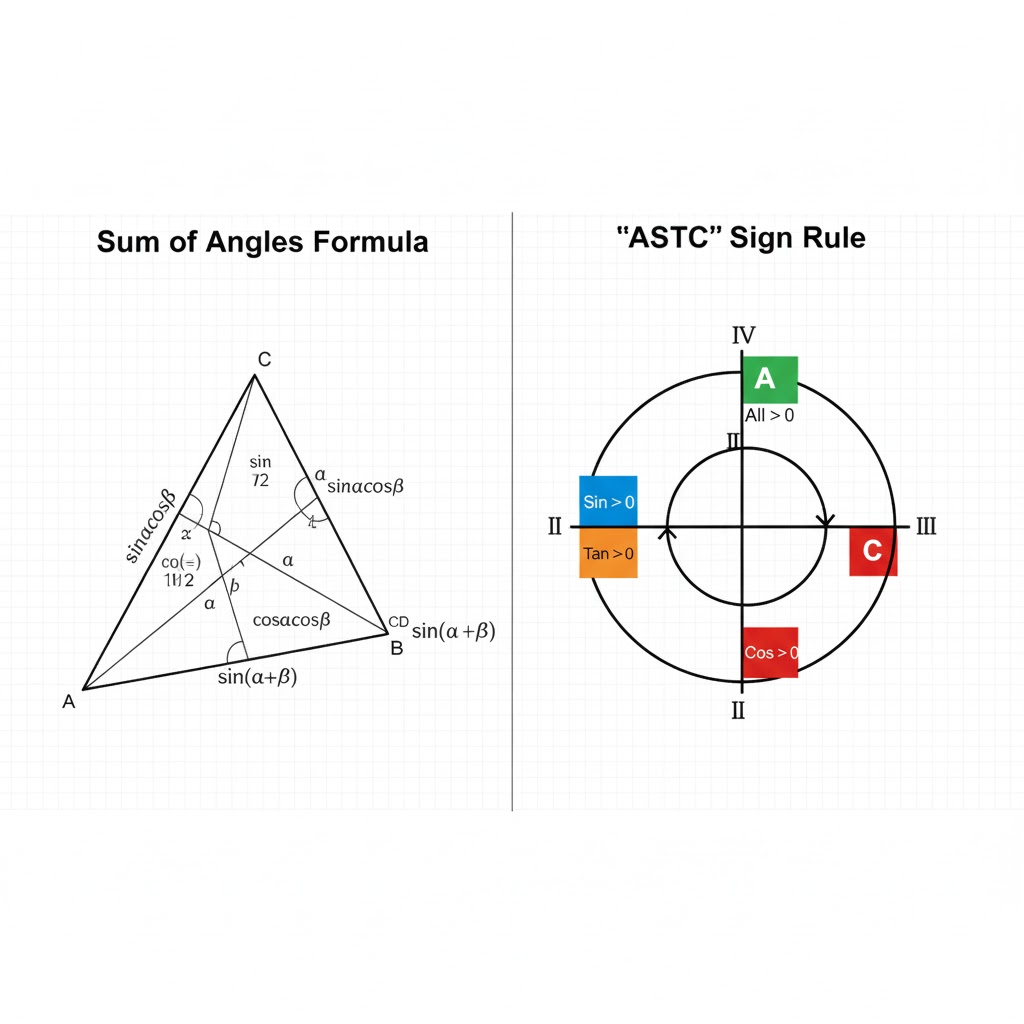
**Rule**: **Odd changes, Even stays; Sign depends on quadrant**.
* For $\frac{k\pi}{2} \pm \alpha$:
* Odd $k$ $\Rightarrow \sin \leftrightarrow \cos$
* Even $k$ $\Rightarrow$ Function stays same
* Sign: Check the sign of the original function in the quadrant of the original angle (assuming $\alpha$ is acute).
#### (3) Sum/Difference & Double Angle
* $\sin(\alpha \pm \beta) = \sin\alpha\cos\beta \pm \cos\alpha\sin\beta$
* $\cos(\alpha \pm \beta) = \cos\alpha\cos\beta \mp \sin\alpha\sin\beta$ (Sign flips!)
* $\sin 2\alpha = 2\sin\alpha\cos\alpha$
* $\cos 2\alpha = 2\cos^2\alpha - 1 = 1 - 2\sin^2\alpha$
---
4. Typical Examples
**Example 1: Period and Range**
Find period and max value of $f(x) = 2\sin(2x - \frac{\pi}{3}) + 1$.
**Solution**:
* **Period**: $T = \frac{2\pi}{2} = \pi$.
* **Max Value**: Max of $\sin$ is 1. So $2(1) + 1 = 3$.
**Example 2: Reduction**
Simplify $\cos(\pi + \alpha) + \sin(\frac{\pi}{2} + \alpha)$.
**Solution**:
* $\cos(\pi + \alpha)$: Even $\pi/2$, Quadrant III (cos is -) $\Rightarrow -\cos\alpha$.
* $\sin(\frac{\pi}{2} + \alpha)$: Odd $\pi/2$, Quadrant II (sin is +) $\Rightarrow +\cos\alpha$.
* Sum $= 0$.
**Example 3: Equation**
Solve $\cos 2x = \cos x$ for $x \in [0, 2\pi)$.
**Solution**:
$2\cos^2 x - 1 = \cos x \Rightarrow (2\cos x + 1)(\cos x - 1) = 0$.
* $\cos x = 1 \Rightarrow x=0$.
* $\cos x = -0.5 \Rightarrow x = 2\pi/3, 4\pi/3$.
---
5. Common Pitfalls
* **Linearity Error**: $\sin(A+B) \neq \sin A + \sin B$. Never distribute sin.
* **Sign Confusion**: Remember $\cos(A-B)$ has a PLUS sign.
* **Missing Solutions**: $\sin x = 0.5$ has two solutions in $[0, 2\pi)$, not just $\pi/6$.