Functions
CSCA Functions study guide organized around the publicly available CSCA syllabus. Practice Mathematics questions on aicsca.com.
Before planning this topic, check the CSCA Exam Guide 2026 for exam dates, registration, fees, and subject requirements.
Syllabus Alignment
This study guide is organized around the publicly available CSCA syllabus for international undergraduate applicants.
Who It Is For
International students preparing for CSCA Math, Physics, Chemistry, or Chinese exams.
Related Practice
CSCA Practice · Go to questions
Past papers and worked video solutions · Timed mock exams · All subject video lessons
Practice by Topic
Jump from this tutorial to filtered practice questions for the same knowledge point.
Related formulas, concepts, and glossary terms
Mathematics Formula & Concept Reference
- Reduction Formula (Complementary Angles)
- Sine of Sum of Two Angles Formula
- Definition of Tangent Function
- Definition of Cosine Function
- Reduction Formulas (Odd-Even Rule, Sign Determined by Quadrant)
- Cosine Values of Special Angles
- Sum of the First n Terms of a Geometric Sequence ( q = 1 )
- Geometric Mean Formula
Mathematics Exam Glossary
Tutorial Content
Functions
1. Module Framework & Learning Objectives
Welcome to the "Functions" module. Functions act as the bridge connecting algebra, geometry, and analysis, and they are a core topic in the CSCA math exam. This module will help you master function definitions, properties, and graph characteristics.
**Learning Objectives:**
* Understand the concept of functions (Domain, Range).
* Master the four major properties: Monotonicity, Parity, Periodicity, and Boundedness.
* Familiarize yourself with the graphs and properties of basic elementary functions.
---
2. Core Concept: What is a Function?
**Definition**: Let $A$ and $B$ be two non-empty sets of real numbers. If for **every** element $x$ in set $A$, there exists a **unique** element $y$ in set $B$ according to a specific correspondence rule $f$, then $f: A \rightarrow B$ is called a function from set $A$ to set $B$, denoted as:
$$
y = f(x), \quad x \in A
$$
Where:
* $x$ is the **Independent Variable**.
* $A$ is the **Domain**.
* The set of function values $\{f(x) | x \in A\}$ is the **Range**.
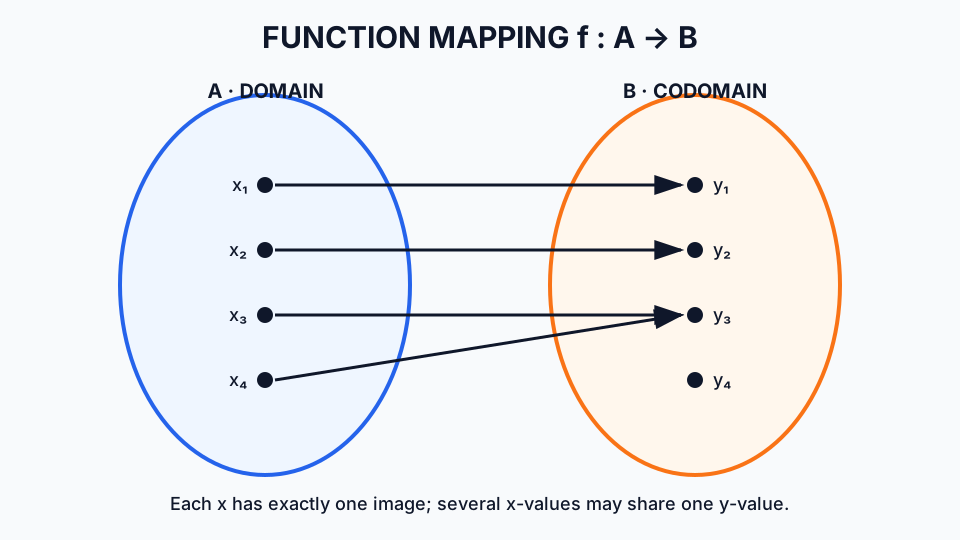
**Note:** The key to a function is "Uniqueness". One $x$ maps to only one $y$, but distinct $x$'s can map to the same $y$.
---
3. Important Properties of Functions
Determining function properties is a common question type in the CSCA exam.
3.1 Monotonicity
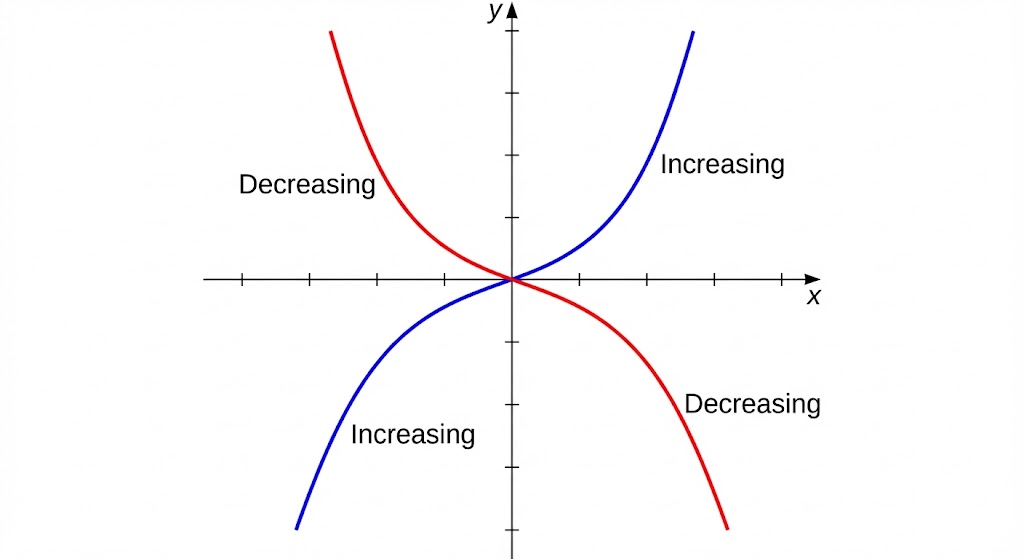
* **Monotonically Increasing**: For any $x_1, x_2$ in the interval, if $x_1 < x_2$, then $f(x_1) < f(x_2)$.
* **Monotonically Decreasing**: For any $x_1, x_2$ in the interval, if $x_1 < x_2$, then $f(x_1) > f(x_2)$.
3.2 Parity (Even and Odd Functions)
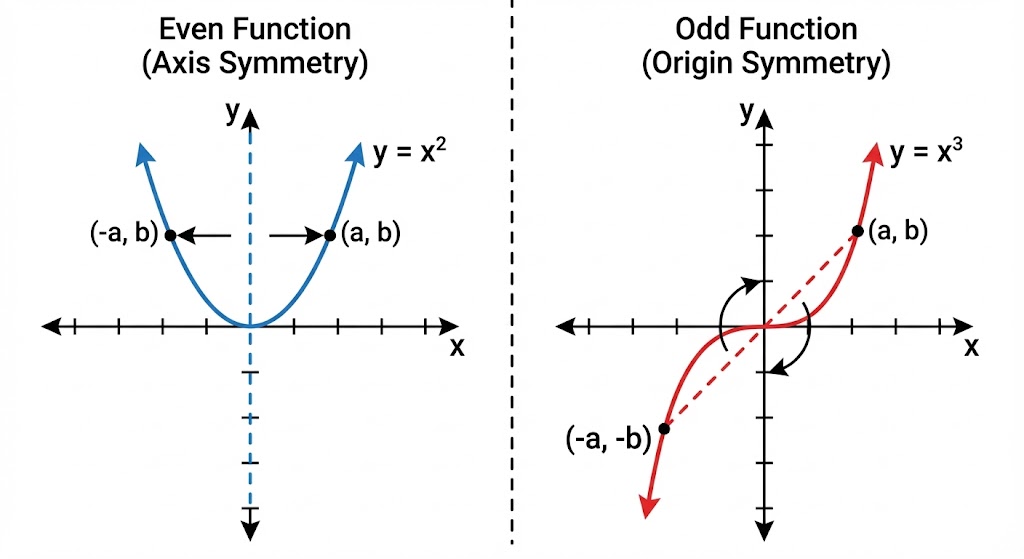
Prerequisite: The domain must be symmetric with respect to the origin.
* **Even Function**: Satisfies $f(-x) = f(x)$. The graph is symmetric with respect to the **y-axis** (e.g., $y = x^2, y = \cos x$).
* **Odd Function**: Satisfies $f(-x) = -f(x)$. The graph is symmetric with respect to the **origin** (e.g., $y = x^3, y = \sin x$).
3.3 Periodicity
If there exists a non-zero constant $T$ such that for any $x$, $f(x+T) = f(x)$, the function is periodic. The smallest positive $T$ is called the **fundamental period**.
* Common examples: The period for $\sin x$ and $\cos x$ is $2\pi$.
---
4. Basic Elementary Functions Quick Reference
Mastering these graphs is crucial for problem-solving.
| Function Type | Expression | Key Features |
| :--- | :--- | :--- |
| **Power Function** | $y = x^\alpha$ | Shape depends on the sign and parity of $\alpha$. |
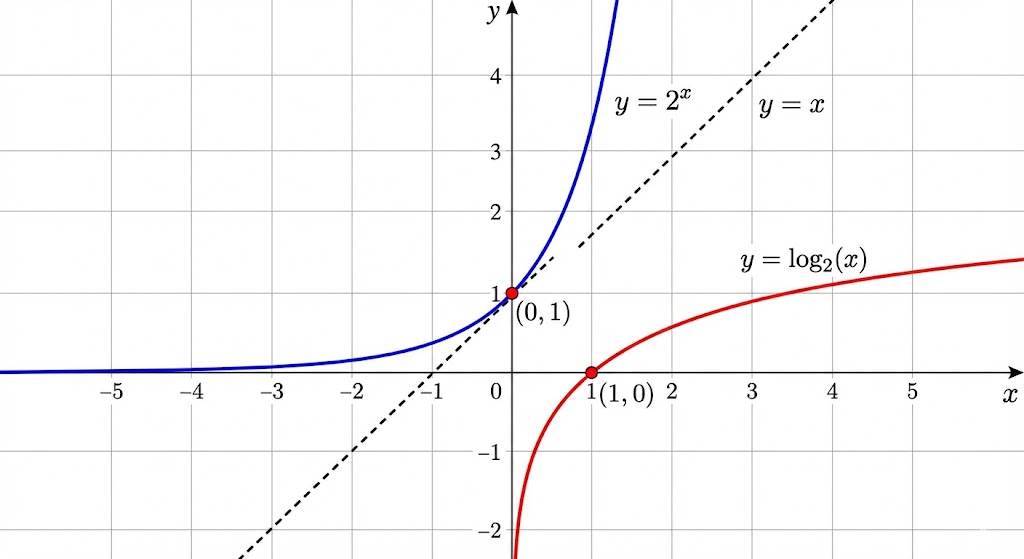
| **Exponential** | $y = a^x (a>0, a\neq 1)$ | Always passes through $(0,1)$. Increases if $a>1$. |
| **Logarithmic** | $y = \log_a x (a>0, a\neq 1)$ | Always passes through $(1,0)$. Inverse of Exponential. |