Preliminary Derivatives
CSCA Preliminary Derivatives study guide organized around the publicly available CSCA syllabus. Practice Mathematics questions on aicsca.com.
Before planning this topic, check the CSCA Exam Guide 2026 for exam dates, registration, fees, and subject requirements.
Syllabus Alignment
This study guide is organized around the publicly available CSCA syllabus for international undergraduate applicants.
Who It Is For
International students preparing for CSCA Math, Physics, Chemistry, or Chinese exams.
Related Practice
CSCA Practice · Go to questions
Past papers and worked video solutions · Timed mock exams · All subject video lessons
Practice by Topic
Jump from this tutorial to filtered practice questions for the same knowledge point.
Related formulas, concepts, and glossary terms
Mathematics Formula & Concept Reference
- Normal Line Equation Formula
- Tangent Line Equation Formula
- Geometric Meaning of Derivative
- Alternative Notation for Derivative (Leibniz Notation)
- Relationship between Differentiability and Continuity at a Point
- Definition of Derivative (Limit Form)
- Left-hand and Right-hand Derivatives
- Inflection Point of a Curve
Mathematics Exam Glossary
Tutorial Content
Preliminary Derivatives
1. Core Concepts: Definition of Derivative
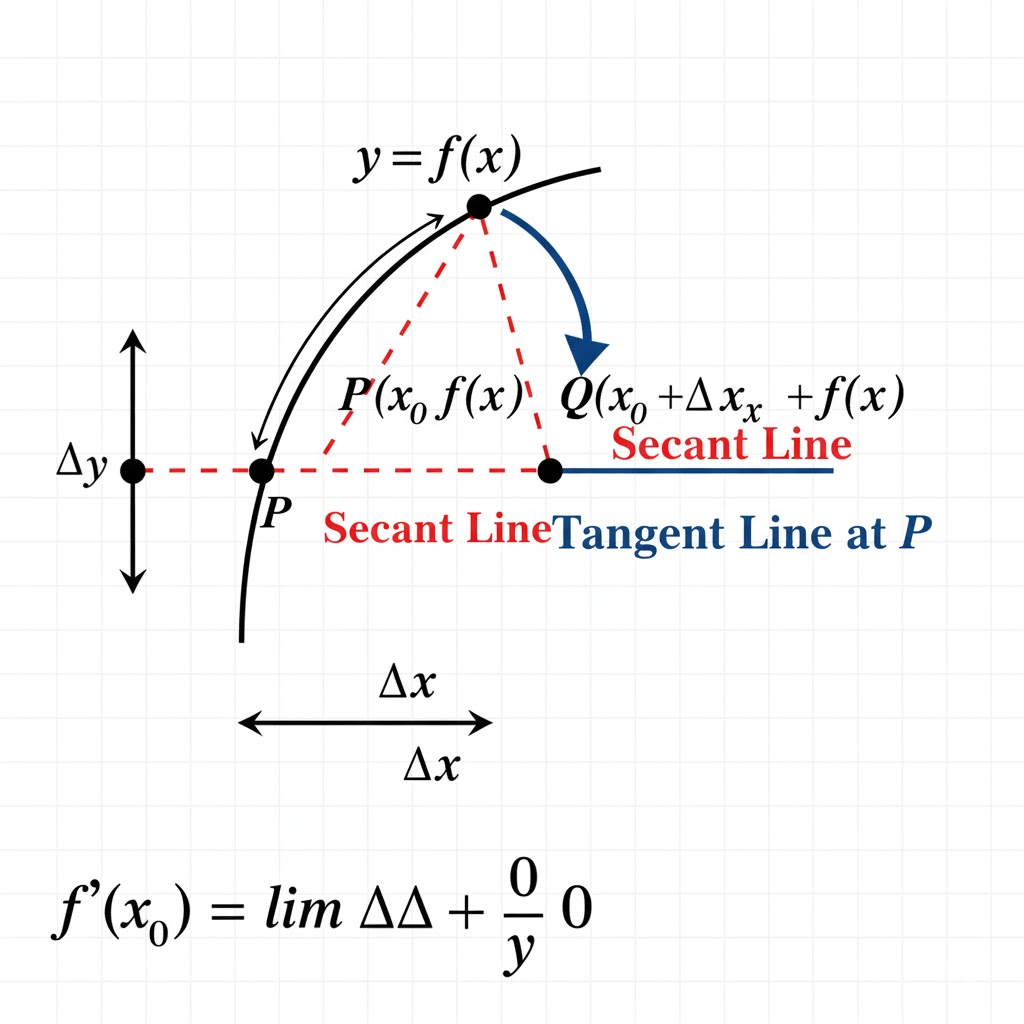
The **Derivative** describes the rate at which a function changes at a certain point, known as the **Instantaneous Rate of Change**.
* **Algebraic Definition**: For a function $y = f(x)$, as $x$ changes by $\Delta x$, $y$ changes by $\Delta y$. The derivative is the limit:
$$ f'(x_0) = \lim_{\Delta x \to 0} \frac{\Delta y}{\Delta x} = \lim_{\Delta x \to 0} \frac{f(x_0 + \Delta x) - f(x_0)}{\Delta x} $$
* **Geometric Meaning**: $f'(x_0)$ represents the **slope of the tangent line** to the curve $y=f(x)$ at the point $(x_0, f(x_0))$.
---
2. Basic Differentiation Rules
For the CSCA exam, memorizing these rules is more practical than using the limit definition every time:
1. **Constant Rule**: $(C)' = 0$
2. **Power Rule**: $(x^n)' = n \cdot x^{n-1}$ (Most Important!)
3. **Sum/Difference Rule**: $[f(x) \pm g(x)]' = f'(x) \pm g'(x)$
4. **Constant Multiple Rule**: $[cf(x)]' = c \cdot f'(x)$
* **Common Derivatives**:
* $(\sin x)' = \cos x$
* $(\cos x)' = -\sin x$
* $(e^x)' = e^x$
* $(\ln x)' = \frac{1}{x}$
---
3. Applications of Derivatives
Derivatives are powerful tools for analyzing the behavior of function graphs:
1. **Tangent Line Equation**:
The slope at $(x_0, y_0)$ is $k = f'(x_0)$. The equation is:
$$ y - y_0 = f'(x_0)(x - x_0) $$
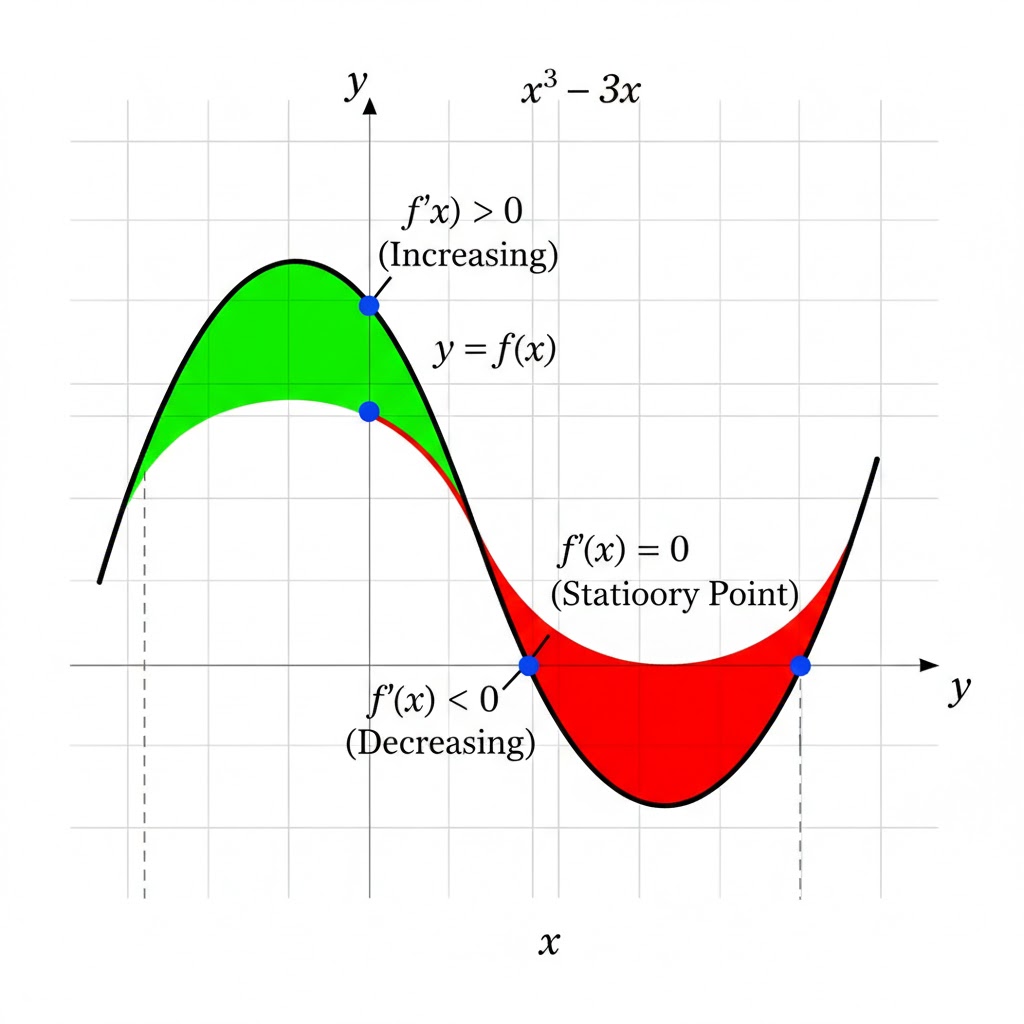
2. **Monotonicity**:
* If $f'(x) > 0$, $f(x)$ is **Monotonically Increasing**.
* If $f'(x) < 0$, $f(x)$ is **Monotonically Decreasing**.
3. **Extrema (Max/Min)**:
* **Stationary Point**: Solve $f'(x) = 0$ to find candidate points.
* **Test**: If $f'(x)$ changes from positive to negative, it's a **Maximum**; if negative to positive, it's a **Minimum**.
---
4. Typical Examples
**Example 1 (Tangent Line)**: Find the tangent line equation for $y = x^2$ at $(1, 1)$.
**Solution**:
1. Differentiate: $y' = (x^2)' = 2x$.
2. Find Slope: At $x=1$, $k = y'|_{x=1} = 2 \times 1 = 2$.
3. Equation: Using point-slope form, $y - 1 = 2(x - 1) \Rightarrow y = 2x - 1$.
**Example 2 (Monotonicity & Extrema)**: Analyze $f(x) = x^3 - 3x$.
**Solution**:
1. Differentiate: $f'(x) = 3x^2 - 3 = 3(x^2 - 1)$.
2. Set $f'(x) = 0$: $x = 1$ or $x = -1$.
3. Analyze Signs:
* $x < -1$: $f'(x) > 0$ (Increasing)
* $-1 < x < 1$: $f'(x) < 0$ (Decreasing)
* $x > 1$: $f'(x) > 0$ (Increasing)
4. Conclusion:
* Increasing on $(-\infty, -1)$ and $(1, +\infty)$. Decreasing on $(-1, 1)$.
* Local Maximum at $x=-1$, Local Minimum at $x=1$.
---
5. Common Pitfalls
* **Formula Errors**: Forgetting the coefficient in the Power Rule (e.g., thinking $(x^3)' = x^2$ instead of $3x^2$).
* **Tangent vs. Normal**: Confusing the Tangent line with the Normal line (slope $-1/k$).
* **Stationary Points**: Not all points where $f'(x)=0$ are extrema (e.g., $y=x^3$ at $x=0$). Always check sign changes.