Maximum and Minimum Values of a Function
CSCA Maximum and Minimum Values of a Function study guide organized around the publicly available CSCA syllabus. Practice Mathematics questions on aicsca.com.
Before planning this topic, check the CSCA Exam Guide 2026 for exam dates, registration, fees, and subject requirements.
Syllabus Alignment
This study guide is organized around the publicly available CSCA syllabus for international undergraduate applicants.
Who It Is For
International students preparing for CSCA Math, Physics, Chemistry, or Chinese exams.
Related Practice
CSCA Practice · Go to questions
Past papers and worked video solutions · Timed mock exams · All subject video lessons
Practice by Topic
Jump from this tutorial to filtered practice questions for the same knowledge point.
Related formulas, concepts, and glossary terms
Mathematics Formula & Concept Reference
- Using First Derivative to Determine Monotonicity and Extrema
- Using Second Derivative to Determine Extrema (Sufficient Condition)
- Necessary Condition for Local Extrema Using Derivative (Fermat's Lemma)
- Definition of Maximum and Minimum of a Function
- Using the Second Derivative to Determine Extrema
- Extreme Value Theorem for Continuous Functions on a Closed Interval
- General Steps to Find Extrema of a Continuous Function on a Closed Interval
- Steps to Find Extrema of a Continuous Function on a Closed Interval
Mathematics Exam Glossary
Tutorial Content
Maximum and Minimum Values of a Function
1. Concept
The **Maximum and Minimum Values** (collectively called **Global Extrema**) describe the boundaries of the function's output range over its entire domain or a specific interval.
Let the domain of $y=f(x)$ be $D$:
* **Maximum Value**: If there exists $x_0 \in D$ such that $f(x) \le f(x_0)$ for **all** $x \in D$, then $y_{max} = f(x_0)$.
* **Minimum Value**: If there exists $x_0 \in D$ such that $f(x) \ge f(x_0)$ for **all** $x \in D$, then $y_{min} = f(x_0)$.
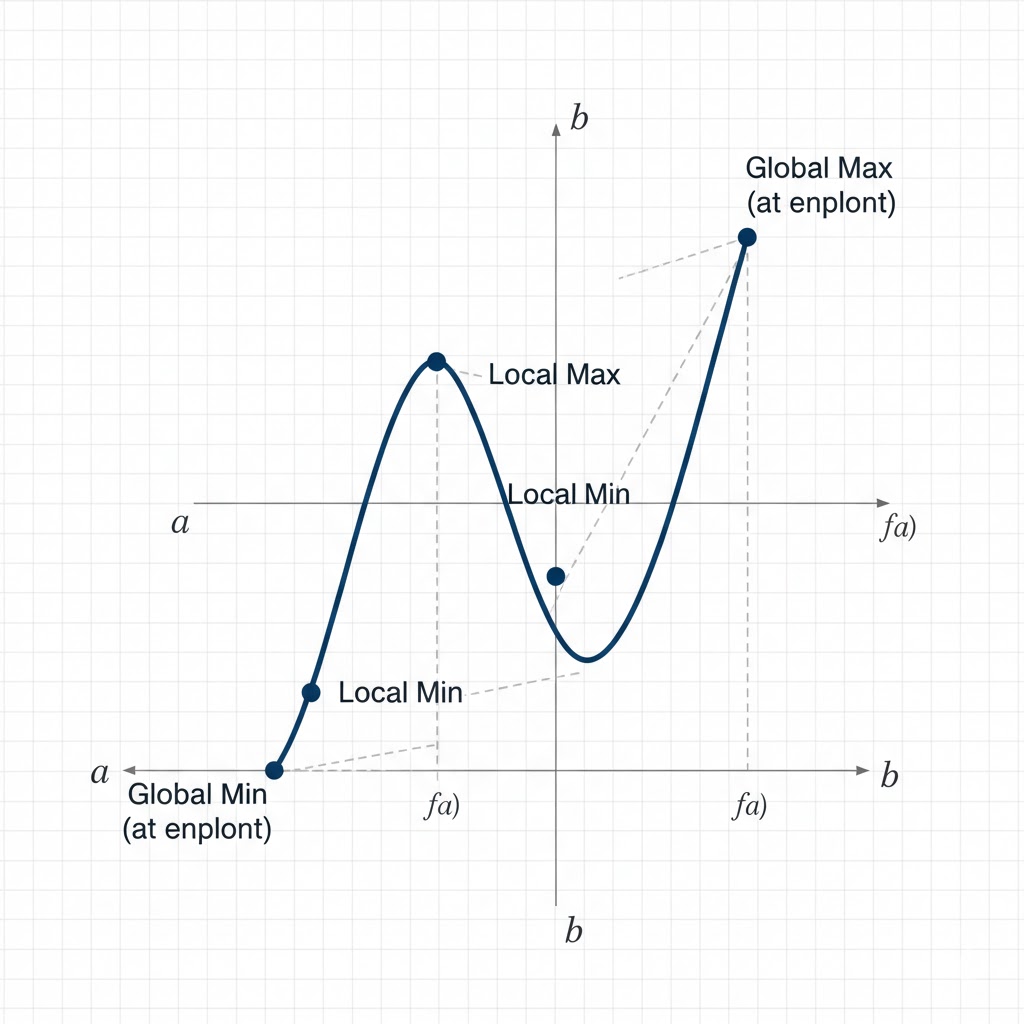
**Key Distinction**:
* **Global Extrema**: The highest/lowest points over the *entire* interval. Unique.
* **Local Extrema**: The highest/lowest points in a *local neighborhood* (peaks and valleys). Can be multiple.
* Global extrema occur at either local extrema or endpoints.
---
2. Common Methods
#### (1) Graphical Method
Sketch the graph and observe the highest and lowest points.
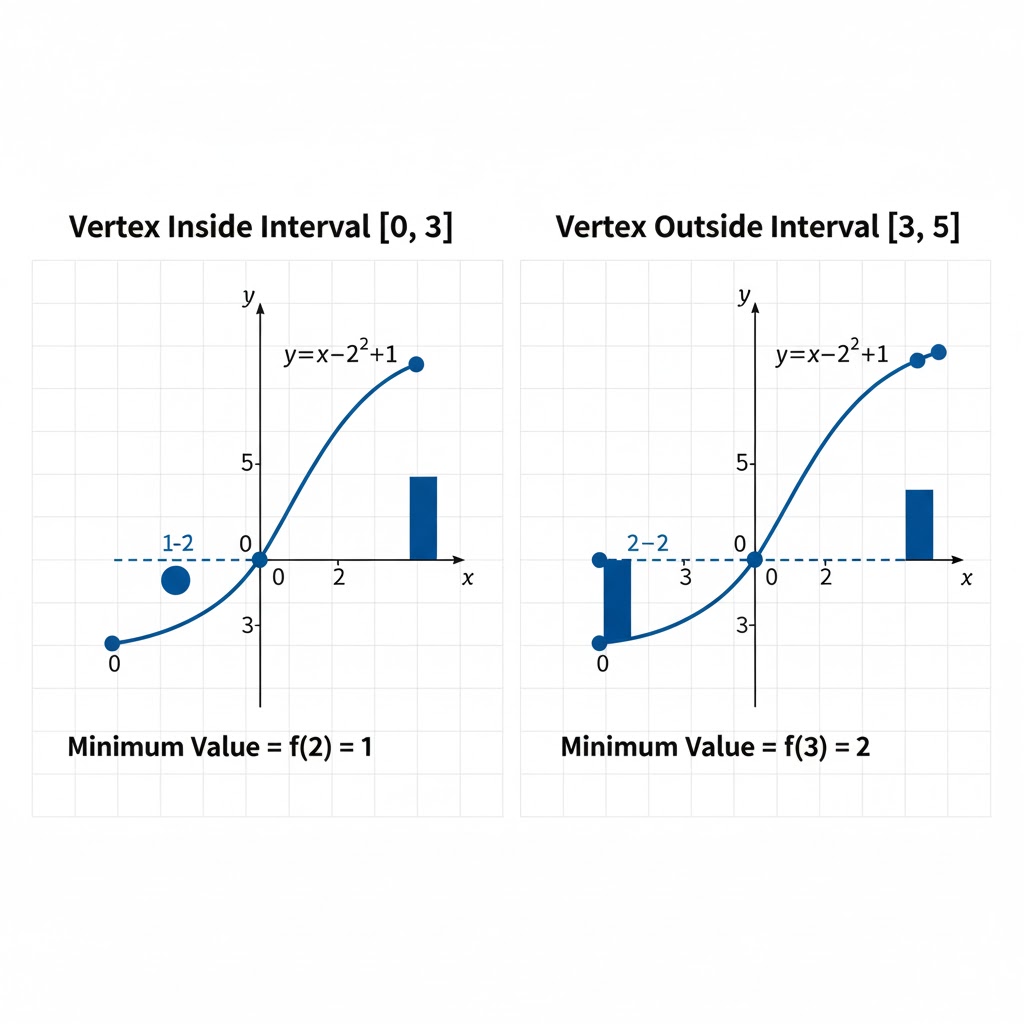
#### (2) Completing the Square (For Quadratics)
For $f(x)=a(x-h)^2+k$ on a closed interval $[m, n]$:
1. Check if the vertex $x=h$ lies inside $[m, n]$.
2. If yes, compare $f(h)$, $f(m)$, and $f(n)$.
3. If no, only compare endpoints $f(m)$ and $f(n)$.
#### (3) Derivative Method (General Approach)
To find extrema of a differentiable function on $[a, b]$ (The **Closed Interval Method**):
1. **Differentiate**: Find $f'(x)$.
2. **Find Critical Points**: Solve $f'(x)=0$ inside the interval.
3. **Evaluate**: Calculate $f(x)$ at all **critical points** AND **endpoints** $a, b$.
4. **Compare**: The largest value is the Maximum; the smallest is the Minimum.
---
3. Classic Examples
**Example 1: Quadratic on a Closed Interval**
Find max and min of $f(x)=x^2-4x+5$ on $[0, 3]$.
**Solution**:
1. **Vertex**: $f(x) = (x-2)^2 + 1$. Axis $x=2$.
2. **Check**: $x=2$ is inside $[0, 3]$.
3. **Evaluate Points**:
* Left Endpoint: $f(0) = 5$
* Vertex: $f(2) = 1$
* Right Endpoint: $f(3) = 2$
4. **Result**: Max is $5$, Min is $1$.
**Example 2: Derivative Method**
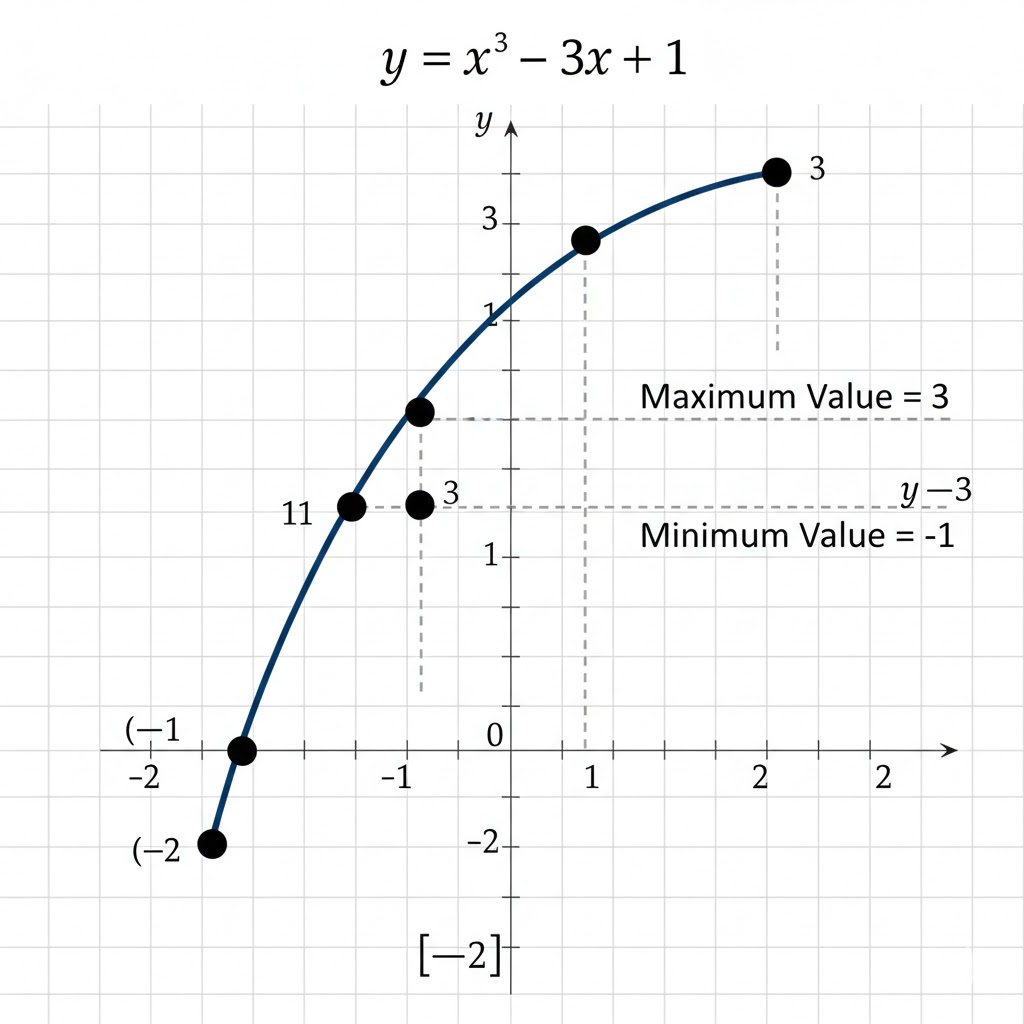
Find max and min of $f(x)=x^3-3x+1$ on $[-2, 2]$.
**Solution**:
1. $f'(x)=3x^2-3$.
2. Set $f'(x)=0 \Rightarrow x=\pm 1$. Both in $[-2, 2]$.
3. **Evaluate**:
* $f(-2) = -1$
* $f(-1) = 3$
* $f(1) = -1$
* $f(2) = 3$
4. **Result**: Max is $3$, Min is $-1$.
---
4. Common Pitfalls
* **Forgetting Endpoints**: In the derivative method, students often find local peaks/valleys but forget to check if the endpoints are higher or lower.
* **Ignoring Interval**: For quadratics, blindly using the vertex formula without checking if the vertex is actually within the given domain.
* **Confusing Local vs. Global**: A local maximum is not necessarily the global maximum.