Basic Elementary Functions
CSCA Basic Elementary Functions study guide organized around the publicly available CSCA syllabus. Practice Mathematics questions on aicsca.com.
Before planning this topic, check the CSCA Exam Guide 2026 for exam dates, registration, fees, and subject requirements.
Syllabus Alignment
This study guide is organized around the publicly available CSCA syllabus for international undergraduate applicants.
Who It Is For
International students preparing for CSCA Math, Physics, Chemistry, or Chinese exams.
Related Practice
CSCA Practice · Go to questions
Past papers and worked video solutions · Timed mock exams · All subject video lessons
Practice by Topic
Jump from this tutorial to filtered practice questions for the same knowledge point.
Related formulas, concepts, and glossary terms
Mathematics Formula & Concept Reference
- Reduction Formula (Complementary Angles)
- Sine of Sum of Two Angles Formula
- Definition of Tangent Function
- Definition of Cosine Function
- Reduction Formulas (Odd-Even Rule, Sign Determined by Quadrant)
- Cosine Values of Special Angles
- Relationship between Tangent, Sine, and Cosine
- Sine Values of Special Angles
Mathematics Exam Glossary
Tutorial Content
Basic Elementary Functions
1. Overview
Basic elementary functions are the fundamental "building blocks" for the CSCA exam. They are rarely tested on definitions alone but are used to test **Domain, Range, Monotonicity, Parity**, and **Graph Transformations**. The four main categories are:
1. Power Functions
2. Exponential Functions
3. Logarithmic Functions
4. Trigonometric Functions
---
2. Power Functions
**Formula**: $y = x^{\alpha}$ ($\alpha$ is a constant).
**Exam Focus**: Master the graphs of five common types: $\alpha \in \{1, 2, 3, \frac{1}{2}, -1\}$.
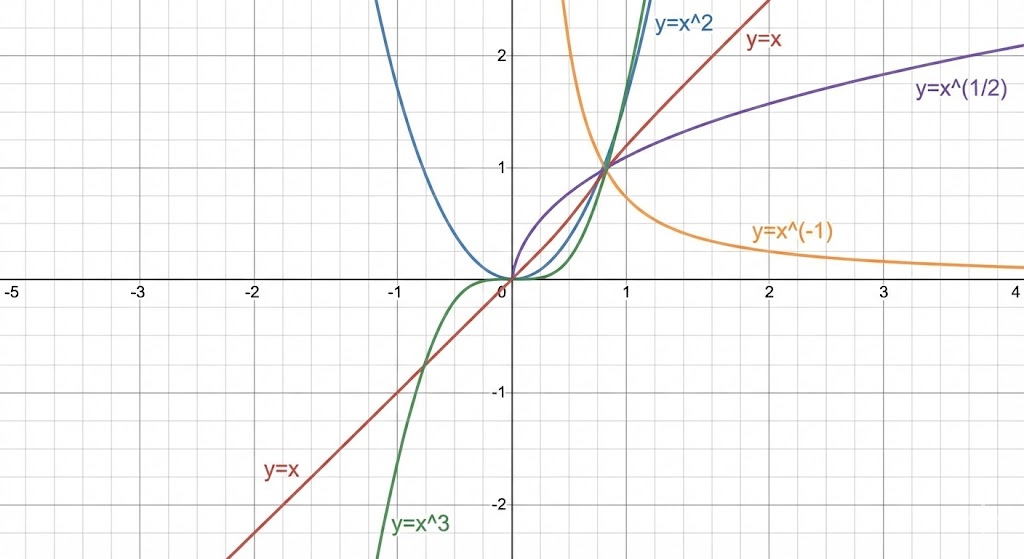
* **Commonality**: All pass through the point $(1, 1)$.
* **Monotonicity**:
* $\alpha > 0$: Increasing on $(0, +\infty)$.
* $\alpha < 0$: Decreasing on $(0, +\infty)$ (Axes are asymptotes).
* **Parity**: Depends on $\alpha$ (e.g., $x^2$ is Even, $x^3$ is Odd).
---
3. Exponential & Logarithmic Functions
These are **Inverse Functions** of each other. Their graphs are symmetric about the line $y=x$. The **Base $a$** determines the growth/decay behavior.
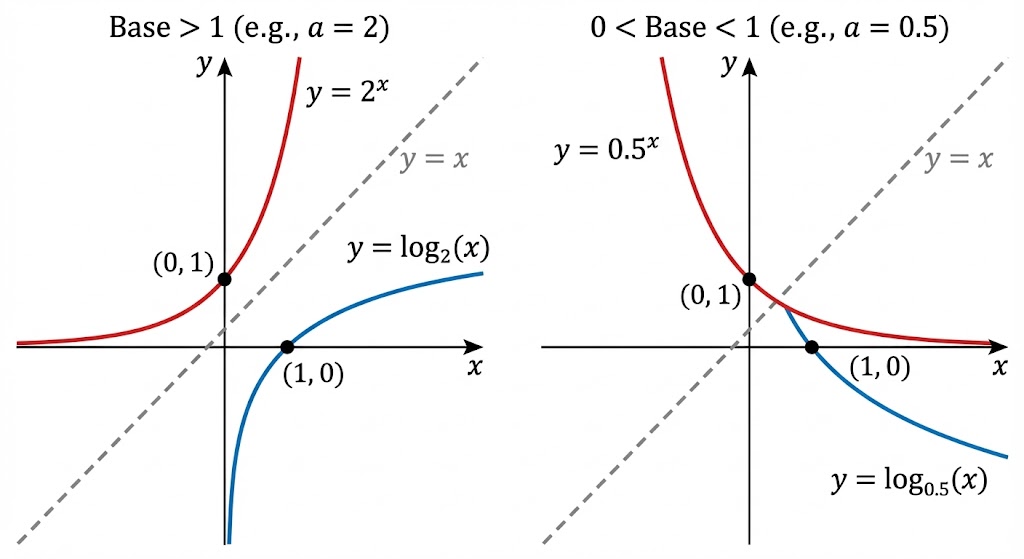
| Feature | Exponential $y = a^x$ | Logarithmic $y = \log_a x$ |
| :--- | :--- | :--- |
| **Condition** | $a > 0, a \neq 1$ | $a > 0, a \neq 1$ |
| **Domain** | $\mathbb{R}$ | $(0, +\infty)$ |
| **Range** | $(0, +\infty)$ | $\mathbb{R}$ |
| **Fixed Point** | $(0, 1)$ | $(1, 0)$ |
| **Trend** | $a>1$ Inc.; $0<a<1$ Dec. | $a>1$ Inc.; $0<a<1$ Dec. |
**Exam Tip**:
* When solving inequalities, check if the base is $>1$. If $0<a<1$, flip the inequality sign.
* Remember the symmetry: Log is the mirror image of Exp across $y=x$.
---
4. Trigonometric Functions
**Exam Focus**: Graph shapes, Period, Symmetry, and Domain restrictions.
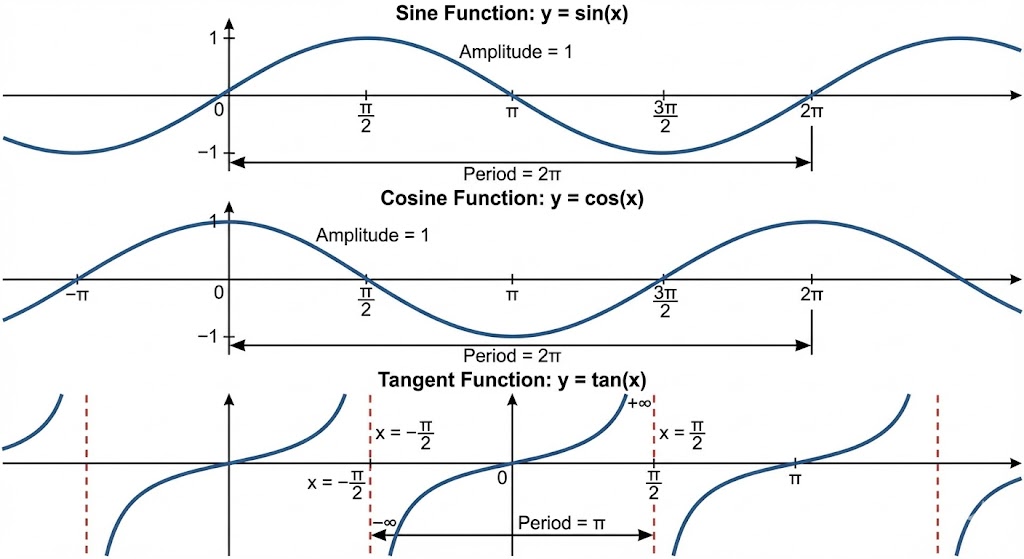
| Function | $y = \sin x$ | $y = \cos x$ | $y = \tan x$ |
| :--- | :--- | :--- | :--- |
| **Period** | $2\pi$ | $2\pi$ | $\pi$ |
| **Parity** | Odd (Origin sym.) | Even (y-axis sym.) | Odd |
| **Range** | $[-1, 1]$ | $[-1, 1]$ | $\mathbb{R}$ |
| **Domain Trap** | $\mathbb{R}$ | $\mathbb{R}$ | $x \neq k\pi + \frac{\pi}{2}$ (Asymptotes) |
---
5. Common Pitfalls
1. **Domain Oversight**: For $\log_a f(x)$ (argument $>0$) or $\tan f(x)$, always define the domain first.
2. **Base Cases**: For $y=a^x$, if $a$ is unknown, you MUST discuss cases $a>1$ and $0<a<1$ separately.
3. **Composite Monotonicity**: For $y = \log_a(g(x))$, apply the "Same-Increasing, Different-Decreasing" rule, but restrict it to the valid domain ($g(x)>0$).