Vectors and Complex Numbers
CSCA Vectors and Complex Numbers study guide organized around the publicly available CSCA syllabus. Practice Mathematics questions on aicsca.com.
Before planning this topic, check the CSCA Exam Guide 2026 for exam dates, registration, fees, and subject requirements.
Syllabus Alignment
This study guide is organized around the publicly available CSCA syllabus for international undergraduate applicants.
Who It Is For
International students preparing for CSCA Math, Physics, Chemistry, or Chinese exams.
Related Practice
CSCA Practice · Go to questions
Past papers and worked video solutions · Timed mock exams · All subject video lessons
Practice by Topic
Jump from this tutorial to filtered practice questions for the same knowledge point.
Related formulas, concepts, and glossary terms
Mathematics Formula & Concept Reference
- Vector Product (Cross Product)
- Magnitude (Length) of a Vector
- Vector Addition
- Dot Product (Inner Product) of Vectors
- Cross Product (Outer Product, 3D only)
- Scalar Multiplication of a Vector
- Vector Addition (Parallelogram Law)
- Scalar Multiplication of Vectors
Mathematics Exam Glossary
Tutorial Content
Vectors and Complex Numbers
Vectors and complex numbers are two powerful tools connecting algebra and geometry. In the CSCA exam, **Vectors** are often used to solve geometric problems involving position, angles, and distances, while **Complex Numbers** test algebraic operations and geometric interpretations (rotation and modulus).
1. Plane Vectors
A vector is a quantity with both **Magnitude** and **Direction**.
#### 1.1 Basic Operations
Let $\vec{a} = (x_1, y_1), \vec{b} = (x_2, y_2)$:
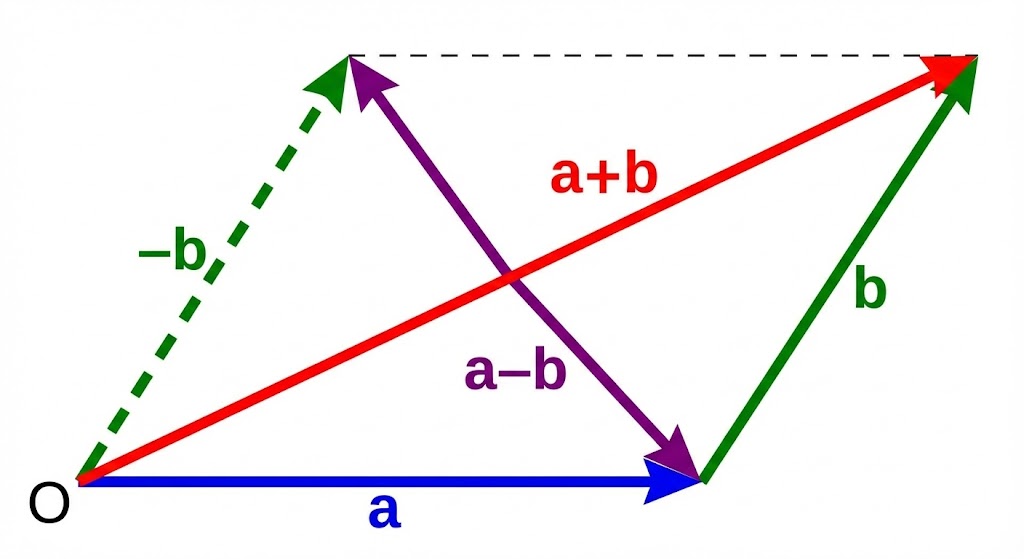
* **Addition/Subtraction**: $\vec{a} \pm \vec{b} = (x_1 \pm x_2, y_1 \pm y_2)$. Geometrically follows the **Parallelogram Law** or **Triangle Law**.
* **Modulus (Magnitude)**: $|\vec{a}| = \sqrt{x_1^2 + y_1^2}$.
#### 1.2 Dot Product (Scalar Product) — **Core Topic**
The result is a real number (scalar), bridging length and angle.
$$\vec{a} \cdot \vec{b} = |\vec{a}| |\vec{b}| \cos \theta = x_1 x_2 + y_1 y_2$$
where $\theta$ is the angle between the vectors $(0^\circ \le \theta \le 180^\circ)$.
**Key Applications**:
1. **Finding Angle**: $\cos \theta = \frac{\vec{a} \cdot \vec{b}}{|\vec{a}| |\vec{b}|}$
2. **Perpendicularity**: $\vec{a} \perp \vec{b} \iff \vec{a} \cdot \vec{b} = 0 \iff x_1 x_2 + y_1 y_2 = 0$
3. **Parallelism**: $\vec{a} // \vec{b} \iff x_1 y_2 - x_2 y_1 = 0$
2. Complex Numbers
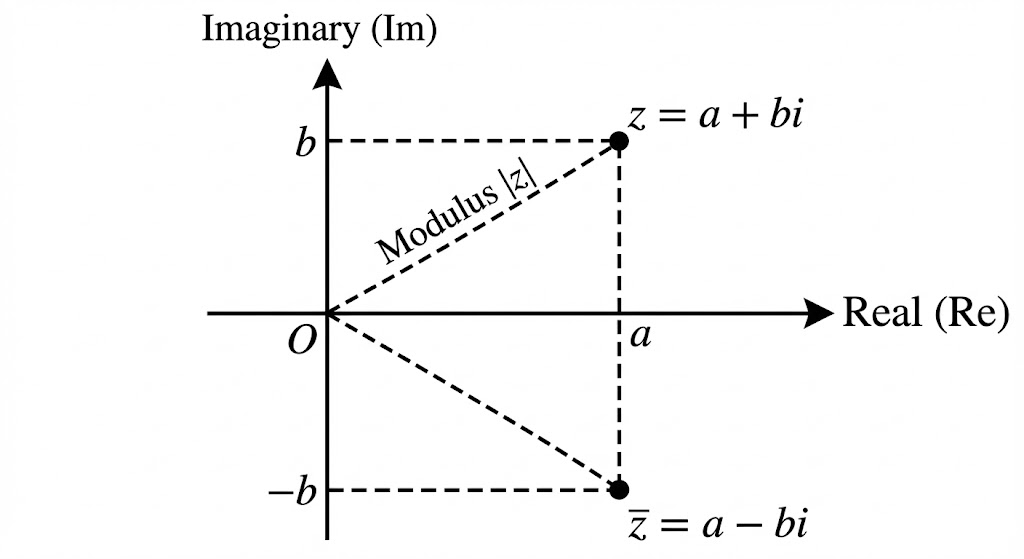
A complex number is of the form $z = a + bi$ ($a, b \in \mathbb{R}, i^2 = -1$). It can be viewed as a point $Z(a, b)$ or a vector $\vec{OZ}$ on the plane.
#### 2.1 Geometry and Modulus
* **Complex Plane**: x-axis is the Real Axis, y-axis is the Imaginary Axis.
* **Modulus**: $|z| = \sqrt{a^2 + b^2}$, representing the distance from the origin.
* **Conjugate**: $\bar{z} = a - bi$, symmetric to $z$ about the Real Axis.
#### 2.2 Operations and Geometric Transformations
* **Arithmetic**: Follows algebraic rules, noting $i^2 = -1$.
* Division trick: Rationalize the denominator (multiply top and bottom by the conjugate of the denominator).
* **Rotation**:
* Multiply by $i$: Rotate $90^\circ$ counter-clockwise.
* Multiply by $-1$: Rotate $180^\circ$ (Central symmetry).
3. Practice Examples
**Example 1**: Given vectors $\vec{a} = (1, 2), \vec{b} = (-3, k)$, if $\vec{a} \perp \vec{b}$, find $k$.
**Solution**:
Since they are perpendicular, $\vec{a} \cdot \vec{b} = 0$.
$1 \times (-3) + 2 \times k = 0 \Rightarrow -3 + 2k = 0 \Rightarrow k = 1.5$.
**Example 2**: If $z = \frac{2i}{1-i}$, find $|z|$.
**Solution**:
Simplify: $z = \frac{2i(1+i)}{(1-i)(1+i)} = \frac{2i - 2}{1 - (-1)} = \frac{-2 + 2i}{2} = -1 + i$.
Modulus: $|z| = \sqrt{(-1)^2 + 1^2} = \sqrt{2}$.
4. Study Tips
* **Vectors**: See "Perpendicular" $\to$ think "Dot product is 0"; see "Parallel" $\to$ think "Cross product of coords is 0".
* **Complex Numbers**: Master rationalizing denominators; understand $|z_1 - z_2|$ as distance between two points.