Geometric Sequences
CSCA Geometric Sequences study guide organized around the publicly available CSCA syllabus. Practice Mathematics questions on aicsca.com.
Before planning this topic, check the CSCA Exam Guide 2026 for exam dates, registration, fees, and subject requirements.
Syllabus Alignment
This study guide is organized around the publicly available CSCA syllabus for international undergraduate applicants.
Who It Is For
International students preparing for CSCA Math, Physics, Chemistry, or Chinese exams.
Related Practice
CSCA Practice · Go to questions
Past papers and worked video solutions · Timed mock exams · All subject video lessons
Practice by Topic
Jump from this tutorial to filtered practice questions for the same knowledge point.
Related formulas, concepts, and glossary terms
Mathematics Formula & Concept Reference
- Sum of the First n Terms of a Geometric Sequence ( q = 1 )
- Geometric Mean Formula
- Sum of an Infinite Geometric Series ( |q| < 1 )
- General Term Formula of a Geometric Sequence
- Sum of the First n Terms of a Geometric Sequence ( q ≠ 1 )
Mathematics Exam Glossary
Tutorial Content
Geometric Sequences
1. Core Concepts
**Definition**: A sequence is called a **Geometric Sequence** if the **ratio** of any term (from the 2nd term) to its preceding term is a constant. This constant is called the **Common Ratio ($q$)**, ($q \neq 0$).
**Mathematical Expression**:
$$\frac{a_{n}}{a_{n-1}} = q \quad (n \ge 2)$$
**Functional Perspective**:
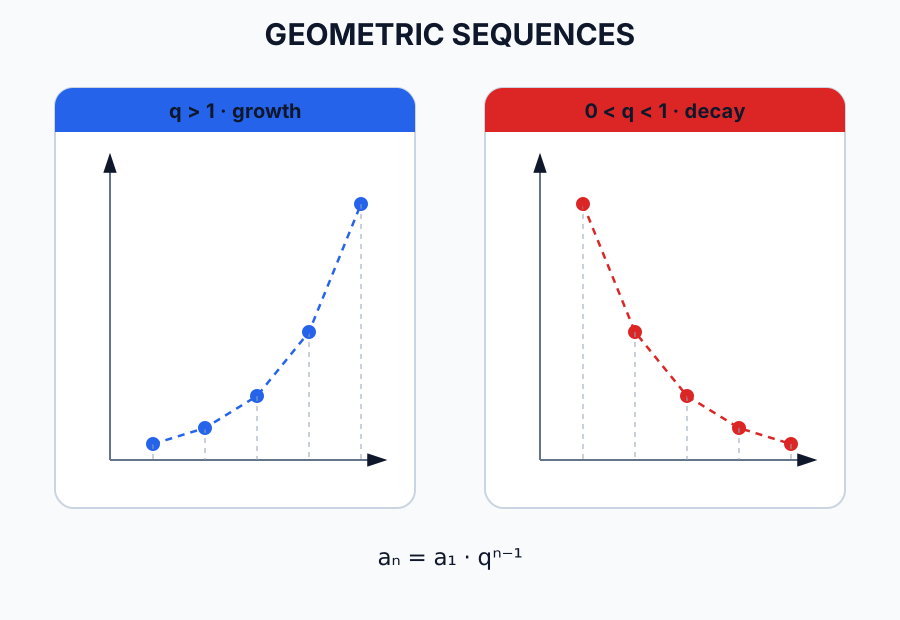
The general term $a_n = a_1 \cdot q^{n-1}$ represents discrete points on an exponential function.
* If $q > 1$: Exponential Growth (e.g., $2, 4, 8...$).
* If $0 < q < 1$: Exponential Decay (e.g., $1, 0.5, 0.25...$).
---
2. Key Formulas
#### (1) General Term Formula
$$a_n = a_1 \cdot q^{n-1}$$
* **Generalized Form**: $a_n = a_m \cdot q^{n-m}$ (Find term $n$ using term $m$).
#### (2) Summation Formulas ($S_n$)
Let $S_n = a_1 + a_2 + \dots + a_n$.
* **If $q = 1$** (Constant sequence):
$$S_n = n a_1$$
* **If $q \neq 1$**:
$$S_n = \frac{a_1(1-q^n)}{1-q} = \frac{a_1(q^n-1)}{q-1}$$
**Derivation Logic (Multiply and Subtract)**:
This is the standard method: Write $S_n$, write $qS_n$, then subtract the two equations. Most intermediate terms cancel out.
#### (3) Infinite Geometric Series Sum
When $|q| < 1$, as $n \to \infty$, the terms approach 0, and the sum approaches a limit:
$$S_{\infty} = \frac{a_1}{1-q}$$
---
3. Key Properties
1. **Geometric Mean**: If $a, b, c$ form a geometric sequence, then $b^2 = ac$.
2. **Index Product Property**: If $m + n = p + k$, then $a_m \cdot a_n = a_p \cdot a_k$.
* E.g., $a_1 \cdot a_6 = a_2 \cdot a_5$.
---
4. Typical Examples
**Example 1: Find General Term**
Given $a_2 = 6, a_5 = 48$, find $a_8$.
**Solution**:
Use generalized form: $a_5 = a_2 \cdot q^{5-2}$.
$48 = 6 \cdot q^3 \Rightarrow q^3 = 8 \Rightarrow q = 2$.
Then $a_8 = a_5 \cdot q^{8-5} = 48 \times 2^3 = 384$.
**Example 2: Infinite Sum**
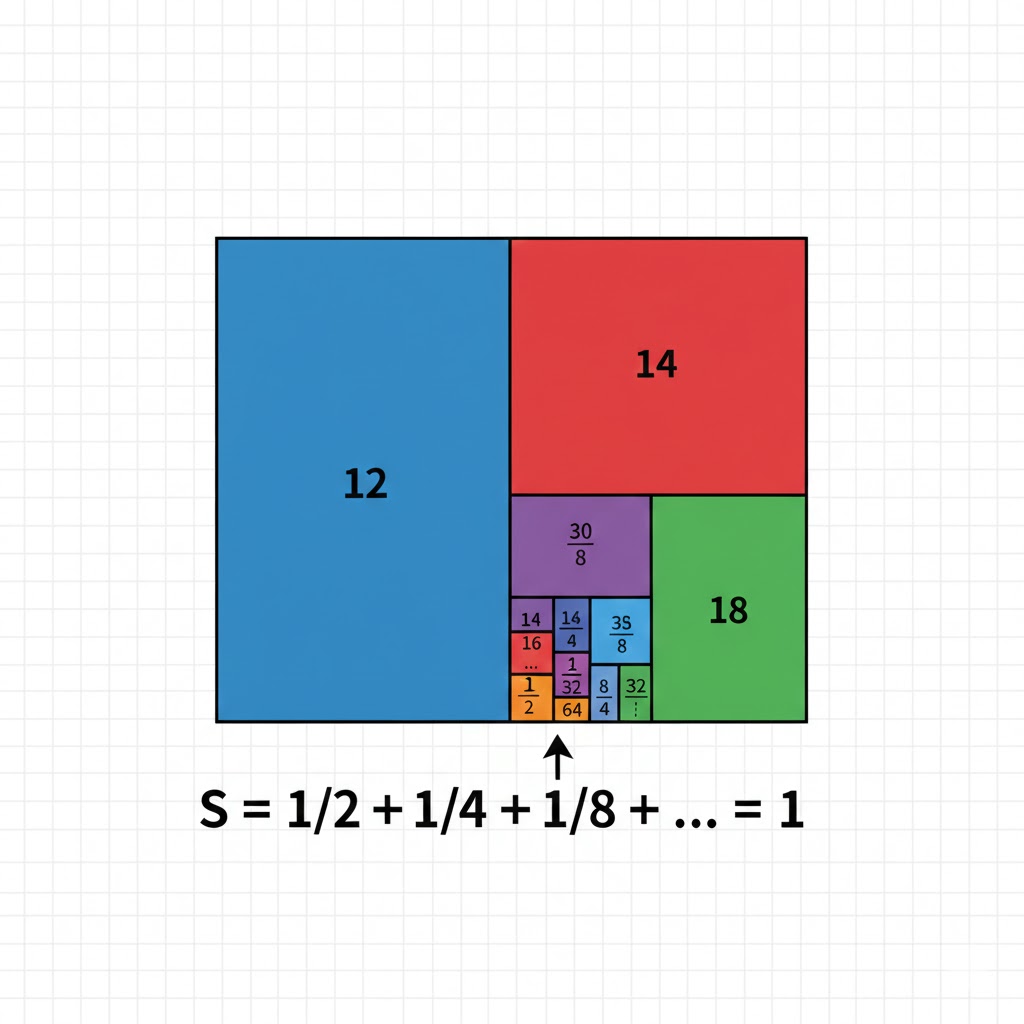
Find the sum: $S = \frac{1}{2} + \frac{1}{4} + \frac{1}{8} + \dots$.
**Solution**:
$a_1 = 1/2, q = 1/2$.
Since $|q| < 1$, use the infinite sum formula:
$S = \frac{a_1}{1-q} = \frac{1/2}{1 - 1/2} = 1$.
**Example 3: Using Properties**
Given geometric sequence $\{a_n\}$ where $a_1 a_{11} = 20$, find $a_4 a_8$.
**Solution**:
Since indices $1+11 = 12$ and $4+8=12$,
$a_4 a_8 = a_1 a_{11} = 20$.
---
5. Common Pitfalls
* **Forgetting $q=1$**: Always check if $q=1$ is possible before using the fraction formula.
* **Sign of q**: If terms alternate signs, $q$ is negative.
* **Solving for q**: When $q^2 = 4$, remember $q = \pm 2$ unless terms are stated to be positive.