Geometry and Algebra
CSCA Geometry and Algebra study guide organized around the publicly available CSCA syllabus. Practice Mathematics questions on aicsca.com.
Before planning this topic, check the CSCA Exam Guide 2026 for exam dates, registration, fees, and subject requirements.
Syllabus Alignment
This study guide is organized around the publicly available CSCA syllabus for international undergraduate applicants.
Who It Is For
International students preparing for CSCA Math, Physics, Chemistry, or Chinese exams.
Related Practice
CSCA Practice · Go to questions
Past papers and worked video solutions · Timed mock exams · All subject video lessons
Practice by Topic
Jump from this tutorial to filtered practice questions for the same knowledge point.
Related formulas, concepts, and glossary terms
Mathematics Formula & Concept Reference
- General Form of a Line Equation
- Conditions for Parallel and Perpendicular Lines
- Point-Slope Form of a Line
- Distance from a Point to a Line
- Slope Relationship of Two Parallel Lines
- Slope-Intercept Form of a Line
- Slope Relationship of Two Perpendicular Lines
- Two-Point Form of a Line Equation
Mathematics Exam Glossary
Tutorial Content
Geometry and Algebra
Module Overview
"Geometry and Algebra" is a core module of the CSCA mathematics examination, defined by the **integration of number and shape**. This module aims to train you to think in two dimensions: using algebraic methods (equations, inequalities) to precisely calculate geometric quantities, and using geometric intuition (shapes, positional relationships) to assist in algebraic solutions. Mastering this module means transforming abstract geometric shapes into computable numerical models.
Learning Objectives
Upon completing this module, you should be able to:
1. **Master Core Tools**: Proficiently use plane and spatial rectangular coordinate systems, vectors, and complex numbers to describe geometric objects.
2. **Understand Curves and Equations**: Master the standard equations and geometric properties of lines, circles, ellipses, hyperbolas, and parabolas.
3. **Establish Spatial Concepts**: Expand from 2D to 3D, understanding spatial coordinate systems and the algebraic expressions of simple solid figures (e.g., spheres, prisms).
4. **Solve Comprehensive Problems**: Flexibly apply "Coordinate Methods" and "Vector Methods" to solve problems involving distance, angles, loci, and extrema.
Content Framework
This module consists of three main branches that form the knowledge system of geometric algebra:
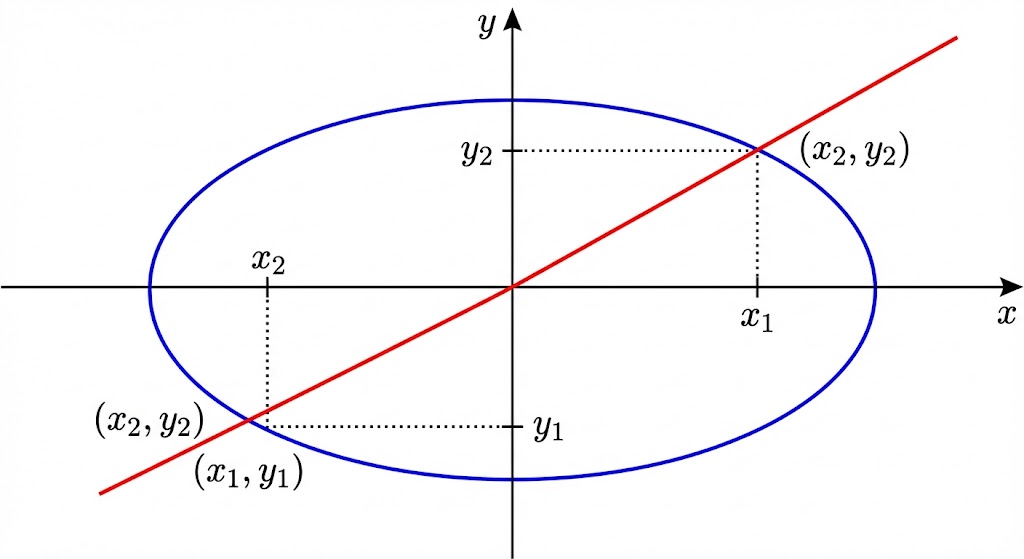
1. Plane Analytic Geometry
This is the foundation. By establishing a plane rectangular coordinate system, we transform geometric problems (e.g., "a line tangent to a circle") into algebraic problems (e.g., "a system of equations with a single solution"). The focus is on mastering the equation characteristics of conic sections (circles, ellipses, hyperbolas, parabolas).
2. Vectors and Complex Numbers
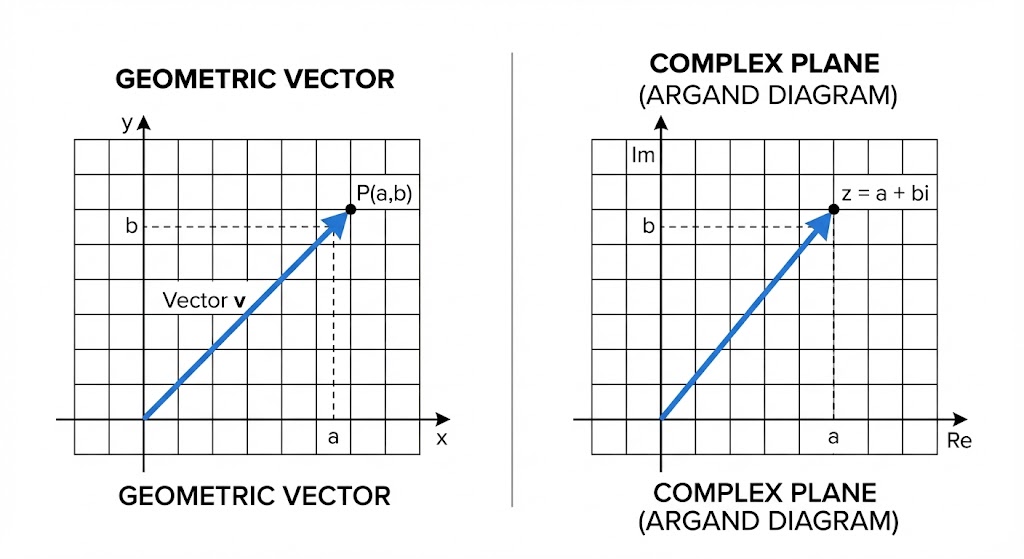
These are two powerful algebraic tools:
* **Vectors**: Quantities with both magnitude and direction, ideal for solving geometric problems involving parallelism, perpendicularity, and angles.
* **Complex Numbers**: The complex plane (Argand Diagram) extends the number system to two dimensions, where operations imply profound geometric rotation and scaling meanings.
3. Spatial Geometry
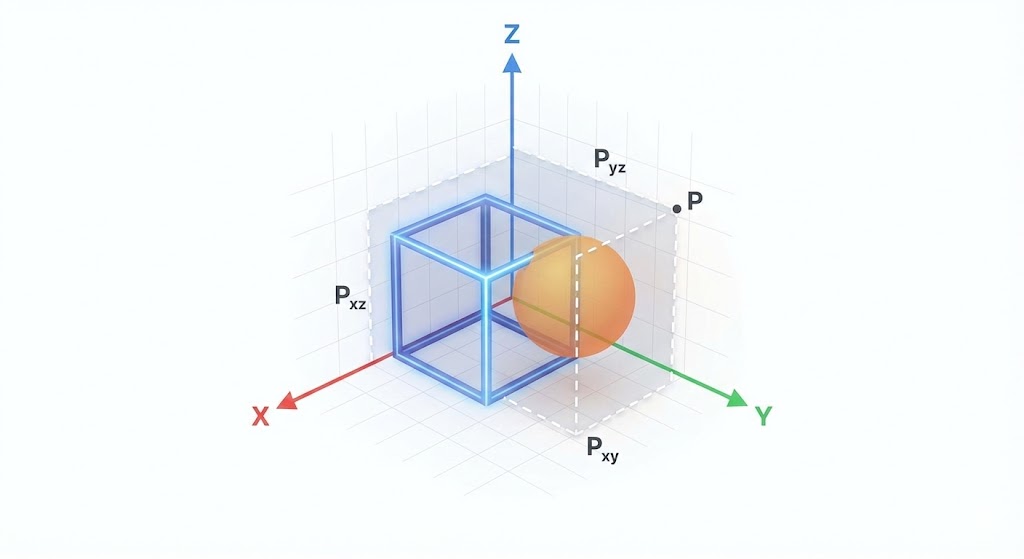
Extending the coordinate system from 2D ($Oxy$) to 3D ($Oxyz$). You will learn how to locate points in space, describe equations of spatial lines and planes, and calculate the surface area and volume of solid figures.
Study Advice
* **Drawing is the First Step**: No matter how complex the problem, start by drawing an accurate geometric sketch.
* **Understand Geometric Meanings**: Do not rote memorize. For example, seeing $|z_1 - z_2|$ should instantly remind you of the distance between two points on the complex plane.
* **Flexible Switching**: For angle and distance problems, prioritize vector dot products; for rotation problems, try complex numbers; for locus problems, the coordinate method is usually most effective.