The AM-GM Inequality
CSCA The AM-GM Inequality study guide organized around the publicly available CSCA syllabus. Practice Mathematics questions on aicsca.com.
Before planning this topic, check the CSCA Exam Guide 2026 for exam dates, registration, fees, and subject requirements.
Syllabus Alignment
This study guide is organized around the publicly available CSCA syllabus for international undergraduate applicants.
Who It Is For
International students preparing for CSCA Math, Physics, Chemistry, or Chinese exams.
Related Practice
CSCA Practice · Go to questions
Past papers and worked video solutions · Timed mock exams · All subject video lessons
Practice by Topic
Jump from this tutorial to filtered practice questions for the same knowledge point.
Related formulas, concepts, and glossary terms
Mathematics Formula & Concept Reference
- Application of Basic Inequality: Minimum Sum
- Arithmetic-Geometric Mean Inequality (AM-GM)
- Basic Inequality (Sum of Squares Inequality)
- Basic Inequality (Arithmetic-Geometric Mean Inequality)
- Application of Basic Inequality: Maximum Product
- Basic Inequality (Generalized to n numbers)
- Variant of the Basic Inequality: a² + b² ≥ 2ab
- Basic Inequality (Two-Variable Form)
Mathematics Exam Glossary
Tutorial Content
The AM-GM Inequality
In the CSCA exam, the **AM-GM Inequality** (Arithmetic Mean-Geometric Mean) is the nuclear weapon for solving **optimization problems** (Max/Min), especially those involving reciprocal relationships (like $x$ and $\frac{1}{x}$).
1. Core Formula
For any two **positive real numbers** $a, b$ (i.e., $a > 0, b > 0$):
$$\frac{a + b}{2} \ge \sqrt{ab}$$
* **Variation 1 (Minimizing Sum)**: $a + b \ge 2\sqrt{ab}$
* **Variation 2 (Maximizing Product)**: $ab \le (\frac{a + b}{2})^2$
* **Condition for Equality**: The equality holds **if and only if** $a = b$.
2. Geometric Interpretation
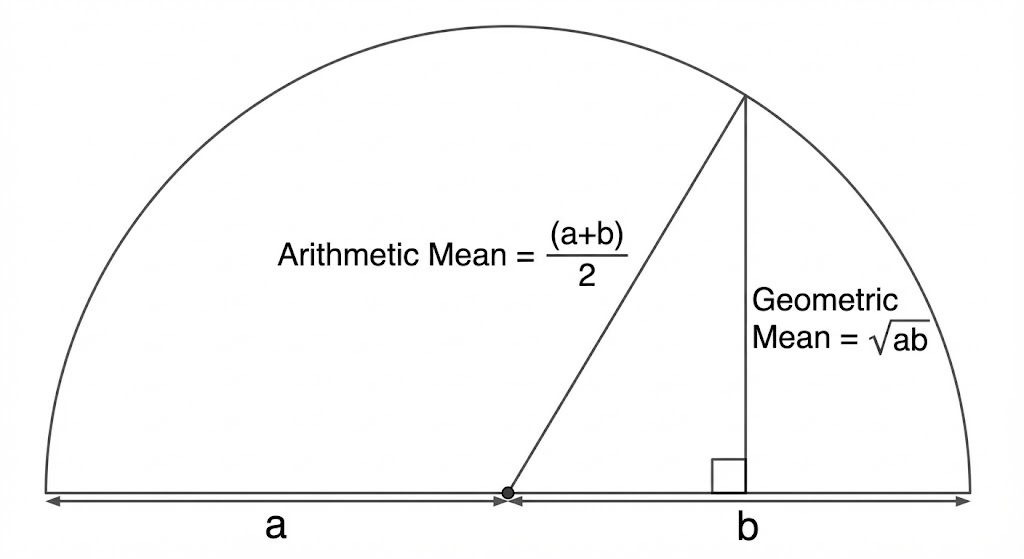
The inequality can be proven visually using a semicircle. For a diameter of $a+b$, the radius (Arithmetic Mean) is always greater than or equal to the half-chord height (Geometric Mean).
3. The Three Prerequisites
Memorize these three checks before applying the formula:
1. **Positive**: Terms must be **positive**. If negative, factor out the negative sign.
2. **Constant**: To find a minimum sum, the **product must be constant**; to find a maximum product, the **sum must be constant**.
3. **Equal**: You must verify that the condition $a=b$ is possible within the domain. If $a$ cannot equal $b$, the formula cannot give the exact minimum/maximum.
4. Typical Model: The Hook Function
Functions of the form $f(x) = x + \frac{k}{x} (k>0, x>0)$ are direct applications of AM-GM. The graph looks like a "Nike" checkmark (Hook). Recognizing this shape helps in quick solving.
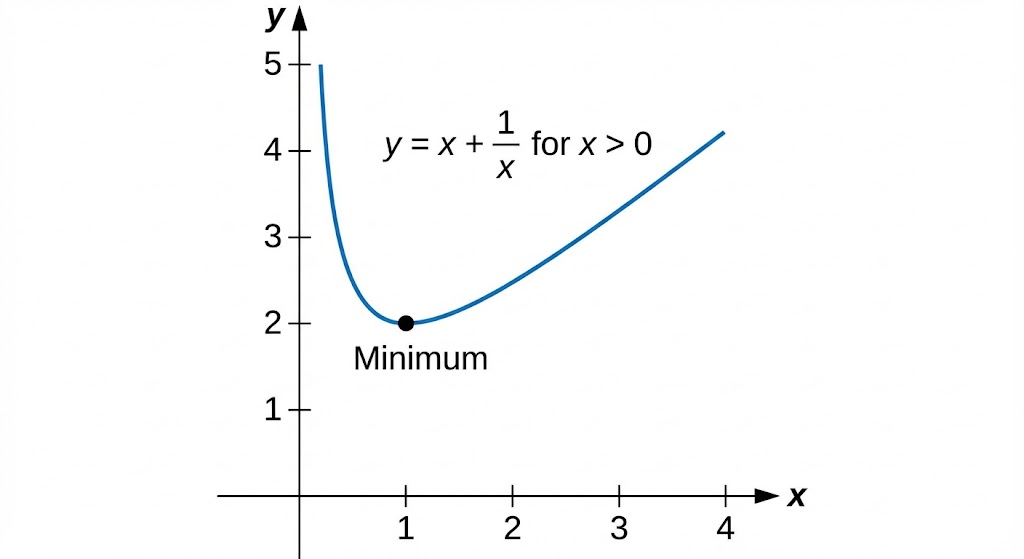
* Minimum point: When $x = \sqrt{k}$, $y_{min} = 2\sqrt{k}$.
5. Worked Examples
**Ex 1: Basic Reciprocal Model**
Given $x > 0$, find the minimum value of $y = x + \frac{4}{x}$.
**Solution**:
1. **Positive**: $x>0$, check.
2. **Constant**: Product $x \cdot \frac{4}{x} = 4$ (constant).
3. **Apply**: $y \ge 2\sqrt{x \cdot \frac{4}{x}} = 2\sqrt{4} = 4$.
4. **Equal**: Set $x = \frac{4}{x} \Rightarrow x^2=4 \Rightarrow x=2$. Since $x=2$ is in the domain, it works.
**Ans**: Minimum is 4.
**Ex 2: Creating a Constant (Grouping)**
Given $x > 2$, find the minimum value of $y = x + \frac{1}{x-2}$.
**Solution**:
Direct multiplication doesn't work. Rewrite $x$ as $(x-2) + 2$.
$y = (x-2) + \frac{1}{x-2} + 2$
Since $x > 2$, $(x-2) > 0$ (Positive).
Apply AM-GM to the first two terms:
$(x-2) + \frac{1}{x-2} \ge 2\sqrt{(x-2) \cdot \frac{1}{x-2}} = 2$
So $y \ge 2 + 2 = 4$.
Equality check: $(x-2) = \frac{1}{x-2} \Rightarrow x=3$.
**Ex 3: Advanced Splitting (Optional)**
Given $x > 0$, find min of $y = 2x + \frac{8}{x^2}$.
**Note**: Product of terms is $\frac{16}{x}$, not constant. Split $2x$ into $x + x$ to use the **3-term AM-GM**: $\frac{a+b+c}{3} \ge \sqrt[3]{abc}$.
$y = x + x + \frac{8}{x^2} \ge 3\sqrt[3]{x \cdot x \cdot \frac{8}{x^2}} = 3\sqrt[3]{8} = 6$.
Equality holds when $x = x = \frac{8}{x^2} \Rightarrow x=2$.