Basic Properties and Solutions of Inequalities
CSCA Basic Properties and Solutions of Inequalities study guide organized around the publicly available CSCA syllabus. Practice Mathematics questions on aicsca.com.
Before planning this topic, check the CSCA Exam Guide 2026 for exam dates, registration, fees, and subject requirements.
Syllabus Alignment
This study guide is organized around the publicly available CSCA syllabus for international undergraduate applicants.
Who It Is For
International students preparing for CSCA Math, Physics, Chemistry, or Chinese exams.
Related Practice
CSCA Practice · Go to questions
Past papers and worked video solutions · Timed mock exams · All subject video lessons
Practice by Topic
Jump from this tutorial to filtered practice questions for the same knowledge point.
Related formulas, concepts, and glossary terms
Mathematics Formula & Concept Reference
- Application of Basic Inequality: Minimum Sum
- Solution Set Mnemonic for Quadratic Inequalities ( a > 0, Δ > 0 )
- Arithmetic-Geometric Mean Inequality (AM-GM)
- Basic Inequality (Sum of Squares Inequality)
- Basic Inequality (Arithmetic-Geometric Mean Inequality)
- Application of Basic Inequality: Maximum Product
- Solution Set Rules for Quadratic Inequalities (a > 0)
- Basic Inequality (Generalized to n numbers)
Mathematics Exam Glossary
Tutorial Content
Basic Properties and Solutions of Inequalities
Inequalities are a core algebraic tool in the CSCA exam. Solving an inequality essentially involves transforming complex expressions into the form $x > a$ or $x < a$ using specific properties.
1. Three Key Properties
* **Transitivity**: If $a < b$ and $b < c$, then $a < c$.
* **Addition Property**: Adding (or subtracting) the same number to both sides **does not change** the direction of the inequality.
* $a < b \iff a+c < b+c$
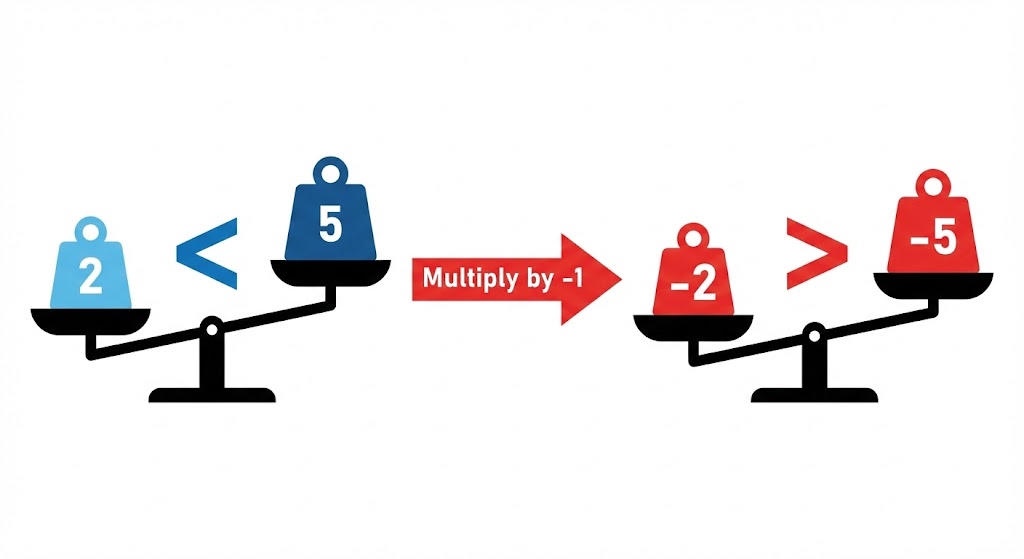
* **Multiplication Property —— 🚩 The Only Trap!**
* Multiplying by a **positive** number: Direction stays the **same**. ($a < b, c > 0 \implies ac < bc$)
* Multiplying by a **negative** number: Direction **reverses**. ($a < b, c < 0 \implies ac > bc$)
2. General Solution Methods
#### (1) Linear Inequalities
* **Method**: Rearrange terms $\rightarrow$ Combine like terms $\rightarrow$ Divide by the coefficient.
* **Note**: Remember to **flip the inequality sign** if dividing by a negative coefficient.
#### (2) Quadratic Inequalities
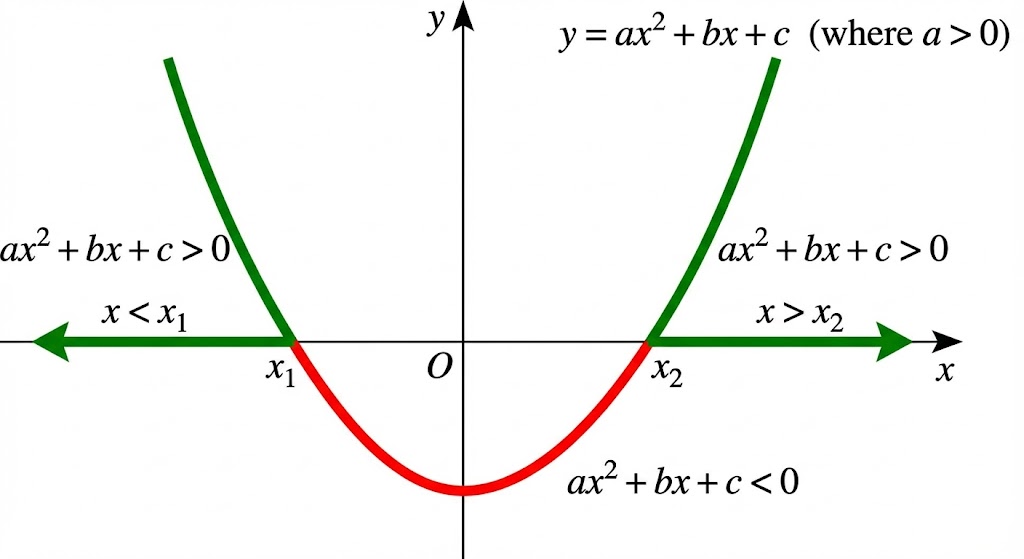
Form: $ax^2+bx+c > 0 (a>0)$.
* **Steps**:
1. **Find Roots**: Solve $ax^2+bx+c=0$ for roots $x_1, x_2$ (assume $x_1 < x_2$).
2. **Sketch Graph**: Draw a parabola opening upwards.
3. **Determine Intervals**:
* For $>0$ (Graph above x-axis): Take the "tails" (outside), i.e., $x < x_1$ or $x > x_2$.
* For $<0$ (Graph below x-axis): Take the "middle" (between), i.e., $x_1 < x < x_2$.
#### (3) Rational Inequalities
Form: $\frac{f(x)}{g(x)} > 0$.
* **Core Trick**: Use the principle that "same signs give positive, different signs give negative" to convert division into multiplication.
* $\frac{f(x)}{g(x)} > 0 \iff f(x) \cdot g(x) > 0$
* $\frac{f(x)}{g(x)} \le 0 \iff f(x) \cdot g(x) \le 0$ AND $g(x) \neq 0$ (denominator cannot be zero).
3. Exam Tips
* For higher-degree inequalities, the **Method of Intervals (Wavy Curve Method)** is a powerful tool to master in advanced modules.
* Never cross-multiply the denominator in rational inequalities (since its sign is unknown). Instead, move terms to one side or use the multiplication conversion method above.