Monotonicity of Functions
Distinguish strict increase from nondecrease. Worked examples explain derivative tests, interval endpoints, and solving inequalities with monotonicity.
Before planning this topic, check the CSCA Exam Guide 2026 for exam dates, registration, fees, and subject requirements.
Syllabus Alignment
This study guide is organized around the publicly available CSCA syllabus for international undergraduate applicants.
Who It Is For
International students preparing for CSCA Math, Physics, Chemistry, or Chinese exams.
Related Practice
CSCA Practice · Go to questions
Past papers and worked video solutions · Timed mock exams · All subject video lessons
Practice by Topic
Jump from this tutorial to filtered practice questions for the same knowledge point.
Related formulas, concepts, and glossary terms
Mathematics Formula & Concept Reference
- Interval Notation for Monotonicity
- Definition of Monotonically Decreasing Function
- Definition of Monotonically Increasing Function
- Using Derivative to Determine Monotonicity of a Function
Mathematics Exam Glossary
Tutorial Content
Monotonicity of Functions
Monotonicity describes how a function's values change as its input increases. A precise statement identifies both the interval being considered and whether equal output values are allowed.
1. Strict and non-strict monotonicity
Let be an interval within the domain of . For every pair with , use the following definitions:
| Term | Required relationship |
|---|---|
| Strictly increasing | |
| Strictly decreasing | |
| Nondecreasing | |
| Nonincreasing |
Nondecreasing and nonincreasing functions may have equal values at different inputs. A constant function, for example, is both nondecreasing and nonincreasing, but it is not strictly monotonic on an interval containing distinct inputs.
Terminology varies between textbooks: “increasing” and “monotonically increasing” may mean either strictly increasing or nondecreasing. This tutorial distinguishes the two. The examples below use the strict meaning; when working with another source, check its definition.
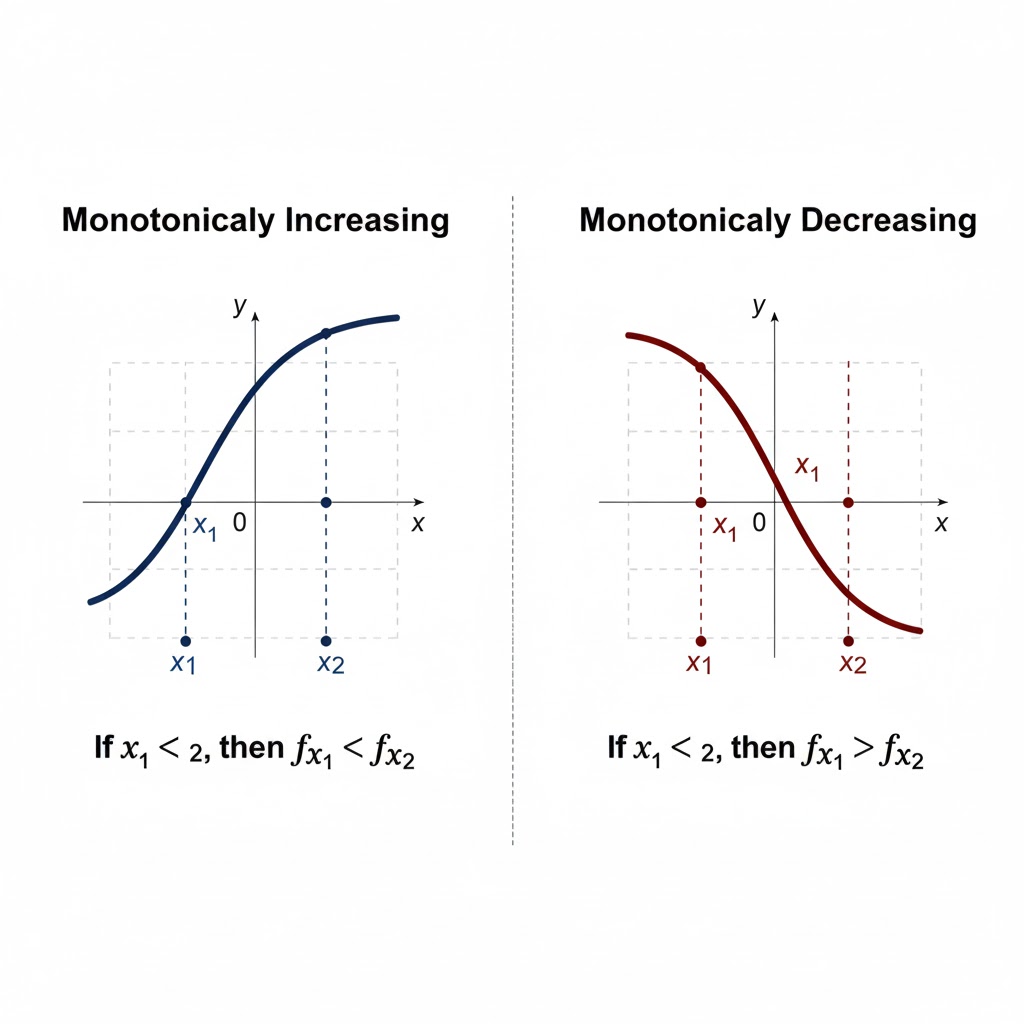
A function can be monotonic on one interval without being monotonic on its entire domain. Always state the interval with your conclusion.
2. How to test for monotonicity
Using the derivative
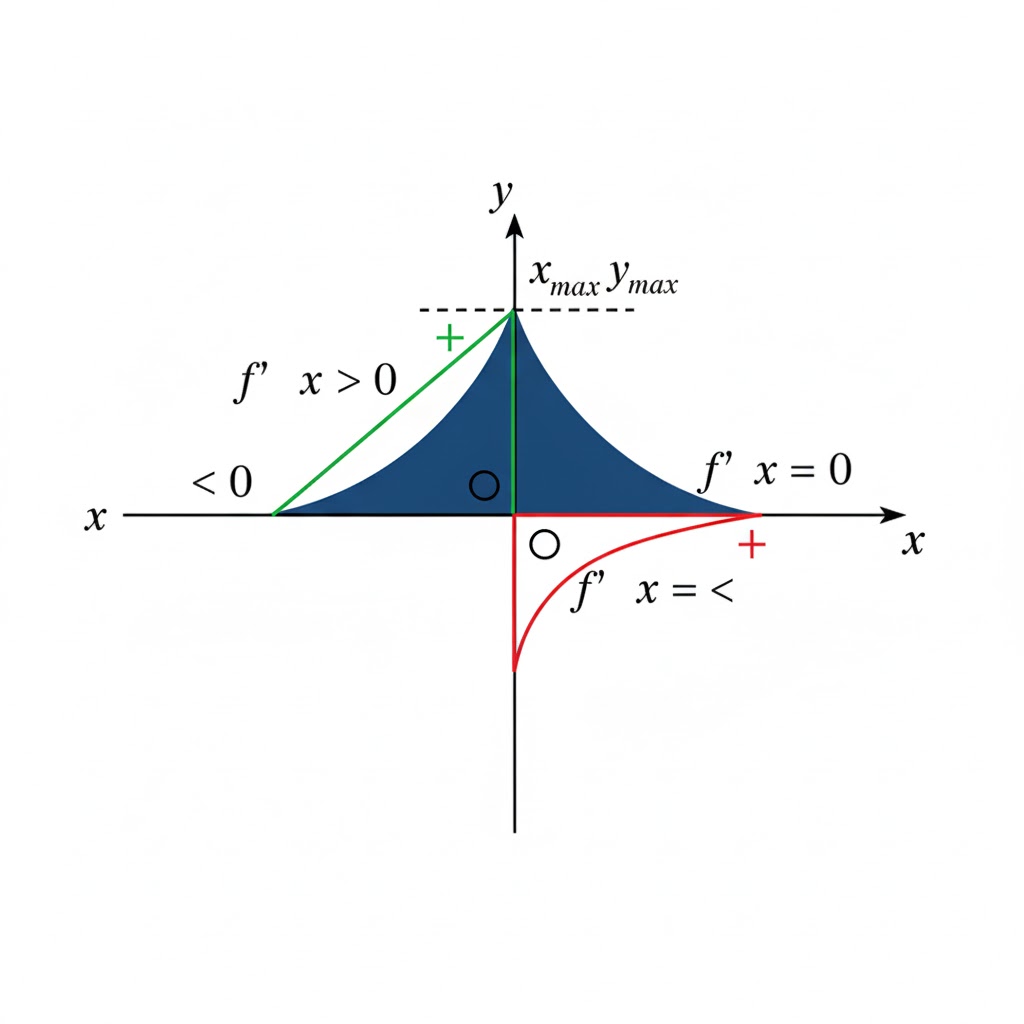
Suppose is continuous on and differentiable in its interior. Check the derivative at every interior point:
- If throughout the interior, is strictly increasing on .
- If throughout the interior, is strictly decreasing on .
- If throughout the interior, is nondecreasing; if , it is nonincreasing.
- If throughout the interior, is constant on the interval.
A strictly increasing function need not have a positive derivative at every point. For example, is strictly increasing on , even though . A zero derivative at one point does not, by itself, rule out strict monotonicity.
Using the definition
Take arbitrary inputs with and examine . If this difference is negative for every such pair, the function is strictly increasing; if it is positive, the function is strictly decreasing. Replacing these strict inequalities with or gives the tests for nondecreasing or nonincreasing functions.
Checking a few selected points is not enough to establish monotonicity on an entire interval.
3. Worked examples
Example 1: Find the intervals of increase and decrease
Find the intervals on which is increasing or decreasing.
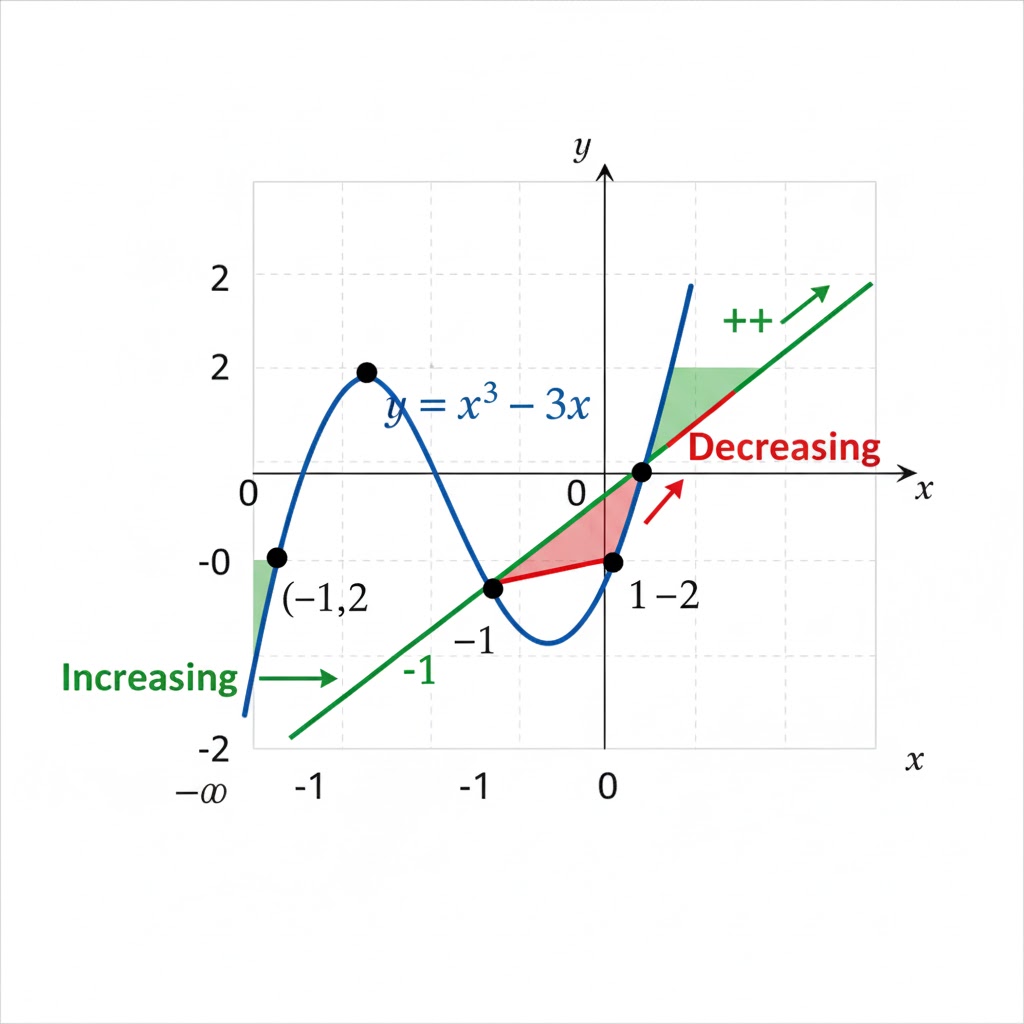
The domain is , and
- For or , the derivative is positive.
- For , the derivative is negative.
- At , the derivative is zero.
The function is strictly increasing on and , and strictly decreasing on . These endpoints may be included because the function is continuous there. Having a zero derivative at an endpoint does not prevent strict monotonicity on the interval.
Example 2: Solve an inequality using strict increase
Suppose is strictly increasing on and . Solve within that interval.
Replace with . Strict increase gives
Combining this with gives the solution set .
The word “strictly” matters. For a nondecreasing function, still implies , but the reverse implication may fail: the function could remain equal to over an interval.
4. Conditions to check
- Start with the domain. Exclude zero denominators and check restrictions such as nonnegative radicands for real even roots.
- Check separate intervals separately. Being decreasing on two intervals does not establish decrease on their union. For instance, is strictly decreasing on each of and , but gives . That pair violates decrease across the entire domain.
- Keep track of strict inequalities. Before replacing an inequality between function values with one between inputs, check which definition the problem uses.
Sources and review
Content reviewed: 12 September 2026.
Jiří Lebl, Basic Analysis, §3.6: monotone and strictly monotone functions