Sequences
CSCA Sequences study guide organized around the publicly available CSCA syllabus. Practice Mathematics questions on aicsca.com.
Before planning this topic, check the CSCA Exam Guide 2026 for exam dates, registration, fees, and subject requirements.
Syllabus Alignment
This study guide is organized around the publicly available CSCA syllabus for international undergraduate applicants.
Who It Is For
International students preparing for CSCA Math, Physics, Chemistry, or Chinese exams.
Related Practice
CSCA Practice · Go to questions
Past papers and worked video solutions · Timed mock exams · All subject video lessons
Practice by Topic
Jump from this tutorial to filtered practice questions for the same knowledge point.
Related formulas, concepts, and glossary terms
Mathematics Formula & Concept Reference
- Sum of the First n Terms of a Geometric Sequence ( q = 1 )
- Geometric Mean Formula
- Sum of an Infinite Geometric Series ( |q| < 1 )
- General Term Formula of a Geometric Sequence
- Sum of the First n Terms of a Geometric Sequence ( q ≠ 1 )
- Sum of the First n Terms of an Arithmetic Sequence (Formula 1)
- General Term Formula of Arithmetic Sequence
- Sum of the First n Terms of an Arithmetic Sequence (Formula 2)
Mathematics Exam Glossary
Tutorial Content
Sequences
1. Core Concepts
A **Sequence** is an ordered list of numbers. From a functional perspective, a sequence is a function $f(n)$ whose domain is the set of positive integers $\mathbb{N}^*$. When the independent variable $n$ takes values $1, 2, 3, ...$, the corresponding function values $a_n$ form the sequence.
* **General Term ($a_n$)**: The formula relating the $n$-th term to the index $n$, i.e., $a_n = f(n)$.
* **Partial Sum ($S_n$)**: The sum of the first $n$ terms, $S_n = a_1 + a_2 + ... + a_n$.
* **Relationship between $a_n$ and $S_n$** (High frequency test point):
$$a_n = \begin{cases} S_1 & (n=1) \\ S_n - S_{n-1} & (n \ge 2) \end{cases}$$
---
2. Arithmetic Sequence
**Definition**: Starting from the 2nd term, the **difference** between each term and the preceding one is a constant (Common Difference $d$).
$$a_{n} - a_{n-1} = d$$
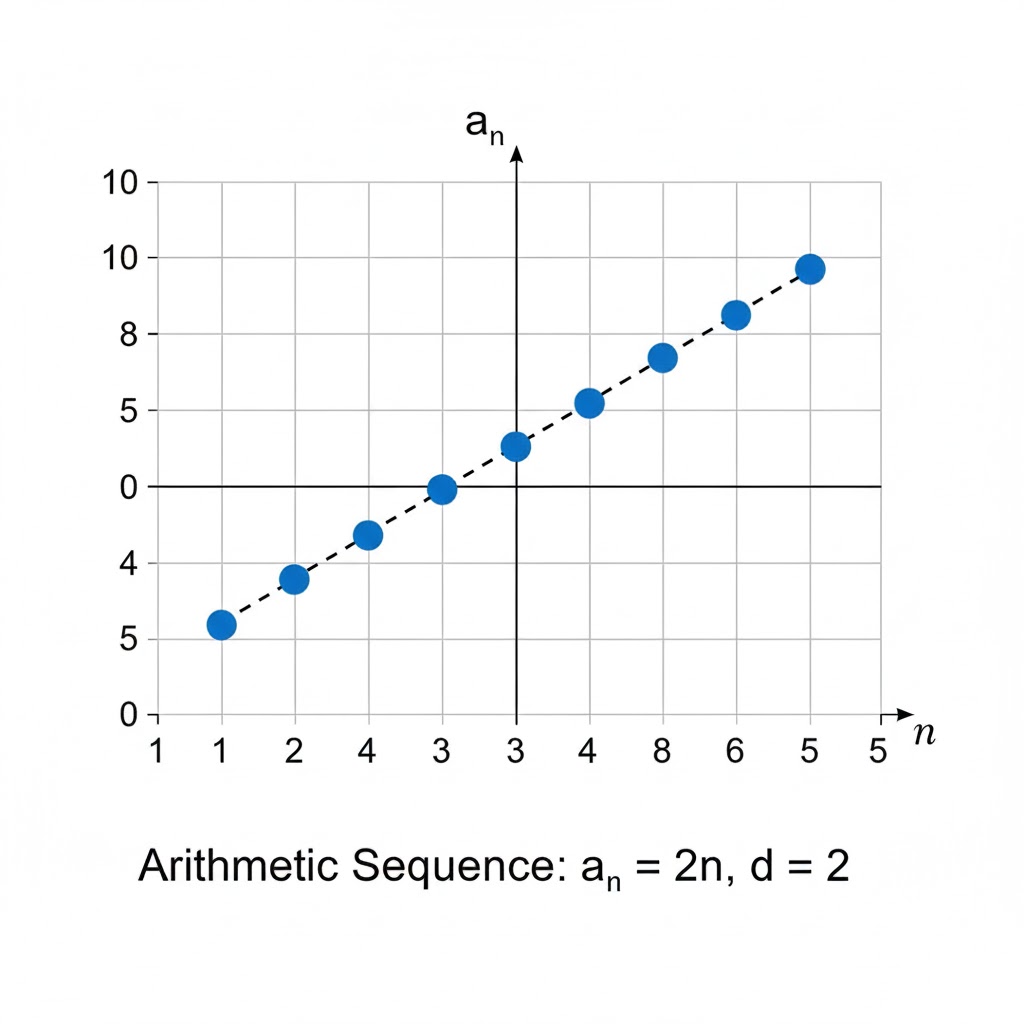
**Graph Characteristics**:
The graph of an arithmetic sequence consists of **collinear** discrete points. It corresponds to a linear function $y = dx + (a_1-d)$.
**Key Formulas**:
1. **General Term**: $a_n = a_1 + (n-1)d$
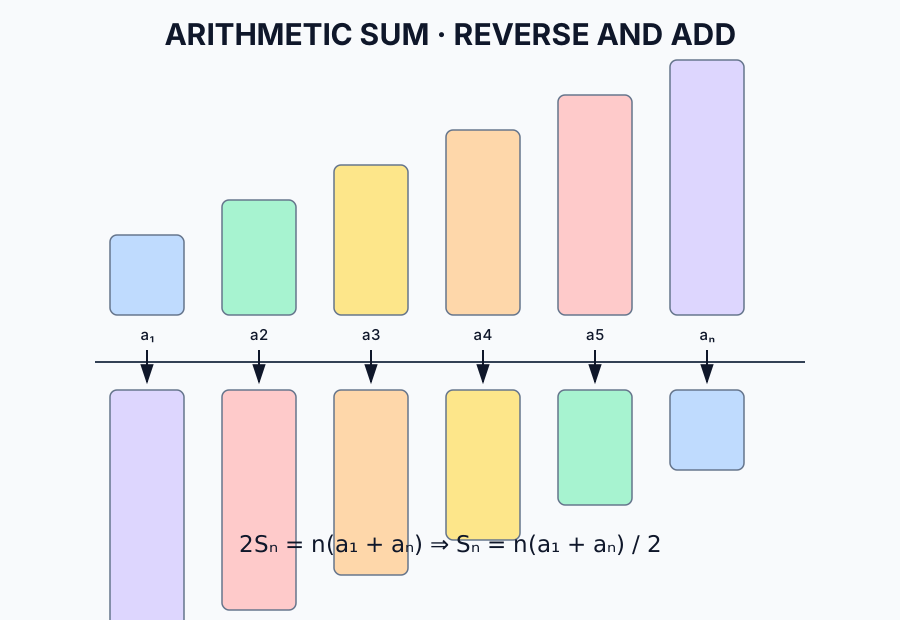
2. **Summation**: $S_n = \frac{n(a_1 + a_n)}{2} = na_1 + \frac{n(n-1)}{2}d$
3. **Mean Property**: If $a, b, c$ form an arithmetic sequence, then $2b = a + c$.
---
3. Geometric Sequence
**Definition**: Starting from the 2nd term, the **ratio** of each term to the preceding one is a constant (Common Ratio $q, q\neq 0$).
$$\frac{a_n}{a_{n-1}} = q$$
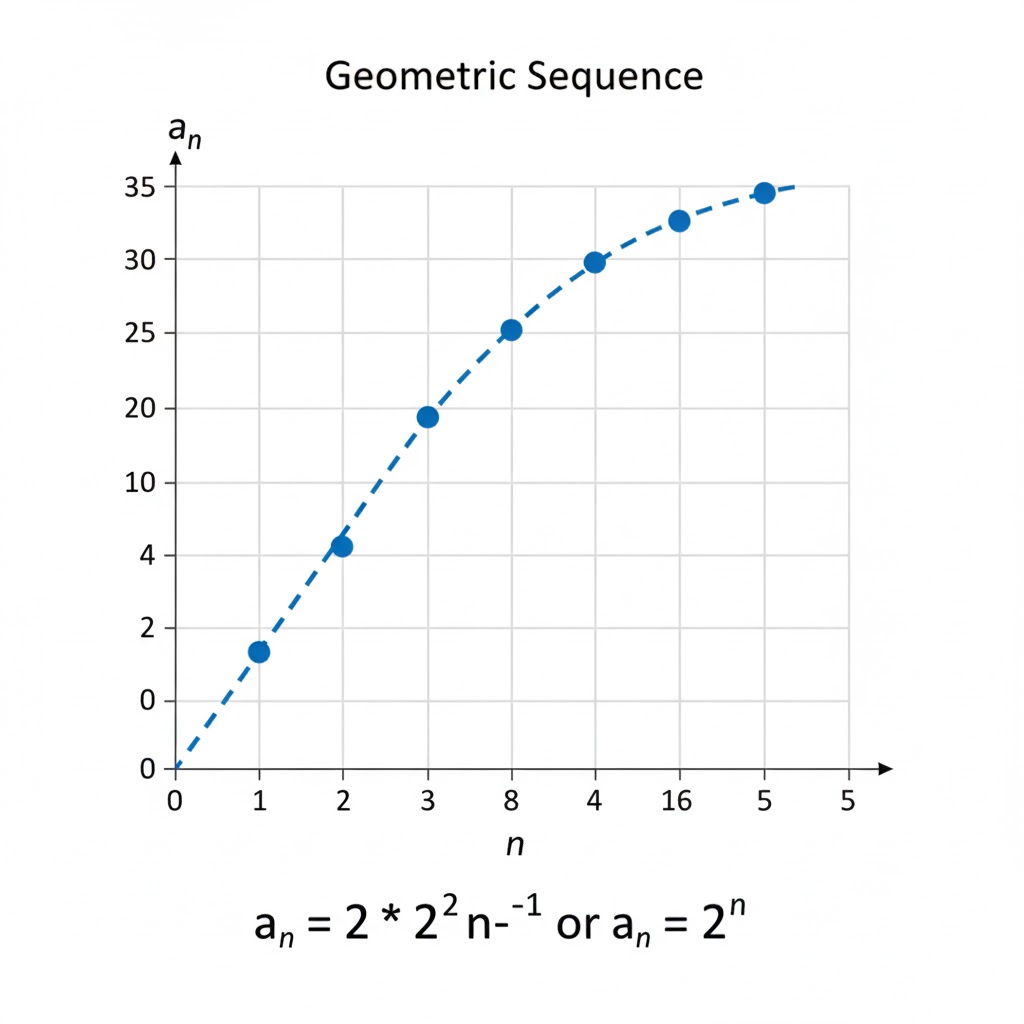
**Graph Characteristics**:
When $q > 0$ and $q \neq 1$, the graph consists of discrete points lying on an exponential function $y = a \cdot q^x$.
**Key Formulas**:
1. **General Term**: $a_n = a_1 \cdot q^{n-1}$
2. **Summation**:
* If $q = 1$: $S_n = n a_1$
* If $q \neq 1$: $S_n = \frac{a_1(1-q^n)}{1-q}$
3. **Mean Property**: If $a, b, c$ form a geometric sequence, then $b^2 = ac$ (pay attention to the sign of $b$).
---
4. Examples & Tips
**Example 1 (Arithmetic Sum)**:
In an arithmetic sequence $\{a_n\}$, $a_1=2, a_{10}=29$, find $S_{10}$.
* **Solution**: Use the formula analogous to the area of a trapezoid: $S_{10} = \frac{10(a_1 + a_{10})}{2} = \frac{10(2+29)}{2} = 155$.
**Example 2 (Finding $a_n$ from $S_n$)**:
Given $S_n = n^2 + n$, find $a_n$ and identify the sequence type.
* **Solution**:
* $a_1 = S_1 = 2$
* For $n \ge 2$, $a_n = S_n - S_{n-1} = (n^2+n) - [(n-1)^2+(n-1)] = 2n$.
* Check $n=1$: $2 \times 1 = 2$, it matches.
* $a_n = 2n$ is a linear function of $n$, so it is an arithmetic sequence.