Operations on Sets
CSCA Operations on Sets study guide organized around the publicly available CSCA syllabus. Practice Mathematics questions on aicsca.com.
Before planning this topic, check the CSCA Exam Guide 2026 for exam dates, registration, fees, and subject requirements.
Syllabus Alignment
This study guide is organized around the publicly available CSCA syllabus for international undergraduate applicants.
Who It Is For
International students preparing for CSCA Math, Physics, Chemistry, or Chinese exams.
Related Practice
CSCA Practice · Go to questions
Past papers and worked video solutions · Timed mock exams · All subject video lessons
Practice by Topic
Jump from this tutorial to filtered practice questions for the same knowledge point.
Related formulas, concepts, and glossary terms
Mathematics Formula & Concept Reference
Mathematics Exam Glossary
Tutorial Content
Operations on Sets
Set operations are a mandatory topic in the CSCA exam. Mastering definitions of **Union**, **Intersection**, and **Complement**, along with their representations in Venn Diagrams and on the number line, is key to solving these problems.
1. Three Basic Operations
Let $A$ and $B$ be two sets, and $U$ be the universal set.
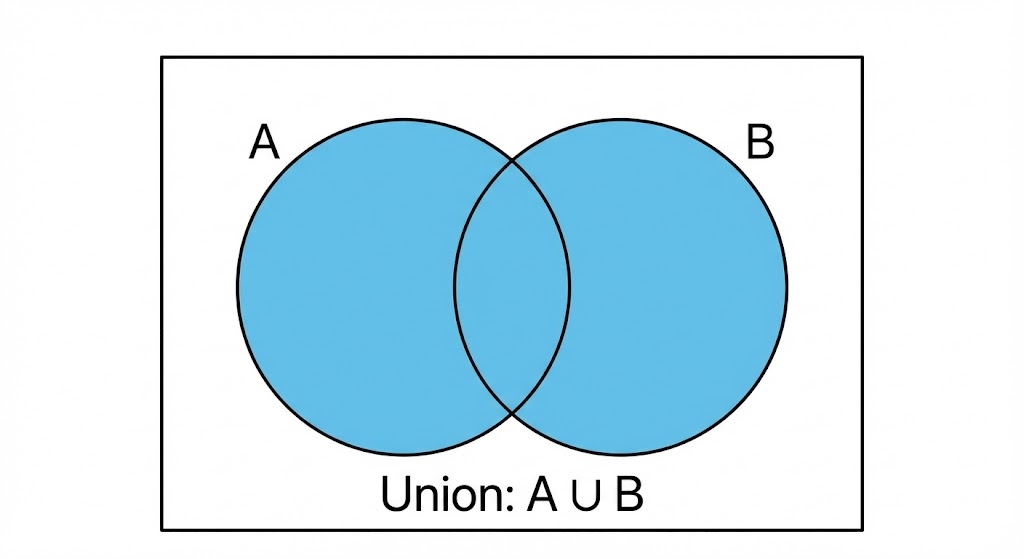
#### (1) Union
* **Definition**: The set of elements that belong to $A$ **OR** $B$.
* **Symbol**: $A \cup B$
* **Mnemonic**: "Combine A and B, counting duplicates only once."
* **Venn Diagram**:
#### (2) Intersection
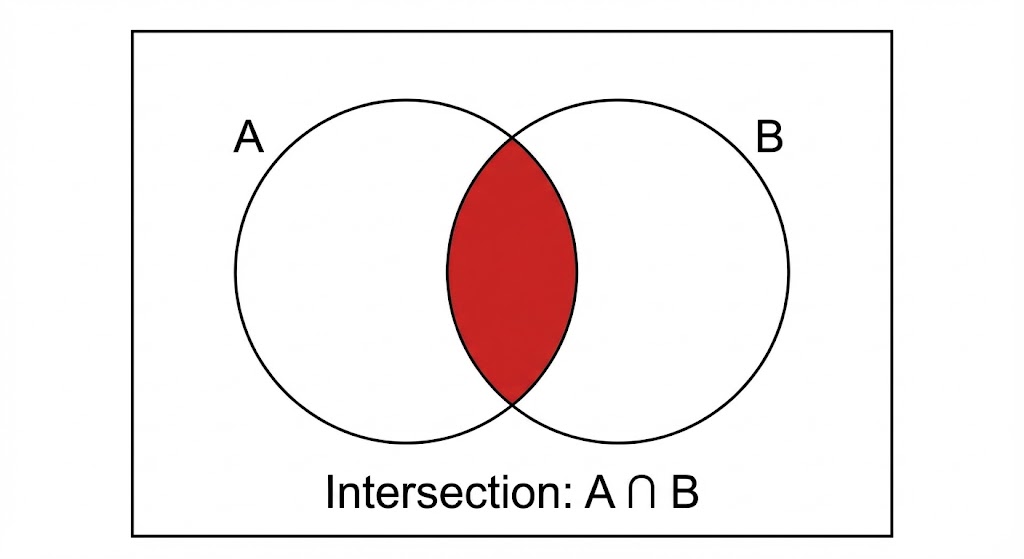
* **Definition**: The set of elements that belong to **BOTH** $A$ **AND** $B$.
* **Symbol**: $A \cap B$
* **Mnemonic**: "The common part shared by A and B." If $A \cap B = \varnothing$, the sets are **Disjoint**.
* **Venn Diagram**:
#### (3) Complement
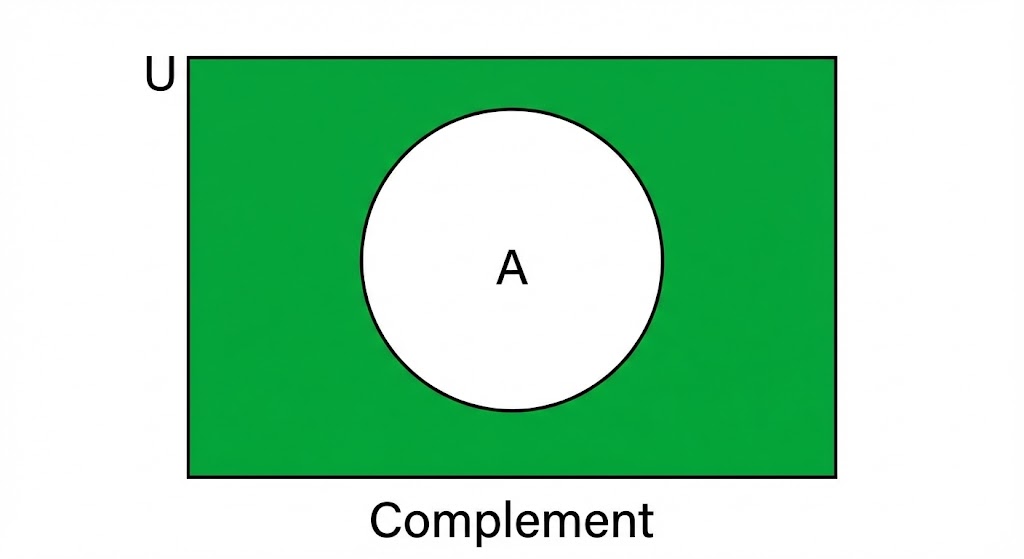
* **Definition**: The set of elements in the universal set $U$ that are **NOT** in $A$.
* **Symbol**: $\complement_U A$ (Common in Chinese textbooks) or $A^c$.
* **Mnemonic**: "Remove A from U; what remains is the complement."
* **Venn Diagram**:
2. Important Laws of Operations
The CSCA exam often uses these laws to simplify set problems:
* **Commutative Laws**: $A \cup B = B \cup A$, $A \cap B = B \cap A$
* **Distributive Laws**:
* $A \cap (B \cup C) = (A \cap B) \cup (A \cap C)$
* $A \cup (B \cap C) = (A \cup B) \cap (A \cup C)$
* **De Morgan's Laws ★ Key Point**:
* $\complement_U (A \cup B) = (\complement_U A) \cap (\complement_U B)$ (Complement of Union = Intersection of Complements)
* $\complement_U (A \cap B) = (\complement_U A) \cup (\complement_U B)$ (Complement of Intersection = Union of Complements)
3. Worked Examples
**Example 1: Interval Operations**
Let set $A = \{x | -2 \le x < 3\}$ and $B = \{x | 1 < x \le 5\}$. Find $A \cup B$ and $A \cap B$.
**Tip**: Draw a number line!
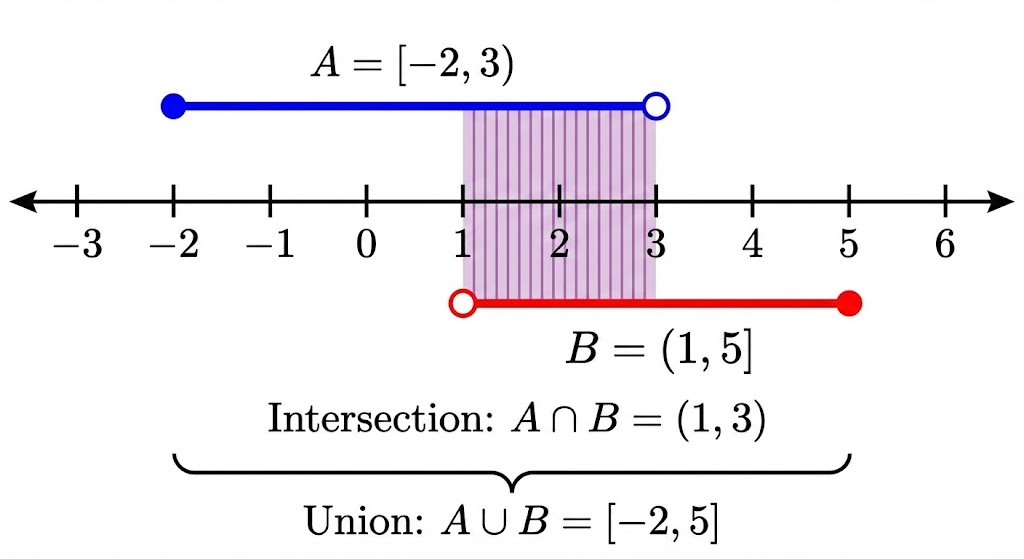
* **Union ($A \cup B$)**: The total range covered. From left endpoint $-2$ to right endpoint $5$. $\Rightarrow [-2, 5]$
* **Intersection ($A \cap B$)**: The overlapping section where both lines exist. From $1$ (exclusive) to $3$ (exclusive). $\Rightarrow (1, 3)$
**Example 2: Discrete Set Operations**
Given $U = \{1,2,3,4,5,6\}$, $A = \{1, 4\}$, $B = \{1, 3, 5\}$. Find $\complement_U (A \cup B)$.
**Solution**:
1. First, find the union: $A \cup B = \{1, 3, 4, 5\}$
2. Next, find the complement: Remove $\{1, 3, 4, 5\}$ from $U$, leaving $\{2, 6\}$.
Thus, $\complement_U (A \cup B) = \{2, 6\}$.