Sets
CSCA Sets study guide organized around the publicly available CSCA syllabus. Practice Mathematics questions on aicsca.com.
Before planning this topic, check the CSCA Exam Guide 2026 for exam dates, registration, fees, and subject requirements.
Syllabus Alignment
This study guide is organized around the publicly available CSCA syllabus for international undergraduate applicants.
Who It Is For
International students preparing for CSCA Math, Physics, Chemistry, or Chinese exams.
Related Practice
CSCA Practice · Go to questions
Past papers and worked video solutions · Timed mock exams · All subject video lessons
Practice by Topic
Jump from this tutorial to filtered practice questions for the same knowledge point.
Related formulas, concepts, and glossary terms
Mathematics Formula & Concept Reference
- Set Difference
- Union
- Complement
- Intersection
- De Morgan's Laws
- De Morgan's Laws (Set Form)
- Interval Notation
- Set Representation: Set-Builder Notation
Mathematics Exam Glossary
Tutorial Content
Sets
Sets form the foundational language for all subsequent algebraic problems in the CSCA exam. Accurately understanding definitions, standard number set notations, and relationships between sets is key to avoiding misinterpretation of questions.
1. Core Definitions and Notation
A set is **a well-defined collection of distinct objects**.
* **Element**: An object in a set. If $a$ is in set $A$, we write $a \in A$ (belongs to); otherwise, $a \notin A$.
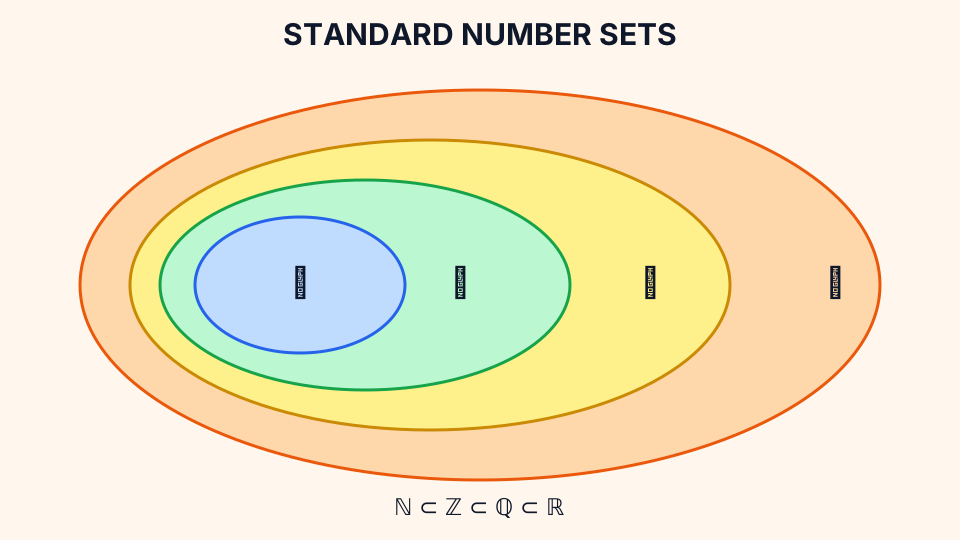
* **Standard Number Sets**: **Must Memorize for Exam!**
* $\mathbb{N}$: Natural numbers (0, 1, 2...)
* $\mathbb{Z}$: Integers (..., -1, 0, 1, ...)
* $\mathbb{Q}$: Rational numbers
* $\mathbb{R}$: Real numbers
2. Representation of Sets
The CSCA exam often tests the conversion between two methods:
1. **Roster Notation**: Listing elements explicitly.
* Ex: $A = \{1, 2, 3\}$
2. **Set-Builder Notation**: This is often the **challenging part**. Format: $\{x | P(x)\}$.
* Ex: $B = \{x \in \mathbb{R} | x^2 - 1 = 0\}$, which implies $B = \{-1, 1\}$.
* **Note**: The variable before the bar $|$ represents the element, and the condition follows.
3. Relationships: Subsets
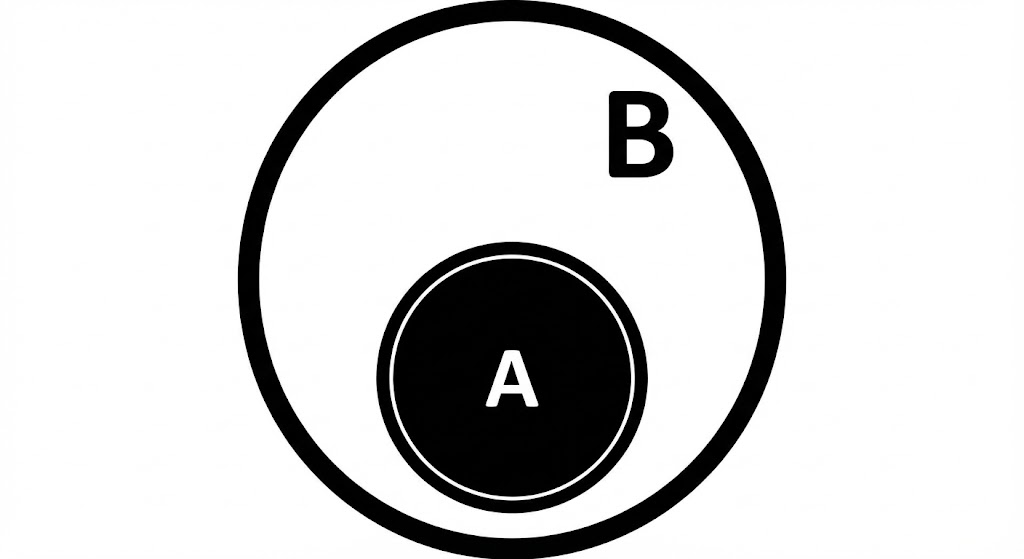
* **Definition**: If **every** element of set $A$ is also an element of set $B$, then $A$ is a subset of $B$, denoted $A \subseteq B$.
* **Proper Subset**: If $A \subseteq B$ and $A \neq B$, denoted $A \subsetneq B$.
* **Empty Set ($\varnothing$)**: Contains no elements. **Rule: The empty set is a subset of every set** (i.e., $\varnothing \subseteq A$).
4. Common Pitfalls
**Symbol Distinction: $\in$ vs $\subseteq$**
* $\in$ connects an **Element** and a **Set**. (e.g., $1 \in \{1, 2\}$)
* $\subseteq$ connects a **Set** and a **Set**. (e.g., $\{1\} \subseteq \{1, 2\}$)
* **Incorrect**: $1 \subseteq \{1, 2\}$ or $\{1\} \in \{1, 2\}$.