Definition of the Derivative
CSCA Definition of the Derivative study guide organized around the publicly available CSCA syllabus. Practice Mathematics questions on aicsca.com.
Before planning this topic, check the CSCA Exam Guide 2026 for exam dates, registration, fees, and subject requirements.
Syllabus Alignment
This study guide is organized around the publicly available CSCA syllabus for international undergraduate applicants.
Who It Is For
International students preparing for CSCA Math, Physics, Chemistry, or Chinese exams.
Related Practice
CSCA Practice · Go to questions
Past papers and worked video solutions · Timed mock exams · All subject video lessons
Practice by Topic
Jump from this tutorial to filtered practice questions for the same knowledge point.
Related formulas, concepts, and glossary terms
Mathematics Formula & Concept Reference
- Alternative Notation for Derivative (Leibniz Notation)
- Relationship between Differentiability and Continuity at a Point
- Definition of Derivative (Limit Form)
- Left-hand and Right-hand Derivatives
Mathematics Exam Glossary
Tutorial Content
Definition of the Derivative
1. Core Concepts
The **Derivative** is the cornerstone of calculus, quantifying how fast a function changes at a specific point.
* **Physical Meaning**: Instantaneous Rate of Change (e.g., Velocity is the derivative of Displacement).
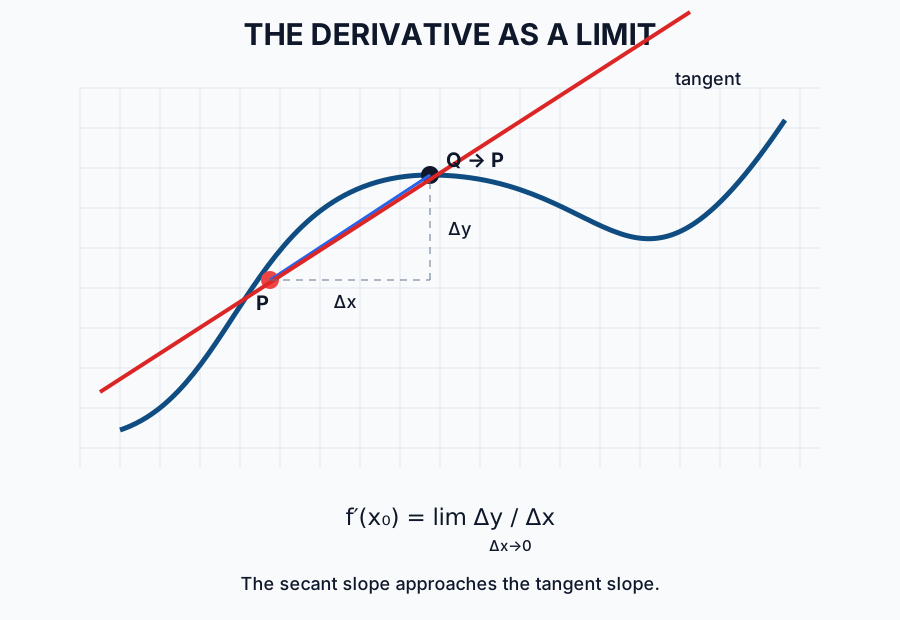
* **Geometric Meaning**: The **Slope of the Tangent Line** to the curve at a specific point.
---
2. Definition and Formula
Let $y = f(x)$ be defined near $x_0$. When $x$ changes by $\Delta x$, $y$ changes by $\Delta y = f(x_0 + \Delta x) - f(x_0)$.
If the limit exists, the function is **Differentiable** at $x_0$, and the limit is called the **Derivative**:
$$ f'(x_0) = \lim_{\Delta x \to 0} \frac{\Delta y}{\Delta x} = \lim_{\Delta x \to 0} \frac{f(x_0 + \Delta x) - f(x_0)}{\Delta x} $$
**Notation**: $f'(x_0)$, $y'|_{x=x_0}$, or $\frac{dy}{dx}|_{x=x_0}$.
**Intuition**:
1. $\frac{\Delta y}{\Delta x}$ is the slope of the secant line, representing the **Average Rate of Change**.
2. As $\Delta x \to 0$, the secant line approaches the tangent line, and the average rate becomes the **Instantaneous Rate of Change**.
---
3. Three-Step Method to Find the Derivative
1. **Find Increment**: $\Delta y = f(x_0+\Delta x) - f(x_0)$
2. **Find Ratio**: $\frac{\Delta y}{\Delta x}$ (Simplify the expression, usually cancelling $\Delta x$ in the denominator)
3. **Take Limit**: $\lim_{\Delta x \to 0} \frac{\Delta y}{\Delta x}$
---
4. Typical Examples
**Example 1: Polynomial**
Find the derivative of $f(x) = x^2$ at $x=1$ using the definition.
**Solution**:
1. $\Delta y = (1+\Delta x)^2 - 1^2 = 2\Delta x + (\Delta x)^2$
2. $\frac{\Delta y}{\Delta x} = 2 + \Delta x$
3. $\lim_{\Delta x \to 0} (2 + \Delta x) = 2$
$\therefore f'(1) = 2$.
**Example 2: Rational Function**
Find the derivative of $f(x) = \frac{1}{x}$.
**Solution**:
1. $\Delta y = \frac{1}{x+\Delta x} - \frac{1}{x} = \frac{-\Delta x}{x(x+\Delta x)}$
2. $\frac{\Delta y}{\Delta x} = \frac{-1}{x(x+\Delta x)}$
3. $\lim_{\Delta x \to 0} \frac{-1}{x(x+\Delta x)} = -\frac{1}{x^2}$
$\therefore (\frac{1}{x})' = -\frac{1}{x^2}$.
**Example 3: Differentiability (Non-differentiable case)**
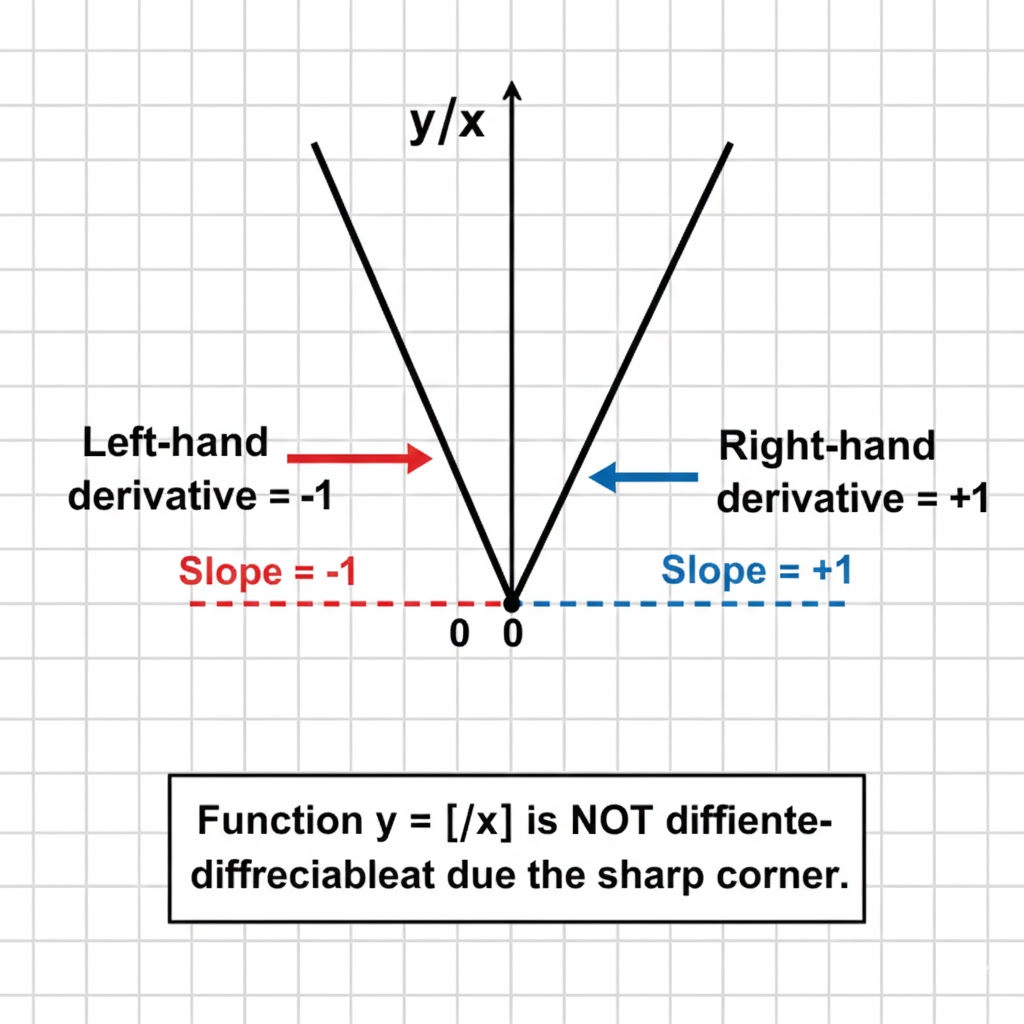
Discuss the differentiability of $f(x) = |x|$ at $x=0$.
**Solution**:
Check the limit $\lim_{\Delta x \to 0} \frac{|\Delta x|}{\Delta x}$.
* **Right Limit** ($\Delta x > 0$): $1$
* **Left Limit** ($\Delta x < 0$): $-1$
Since the limits are not equal, the derivative does not exist.
**Conclusion**: $f(x)=|x|$ is **not differentiable** at $x=0$ (Sharp corner).
---
5. Common Pitfalls
* **Indeterminate Forms**: Always simplify the fraction $\frac{\Delta y}{\Delta x}$ before taking the limit to avoid $\frac{0}{0}$.
* **Continuity vs. Differentiability**: $y=|x|$ is continuous at $x=0$ but not differentiable. **Differentiability implies Continuity, but NOT vice versa**.
* **Notation**: Don't confuse the number $f'(x_0)$ with the function $f'(x)$.