Methods of Representing Sets
CSCA Methods of Representing Sets study guide organized around the publicly available CSCA syllabus. Practice Mathematics questions on aicsca.com.
Before planning this topic, check the CSCA Exam Guide 2026 for exam dates, registration, fees, and subject requirements.
Syllabus Alignment
This study guide is organized around the publicly available CSCA syllabus for international undergraduate applicants.
Who It Is For
International students preparing for CSCA Math, Physics, Chemistry, or Chinese exams.
Related Practice
CSCA Practice · Go to questions
Past papers and worked video solutions · Timed mock exams · All subject video lessons
Practice by Topic
Jump from this tutorial to filtered practice questions for the same knowledge point.
Related formulas, concepts, and glossary terms
Mathematics Formula & Concept Reference
- Interval Notation
- Set-Builder Notation
- Interval Notation (Subsets of Real Numbers)
- Common Number Set Symbols
- Notation of the Empty Set
- Roster (List) Notation of a Set
Mathematics Exam Glossary
Tutorial Content
Methods of Representing Sets
In the CSCA exam, questions often switch between **Set-Builder Notation** (in the question stem) and **Interval Notation** (in the options). Mastering the conversion between these methods is a prerequisite for solving inequality problems.
1. Roster Method
Listing elements explicitly inside curly braces $\{ \}$.
* **Use Case**: Finite sets, or sets of integers with an obvious pattern.
* **Core Rules**:
1. **Unorderedness**: $\{1, 2\}$ is the same as $\{2, 1\}$.
2. **Distinctness**: $\{1, 2, 2\}$ must be written as $\{1, 2\}$.
2. Set-Builder Notation
This is the **most common** notation in exams, used to describe sets defined by a specific property.
**Structure Breakdown**:
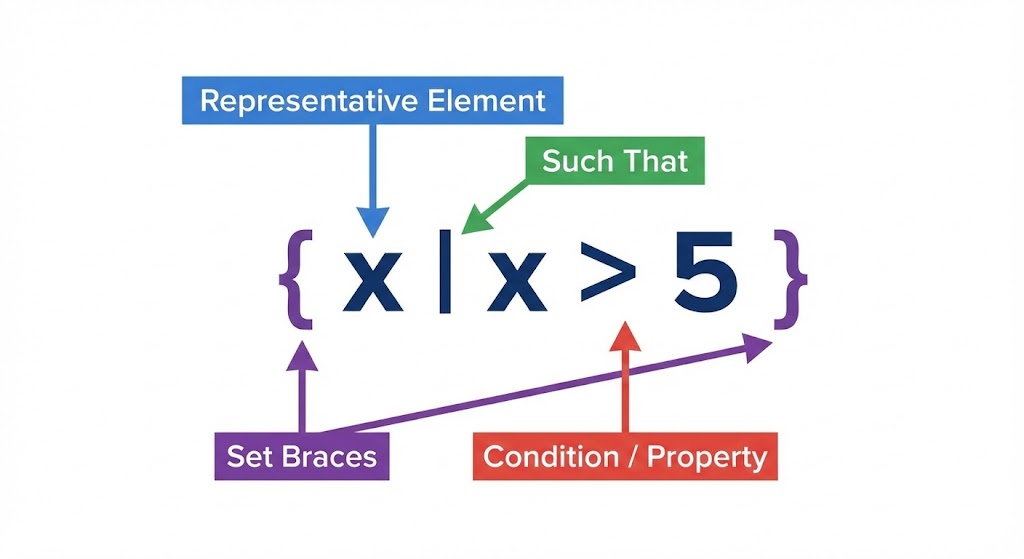
* **Format**: $\{ \text{Representative Element} \mid \text{Condition} \}$
* Example: $A = \{ x \in \mathbb{R} \mid x > 3 \}$
* **Read as**: Set $A$ consists of all elements $x$ in Real numbers such that $x$ is greater than 3.
* **Common Trap**: **Check the domain of the "Representative Element".**
* $A = \{x \in \mathbb{Z} | 0 < x < 3\} = \{1, 2\}$ (Integers)
* $B = \{x \in \mathbb{R} | 0 < x < 3\} = (0, 3)$ (Real Interval)
3. Interval Notation ★ Key Focus
In the CSCA exam, the **solution set of inequalities** is usually required to be expressed in interval notation. You must memorize the correspondence between **bracket shapes** and **inequality signs**.
**Interval & Number Line Reference Chart**:
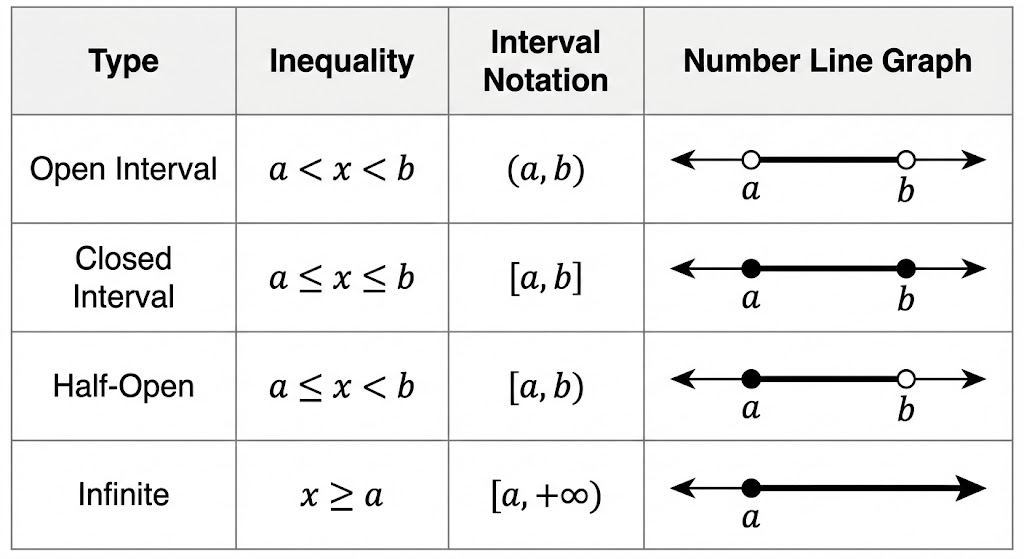
* **Rules Summary**:
* **Parentheses $( \quad )$**: Corresponds to $<, >$ or $\pm \infty$. Indicates endpoints are **excluded** (drawn as **hollow circles** on the number line).
* **Brackets $[ \quad ]$**: Corresponds to $\le, \ge$. Indicates endpoints are **included** (drawn as **solid dots** on the number line).
* **Infinity**: Always use **parentheses** next to $+\infty$ and $-\infty$.
* **Common Conversions**:
* $x \ge 2 \implies [2, +\infty)$
* $x < 5 \implies (-\infty, 5)$
* $x \ne 1 \implies (-\infty, 1) \cup (1, +\infty)$ (The union symbol $\cup$ is also essential).
4. Venn Diagrams
Using closed curves (circles) to represent sets. Primarily used as a visual aid to understand **Union, Intersection, and Complement** operations, rather than as a final answer format.