Power Functions
CSCA Power Functions study guide organized around the publicly available CSCA syllabus. Practice Mathematics questions on aicsca.com.
Before planning this topic, check the CSCA Exam Guide 2026 for exam dates, registration, fees, and subject requirements.
Syllabus Alignment
This study guide is organized around the publicly available CSCA syllabus for international undergraduate applicants.
Who It Is For
International students preparing for CSCA Math, Physics, Chemistry, or Chinese exams.
Related Practice
CSCA Practice · Go to questions
Past papers and worked video solutions · Timed mock exams · All subject video lessons
Practice by Topic
Jump from this tutorial to filtered practice questions for the same knowledge point.
Related formulas, concepts, and glossary terms
Mathematics Formula & Concept Reference
- Common Power Function: α = -1
- Common Power Function: α = n (Positive Integer)
- General Form of Power Function
- Derivative Formula for Power Functions
- Common Power Function: α = (1)/(n) ( n is a Positive Integer)
- Common Power Function: a = 1 (Direct Proportionality)
- Common Power Function: a = 2 (Quadratic Function)
- Common Power Function: a = (1)/(2) (Square Root Function)
Mathematics Exam Glossary
Tutorial Content
Power Functions
1. Core Concepts
**Power Functions** are functions of the form $y = x^{\alpha}$, where $x$ is the variable and $\alpha$ is a constant.
**Key Distinction**:
* **Power Function**: Base is variable $x$, Exponent is constant (e.g., $y=x^3$).
* **Exponential Function**: Base is constant $a$, Exponent is variable $x$ (e.g., $y=3^x$).
---
2. Classification of Graphs and Properties
The shape depends on $\alpha$. In the first quadrant, all power functions pass through $(1, 1)$.
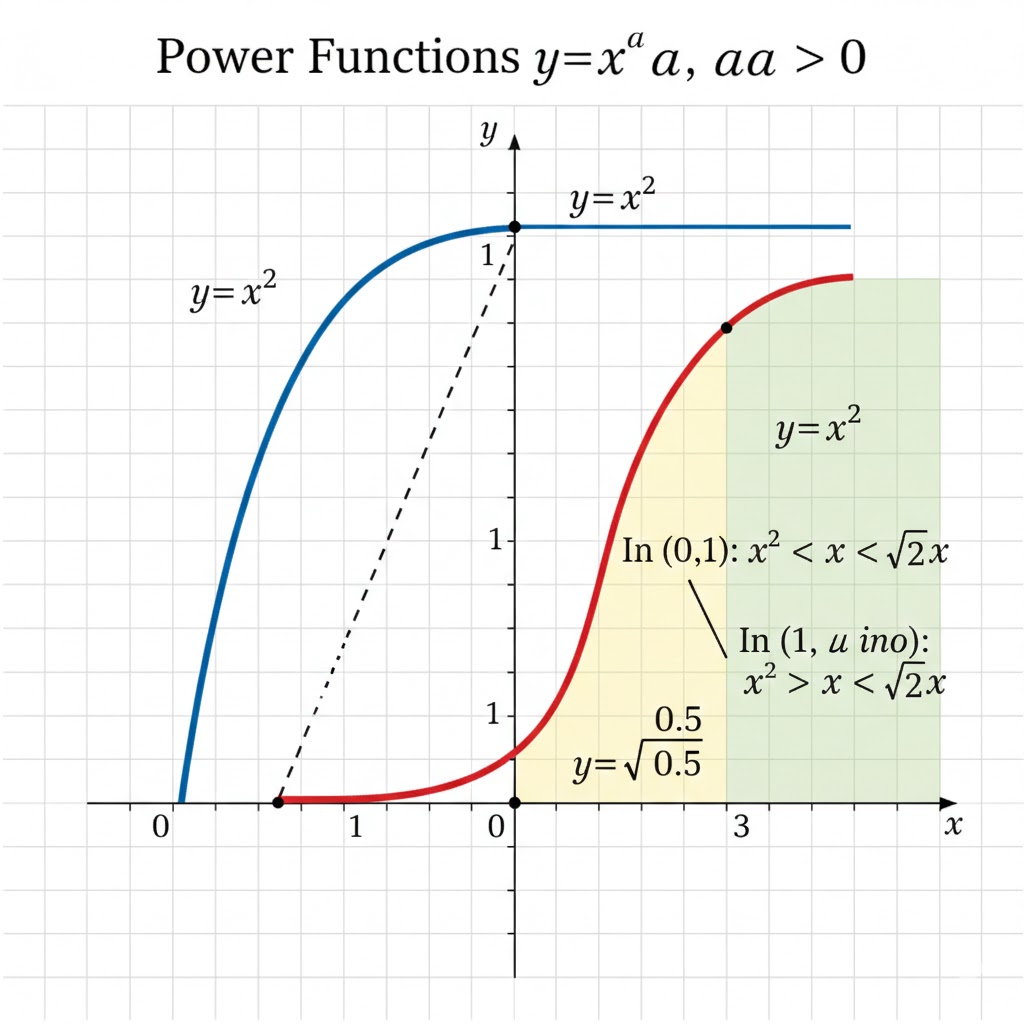
#### (1) $\alpha > 0$ (Passes through Origin)
* **Property**: Passes through $(0,0)$ and $(1,1)$. **Increasing** on $(0, +\infty)$.
* **Shape Details**:
* $\alpha > 1$ (e.g., $x^2, x^3$): **Concave Up**. Grows faster. Below $y=x$ in $(0,1)$, above in $(1, +\infty)$.
* $\alpha = 1$ (e.g., $x$): Straight line.
* $0 < \alpha < 1$ (e.g., $x^{1/2}$): **Concave Down**. Grows slower. Above $y=x$ in $(0,1)$, below in $(1, +\infty)$.
#### (2) $\alpha < 0$ (Does NOT pass through Origin)
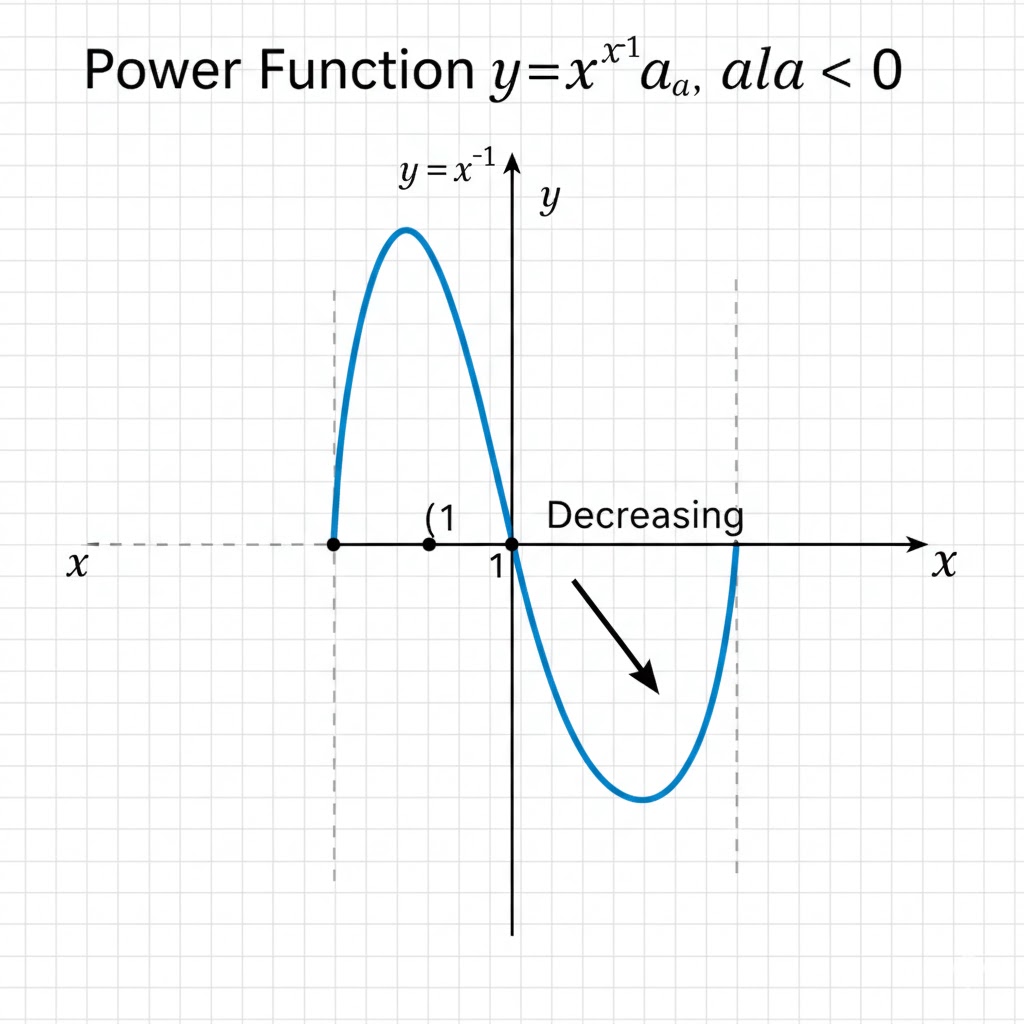
* **Property**: Passes through $(1,1)$. **Decreasing** on $(0, +\infty)$. The axes are **asymptotes**.
* **Example**: $y = x^{-1} = \frac{1}{x}$ (Hyperbola).
#### (3) Parity (Even/Odd)
Depends on $\alpha$:
* Even integer $\alpha$ $\rightarrow$ **Even Function** (Symmetric about y-axis).
* Odd integer $\alpha$ $\rightarrow$ **Odd Function** (Symmetric about origin).
* Fractional $\alpha$ $\rightarrow$ Often **Neither** (due to domain constraints).
---
3. Relative Position of Graphs
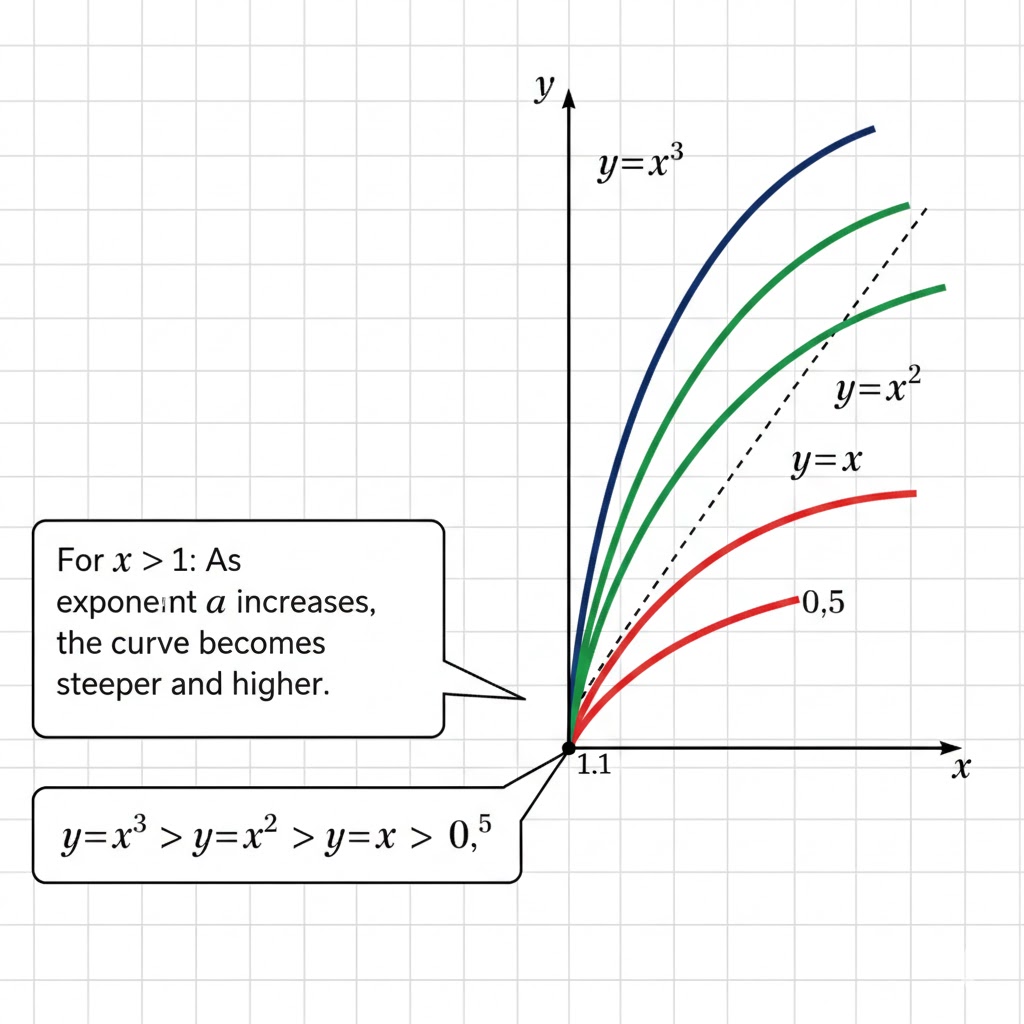
To compare graphs, look at the region where $x > 1$. A larger $\alpha$ means the graph is higher (steeper).
**Rule**: For $x>1$, graphs are arranged from bottom to top as $\alpha$ increases.
---
4. Typical Examples
**Example 1: Domain**
Find domain of $f(x) = (x-2)^{\frac{1}{3}} + (3x-1)^{-2}$.
**Solution**:
1. $(x-2)^{\frac{1}{3}}$: Odd root, domain is $\mathbb{R}$.
2. $(3x-1)^{-2}$: Negative exponent implies denominator $\neq 0 \Rightarrow x \neq \frac{1}{3}$.
**Result**: $(-\infty, \frac{1}{3}) \cup (\frac{1}{3}, +\infty)$.
**Example 2: Comparison**
Compare $3.1^{0.4}$ and $3.2^{0.4}$.
**Solution**:
Use function $y = x^{0.4}$. Since $\alpha = 0.4 > 0$, it is increasing.
Since $3.1 < 3.2$, then $3.1^{0.4} < 3.2^{0.4}$.
**Example 3: Graph Identification**
Match curves $C_1, C_2, C_3$ to $y=x^3, y=x, y=x^{\frac{1}{3}}$.
**Solution**:
Look at $x > 1$:
* Highest curve $C_1$ corresponds to largest $\alpha=3$.
* Middle curve $C_2$ corresponds to $\alpha=1$.
* Lowest curve $C_3$ corresponds to smallest $\alpha=\frac{1}{3}$.
---
5. Common Pitfalls
* **Confusion**: $y=x^2$ is Power, $y=2^x$ is Exponential. Check where the $x$ is.
* **Domain**: For $y=x^{1/2}$ or $y=x^{-1}$, remember $x$ cannot be negative or zero respectively.
* **Monotonicity Notation**: For $\alpha < 0$, never describe the decreasing interval using union $\cup$. Say "decreasing on $(-\infty, 0)$ AND $(0, +\infty)$ separately".