Domain of a Function
CSCA Domain of a Function study guide organized around the publicly available CSCA syllabus. Practice Mathematics questions on aicsca.com.
Before planning this topic, check the CSCA Exam Guide 2026 for exam dates, registration, fees, and subject requirements.
Syllabus Alignment
This study guide is organized around the publicly available CSCA syllabus for international undergraduate applicants.
Who It Is For
International students preparing for CSCA Math, Physics, Chemistry, or Chinese exams.
Related Practice
CSCA Practice · Go to questions
Past papers and worked video solutions · Timed mock exams · All subject video lessons
Practice by Topic
Jump from this tutorial to filtered practice questions for the same knowledge point.
Related formulas, concepts, and glossary terms
Mathematics Formula & Concept Reference
- Domain Condition for Logarithmic Functions
- Basic Concept of Function Domain
- Finding Domain of Composite Functions
- Domain Condition for Rational Functions
- Basic Definition of Function Domain
- Domain of a Rational Function
- Domain of a Function with Even-Indexed Radical
- Finding the Domain of a Composite Function
Mathematics Exam Glossary
Tutorial Content
Domain of a Function
1. Concept
The **domain** of a function is the set of all possible values for the independent variable $x$. It is one of the three essential elements of a function.
Simply put, the domain consists of all real numbers $x$ for which the function $y=f(x)$ is **defined** (makes mathematical sense). Finding the domain is essentially solving a system of inequalities.
---
2. The "Big 5" Rules for Finding the Domain
For functions defined by analytical expressions, we must adhere to the following operational rules:
| Type | Expression | Condition | Note |
| :--- | :--- | :--- | :--- |
| **Fraction** | $\frac{A(x)}{B(x)}$ | $B(x) \neq 0$ | Denominator $\neq 0$ |
| **Even Root** | $\sqrt[2n]{A(x)}$ | $A(x) \ge 0$ | Radicand $\ge 0$ |
| **Logarithm** | $\log_a A(x)$ | $A(x) > 0$ | Argument $> 0$ |
| **Zero Exponent** | $[A(x)]^0$ | $A(x) \neq 0$ | Base $\neq 0$ |
| **Tangent** | $\tan A(x)$ | $A(x) \neq \frac{\pi}{2} + k\pi$ | $k \in \mathbb{Z}$ |
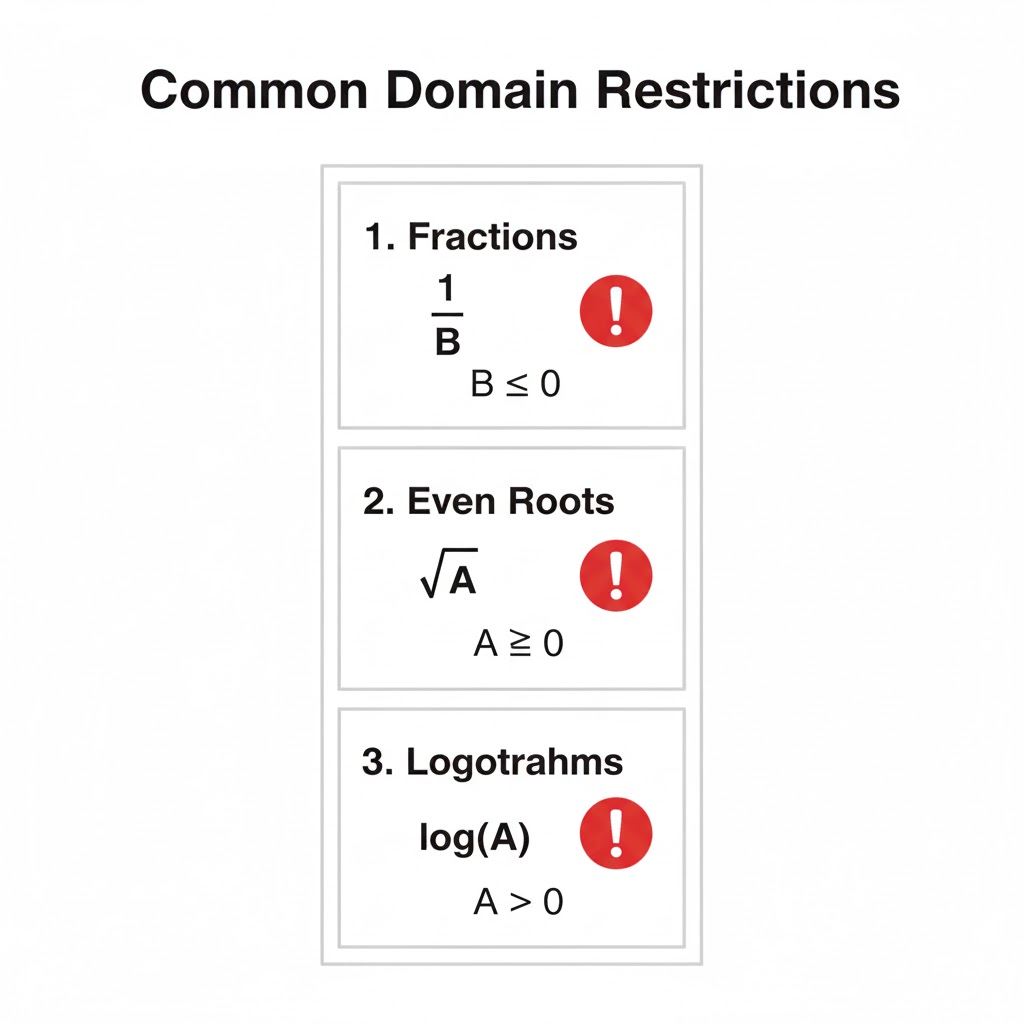
**Key Principle**: If a function contains multiple restrictions, the final domain is the **intersection** of the solution sets for each condition.
---
3. Typical Examples
**Example 1: Combination of Root and Fraction**
Find the domain of $f(x) = \frac{\sqrt{x+1}}{x-2}$.
**Solution**:
Two conditions must be met simultaneously:
1. **Even Root**: $x+1 \ge 0 \Rightarrow x \ge -1$
2. **Denominator**: $x-2 \neq 0 \Rightarrow x \neq 2$
Take the **intersection** of both sets:
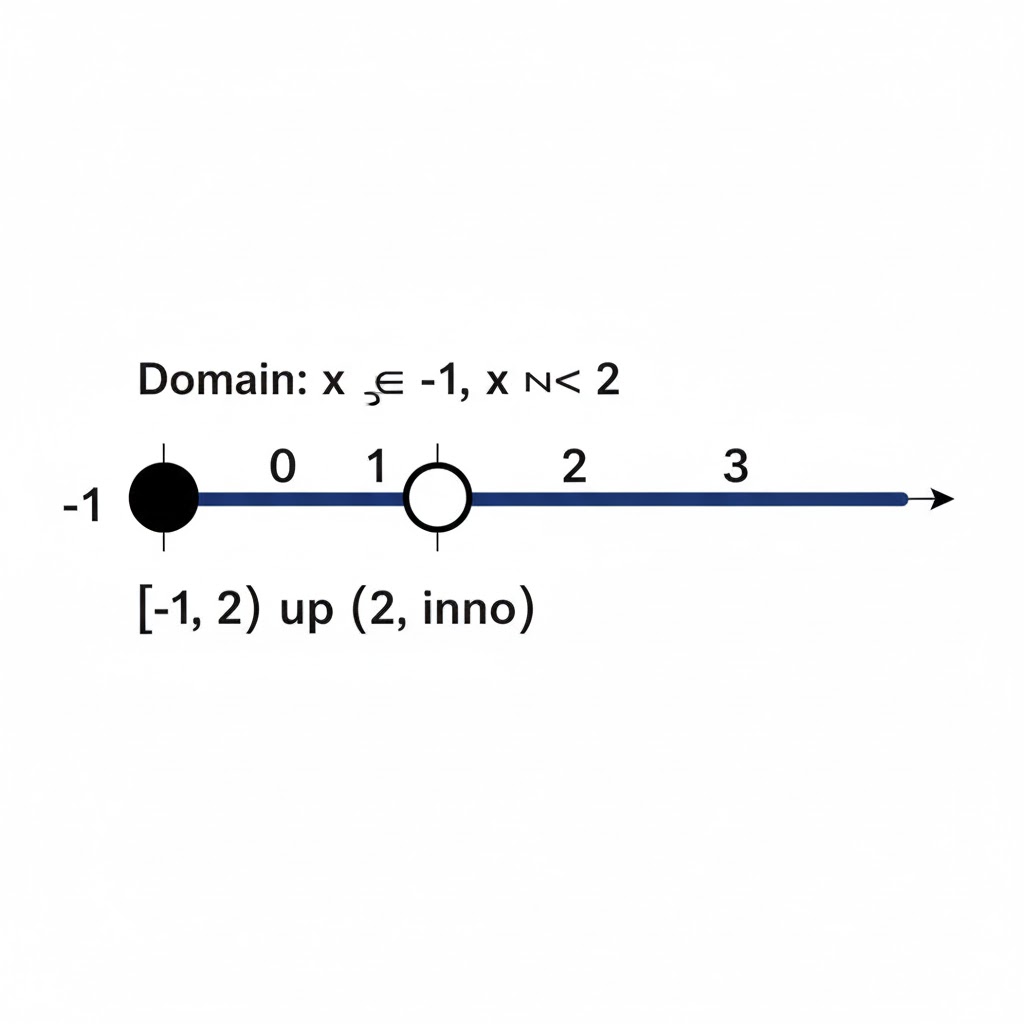
**Result**: The domain is $[-1, 2) \cup (2, +\infty)$.
**Example 2: Combination of Logarithm and Root**
Find the domain of $f(x) = \log_2(x-3) + \sqrt{4-x}$.
**Solution**:
Two conditions must be met simultaneously:
1. **Logarithm**: $x-3 > 0 \Rightarrow x > 3$
2. **Even Root**: $4-x \ge 0 \Rightarrow x \le 4$
Take the **intersection** of both sets:
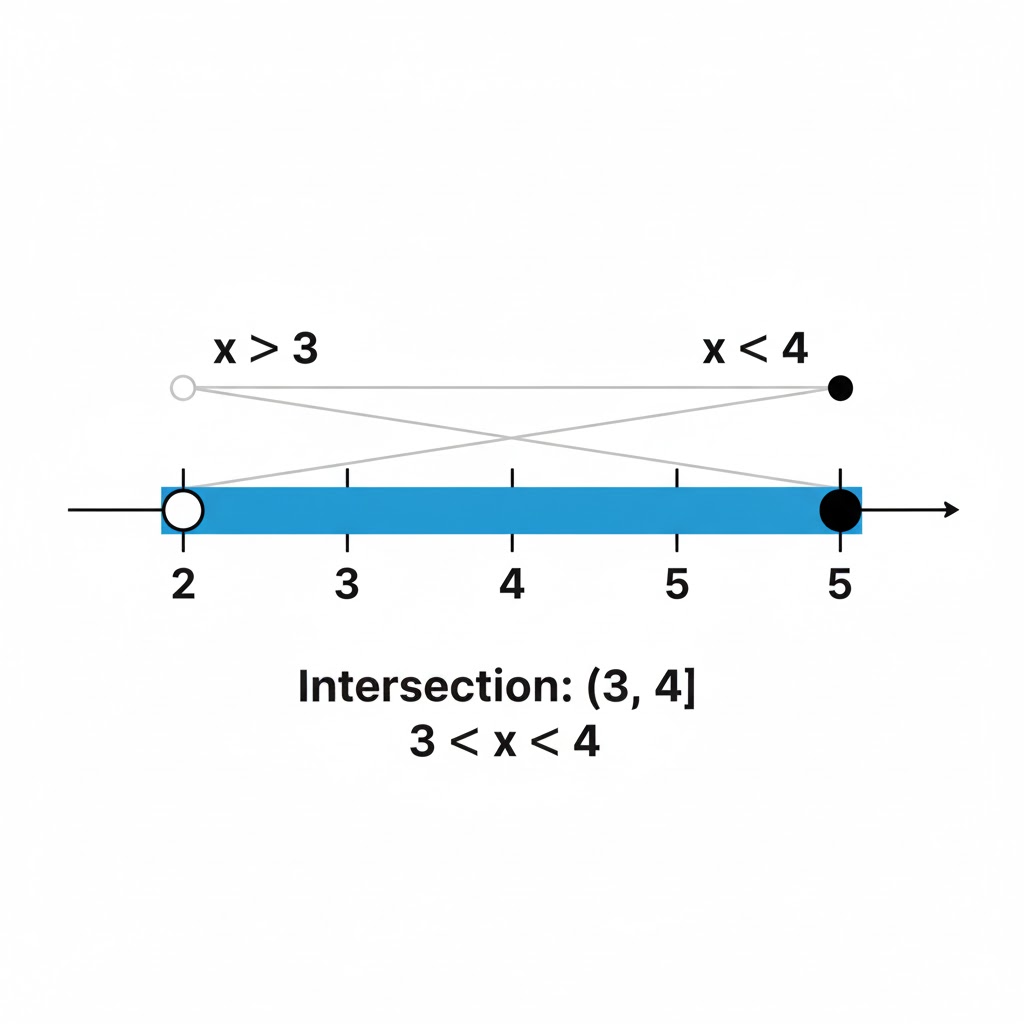
**Result**: The domain is $(3, 4]$.
---
4. Common Pitfalls
* **Interval Endpoints**: Pay attention to open intervals `(` vs. closed intervals `[`. A solid dot means included ($\ge, \le$), while a hollow circle means excluded ($>, <, \neq$).
* **Missing Exclusions**: In Example 1, a common mistake is writing $[-1, +\infty)$ and forgetting to exclude $x=2$.
* **Real-world Context**: If the function models a real problem (e.g., number of people, time), ensure $x$ makes practical sense (e.g., positive integers).