Comprehensive Application of Function Properties
CSCA Comprehensive Application of Function Properties study guide organized around the publicly available CSCA syllabus. Practice Mathematics questions on aicsca.com.
Before planning this topic, check the CSCA Exam Guide 2026 for exam dates, registration, fees, and subject requirements.
Syllabus Alignment
This study guide is organized around the publicly available CSCA syllabus for international undergraduate applicants.
Who It Is For
International students preparing for CSCA Math, Physics, Chemistry, or Chinese exams.
Related Practice
CSCA Practice · Go to questions
Past papers and worked video solutions · Timed mock exams · All subject video lessons
Practice by Topic
Jump from this tutorial to filtered practice questions for the same knowledge point.
Related formulas, concepts, and glossary terms
Mathematics Formula & Concept Reference
- Parity of Functions After Operations
- Definition of Periodicity of a Function
- Monotonicity of Composite Functions (Same Increase/Decrease)
- Definition of Even and Odd Functions
- Definition of Odd and Even Functions
- Definition of Monotonicity of a Function
- Definition of Boundedness of a Function
- Definition of Monotonicity of a Function
Mathematics Exam Glossary
Tutorial Content
Comprehensive Application of Function Properties
1. Core Concepts
This section integrates all properties. Complex CSCA problems often combine **Monotonicity, Parity, Periodicity, and Symmetry**.
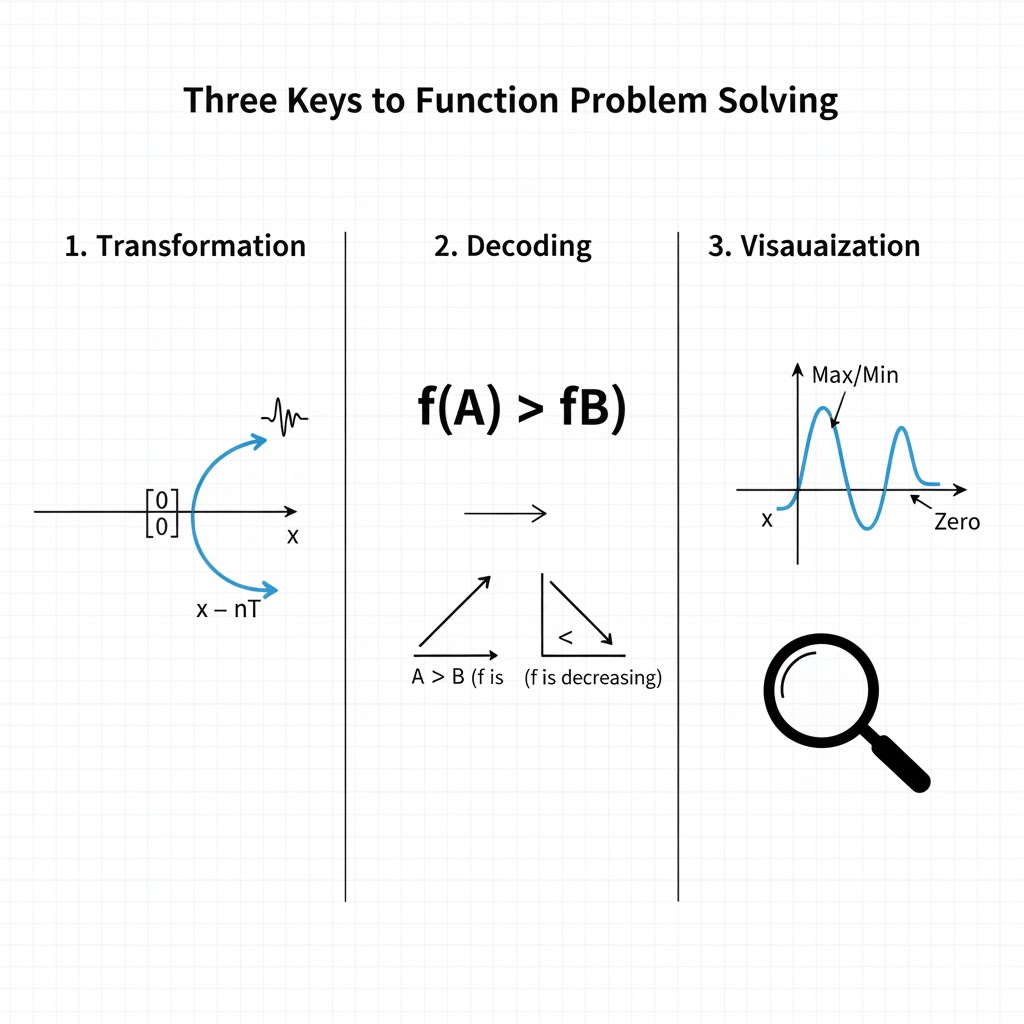
**Three Keys to Solving Problems**:
1. **Transformation**: Use Parity/Periodicity to move the problem from an unknown interval to a known interval (usually $[0, T]$ or $[0, +\infty)$).
2. **Decoding (Removing $f$)**: Use Monotonicity to strip away the function notation. E.g., $f(A) > f(B) \Rightarrow A > B$ (if increasing).
3. **Visualization**: Sketch a graph that satisfies the properties to visually determine roots or extrema.
---
2. Common Models
#### (1) "Parity + Monotonicity" Model
* **Solving Inequalities**:
* If $f(x)$ is **Even** and **Increasing** on $[0, +\infty)$:
$$f(x) > f(a) \iff |x| > |a|$$
* If $f(x)$ is **Even** and **Decreasing** on $[0, +\infty)$:
$$f(x) > f(a) \iff |x| < |a|$$
* **Rule**: For Even functions, compare **Absolute Values**.
#### (2) "Periodicity + Parity" Model
* **Evaluation**: Use Periodicity to shift large inputs (e.g., $f(2025)$) to a small range, then use Parity to solve.
#### (3) "Symmetry + Periodicity" Model
* **Finding Period**:
* Two Axes $x=a, x=b \Rightarrow T = 2|a-b|$
* Two Centers $(a,0), (b,0) \Rightarrow T = 2|a-b|$
* One Axis $x=a$ + One Center $(b,0) \Rightarrow T = 4|a-b|$
---
3. Typical Examples
**Example 1: Abstract Inequality**
Let $f(x)$ be an **Even** function on $\mathbb{R}$ and **Decreasing** on $[0, +\infty)$. Solve $f(2x-1) > f(\frac{1}{3})$.
**Solution**:
1. **Transform**: Since $f(x)$ is even, values depend on $|x|$.
2. **Decode**: Since decreasing on $[0, +\infty)$, "larger output means smaller absolute input".
$$f(2x-1) > f(\frac{1}{3}) \iff |2x-1| < |\frac{1}{3}|$$
3. **Calculate**:
$$-\frac{1}{3} < 2x-1 < \frac{1}{3}$$
$$\frac{2}{3} < 2x < \frac{4}{3} \Rightarrow \frac{1}{3} < x < \frac{2}{3}$$
**Example 2: Periodicity Calculation**
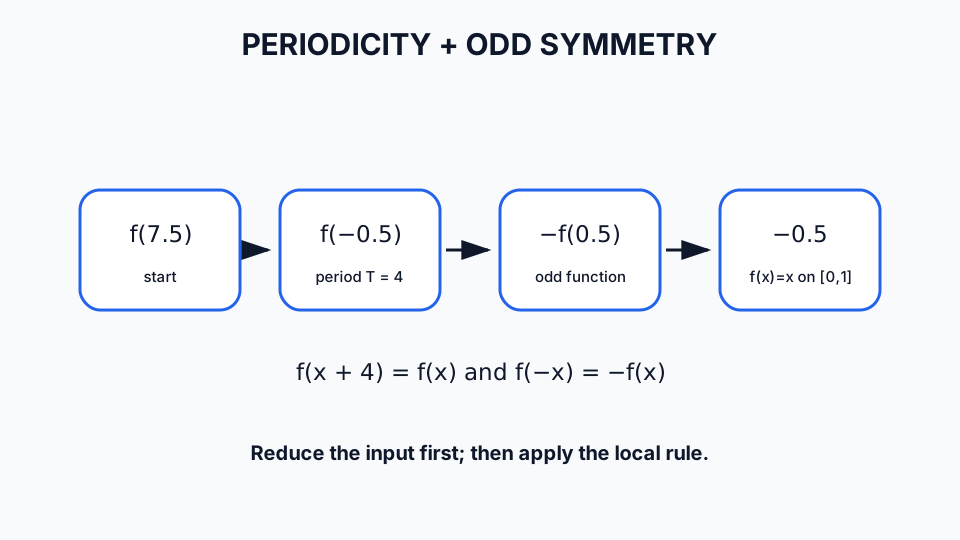
Let $f(x)$ be an **Odd** function on $\mathbb{R}$ with $f(x+2) = -f(x)$. For $0 \le x \le 1$, $f(x)=x$. Find $f(7.5)$.
**Solution**:
1. **Period**: $f(x+2)=-f(x) \Rightarrow T = 4$.
2. **Shift**: $f(7.5) = f(7.5 - 8) = f(-0.5)$.
3. **Parity**: $f(-0.5) = -f(0.5)$ (Odd function).
4. **Evaluate**: $f(0.5) = 0.5$ (Given range).
So $f(7.5) = -0.5$.
**Example 3: Parameter Range**
$f(x) = \frac{ax+1}{x+2}$ is increasing on $(-2, +\infty)$. Find the range of $a$.
**Solution**:
1. **Simplify**: $f(x) = a + \frac{1-2a}{x+2}$.
2. **Analyze**: This is a shifted $y = \frac{k}{x}$.
* $k < 0$ implies increasing.
3. **Solve**: $1-2a < 0 \Rightarrow a > \frac{1}{2}$.
---
4. Common Pitfalls
* **Missing Absolute Value**: Solving $f(x_{even}) > f(a)$ as $x > a$ is wrong. It must be $|x| > |a|$ (if increasing).
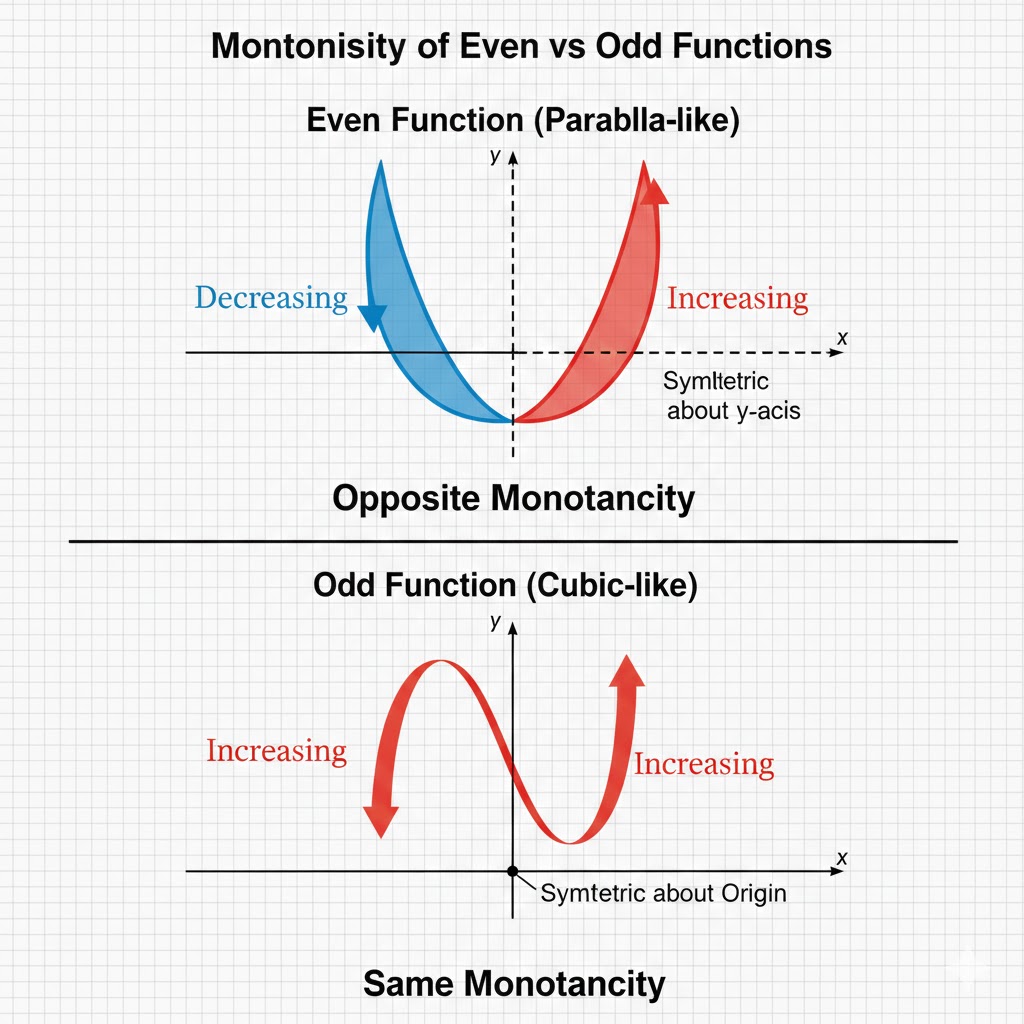
* **Monotonicity Confusion**: Odd functions have the **SAME** monotonicity on symmetric intervals; Even functions have **OPPOSITE** monotonicity.
* **Period Formula**: $f(x+a)=-f(x)$ means $T=2a$, not $a$.