Plane Analytic Geometry
CSCA Plane Analytic Geometry study guide organized around the publicly available CSCA syllabus. Practice Mathematics questions on aicsca.com.
Before planning this topic, check the CSCA Exam Guide 2026 for exam dates, registration, fees, and subject requirements.
Syllabus Alignment
This study guide is organized around the publicly available CSCA syllabus for international undergraduate applicants.
Who It Is For
International students preparing for CSCA Math, Physics, Chemistry, or Chinese exams.
Related Practice
CSCA Practice · Go to questions
Past papers and worked video solutions · Timed mock exams · All subject video lessons
Practice by Topic
Jump from this tutorial to filtered practice questions for the same knowledge point.
Related formulas, concepts, and glossary terms
Mathematics Formula & Concept Reference
- General Form of a Line Equation
- Conditions for Parallel and Perpendicular Lines
- Point-Slope Form of a Line
- Distance from a Point to a Line
- Slope Relationship of Two Parallel Lines
- Slope-Intercept Form of a Line
- Slope Relationship of Two Perpendicular Lines
- Two-Point Form of a Line Equation
Mathematics Exam Glossary
Tutorial Content
Plane Analytic Geometry
Plane analytic geometry is a section of the CSCA exam characterized by heavy calculation and strong logic. Its core philosophy is the **"integration of number and shape"**: by establishing a coordinate system, geometric figures are transformed into algebraic equations, allowing geometric problems to be solved through calculation.
1. Core Foundations: Coordinates and Basic Formulas
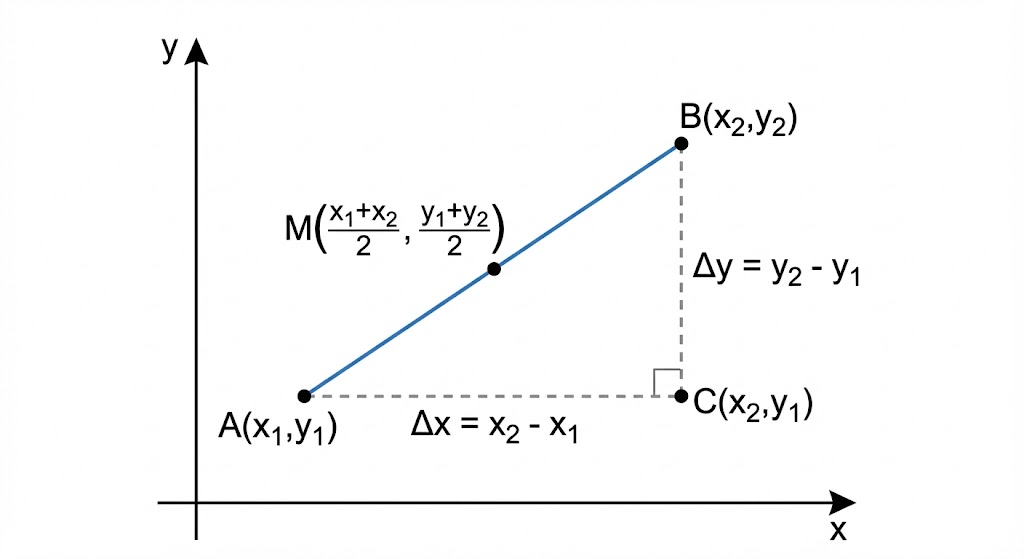
The starting point for all analytic geometry problems is the **Cartesian Coordinate System**. There is a one-to-one correspondence between a point $P$ on the plane and an ordered pair of real numbers $(x, y)$.
Key Formulas for Exam Prep:
* **Distance Formula**: For $A(x_1, y_1)$ and $B(x_2, y_2)$,
$$|AB| = \sqrt{(x_2 - x_1)^2 + (y_2 - y_1)^2}$$
* **Midpoint Formula**: The coordinates of the midpoint $M$ of segment $AB$ are
$$M\left(\frac{x_1 + x_2}{2}, \frac{y_1 + y_2}{2}\right)$$
2. The Straight Line
The line is the most fundamental figure. The CSCA exam frequently tests equation forms and positional relationships.
* **Slope ($k$)**: Describes the steepness of the line, $k = \frac{y_2 - y_1}{x_2 - x_1}$.
* **Equation Forms**:
* Point-Slope Form: $y - y_0 = k(x - x_0)$
* General Form: $Ax + By + C = 0$
* **Positional Relationships**:
* Parallel: $k_1 = k_2$
* Perpendicular: $k_1 \cdot k_2 = -1$
3. Conic Sections
This is the challenging part of the module. They are called "Conic Sections" because they can all be visualized as the intersection of a plane and a **Double-napped Cone**.
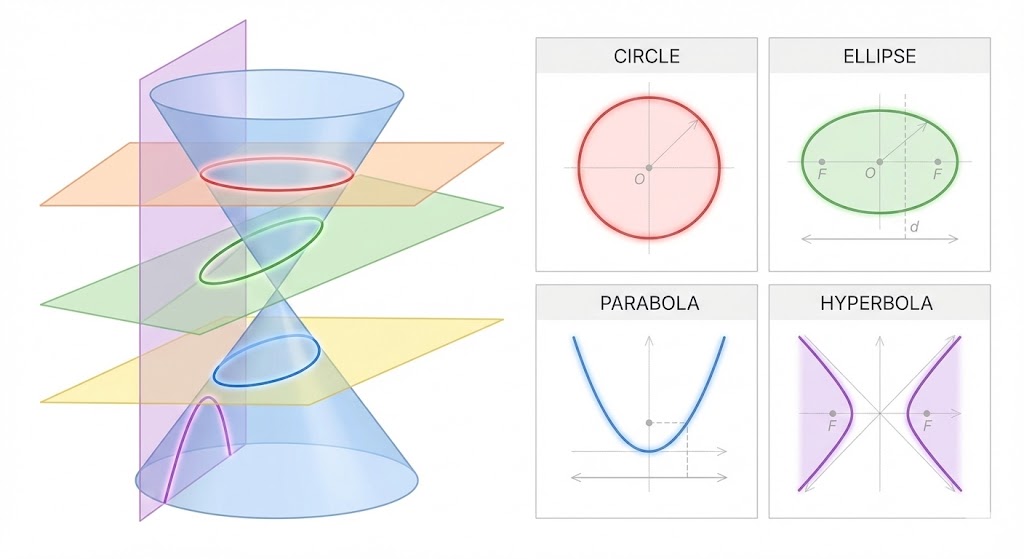
Depending on the angle of the intersecting plane, we derive four basic curves:
1. **Circle**: The plane is perpendicular to the cone's axis.
2. **Ellipse**: The plane is tilted and intersects all generators.
3. **Parabola**: The plane is parallel to one generator.
4. **Hyperbola**: The plane is parallel to the axis (cutting both nappes of the cone).
Algebraically, they all satisfy the **General Quadratic Equation**:
$$Ax^2 + Bxy + Cy^2 + Dx + Ey + F = 0$$
Exam Strategy
When solving such problems, you must not only memorize standard equations (e.g., $\frac{x^2}{a^2} + \frac{y^2}{b^2} = 1$) but also learn to switch quickly between "geometric features" (e.g., foci, directrix) and "algebraic parameters" (e.g., $a, b, c$).