Parity of Functions (Even/Odd)
CSCA Parity of Functions (Even/Odd) study guide organized around the publicly available CSCA syllabus. Practice Mathematics questions on aicsca.com.
Before planning this topic, check the CSCA Exam Guide 2026 for exam dates, registration, fees, and subject requirements.
Syllabus Alignment
This study guide is organized around the publicly available CSCA syllabus for international undergraduate applicants.
Who It Is For
International students preparing for CSCA Math, Physics, Chemistry, or Chinese exams.
Related Practice
CSCA Practice · Go to questions
Past papers and worked video solutions · Timed mock exams · All subject video lessons
Practice by Topic
Jump from this tutorial to filtered practice questions for the same knowledge point.
Related formulas, concepts, and glossary terms
Mathematics Formula & Concept Reference
- Sum of Odd and Even Functions
- Product of Two Even Functions
- Definition of an Odd Function
- Product of Two Odd Functions
- Necessary Condition for Parity
- Operation Properties of Odd and Even Functions: Addition
- Operation Properties of Odd and Even Functions: Multiplication
- Product of Odd and Even Functions
Mathematics Exam Glossary
Tutorial Content
Parity of Functions (Even/Odd)
1. Concept
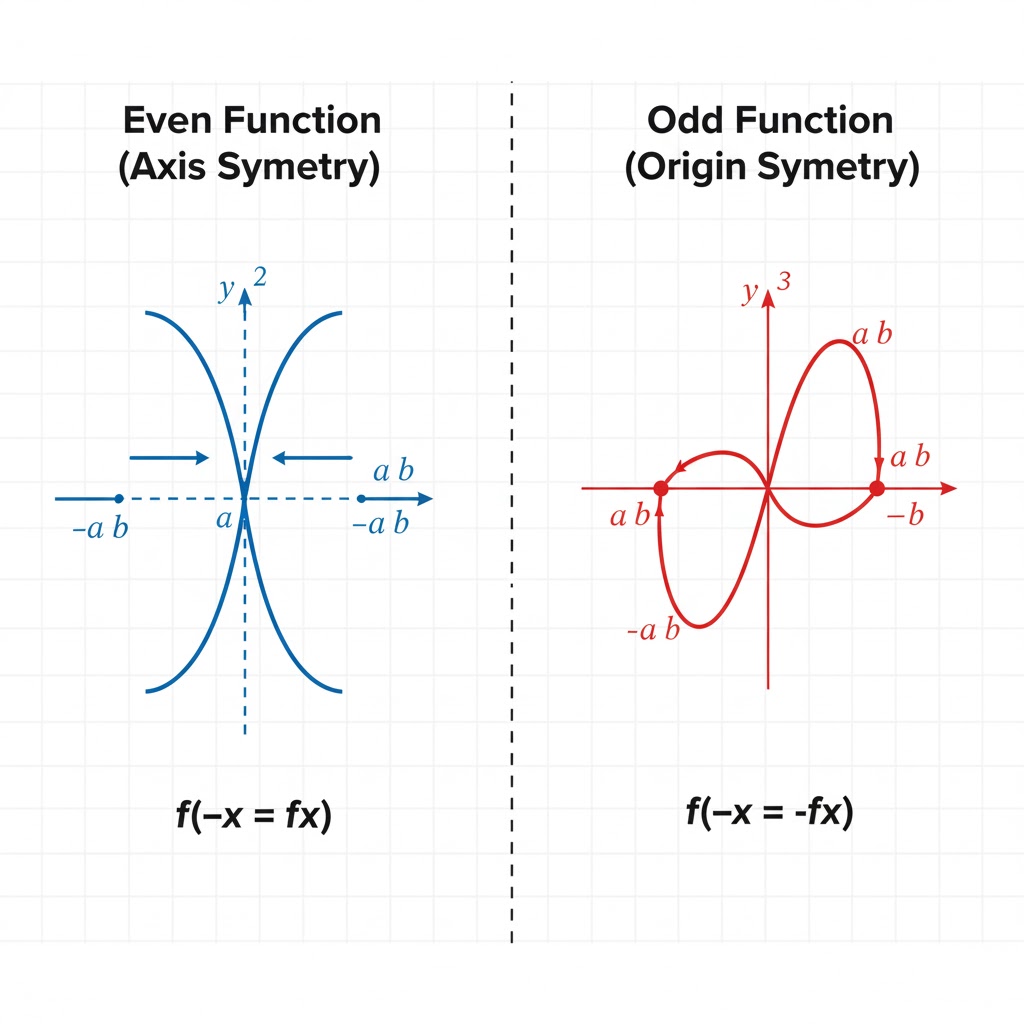
**Parity** describes the symmetry of a function's graph. It is a global property.
**Core Prerequisite**: The domain $D$ MUST be **symmetric about the origin**. If $x \in D$, then $-x \in D$.
Given the domain is symmetric:
* **Even Function**:
* **Definition**: For all $x \in D$, $f(-x) = f(x)$.
* **Graph**: Symmetric about the **y-axis** (like folding paper along the y-axis).
* **Examples**: $y = x^2, y = \cos x, y = |x|$.
* **Odd Function**:
* **Definition**: For all $x \in D$, $f(-x) = -f(x)$.
* **Graph**: Symmetric about the **origin $(0,0)$** (rotational symmetry of $180^\circ$).
* **Examples**: $y = x^3, y = \sin x, y = 1/x$.
 ---
---
2. Methods of Determination
#### (1) Definition Method (Standard)
1. **Check Domain**: Is it symmetric about the origin? If NO $\rightarrow$ **Neither even nor odd**.
2. **Compute $f(-x)$**: Substitute $-x$ and simplify.
3. **Compare**:
* $f(-x) = f(x) \rightarrow$ **Even**
* $f(-x) = -f(x) \rightarrow$ **Odd**
* Neither $\rightarrow$ **Neither**
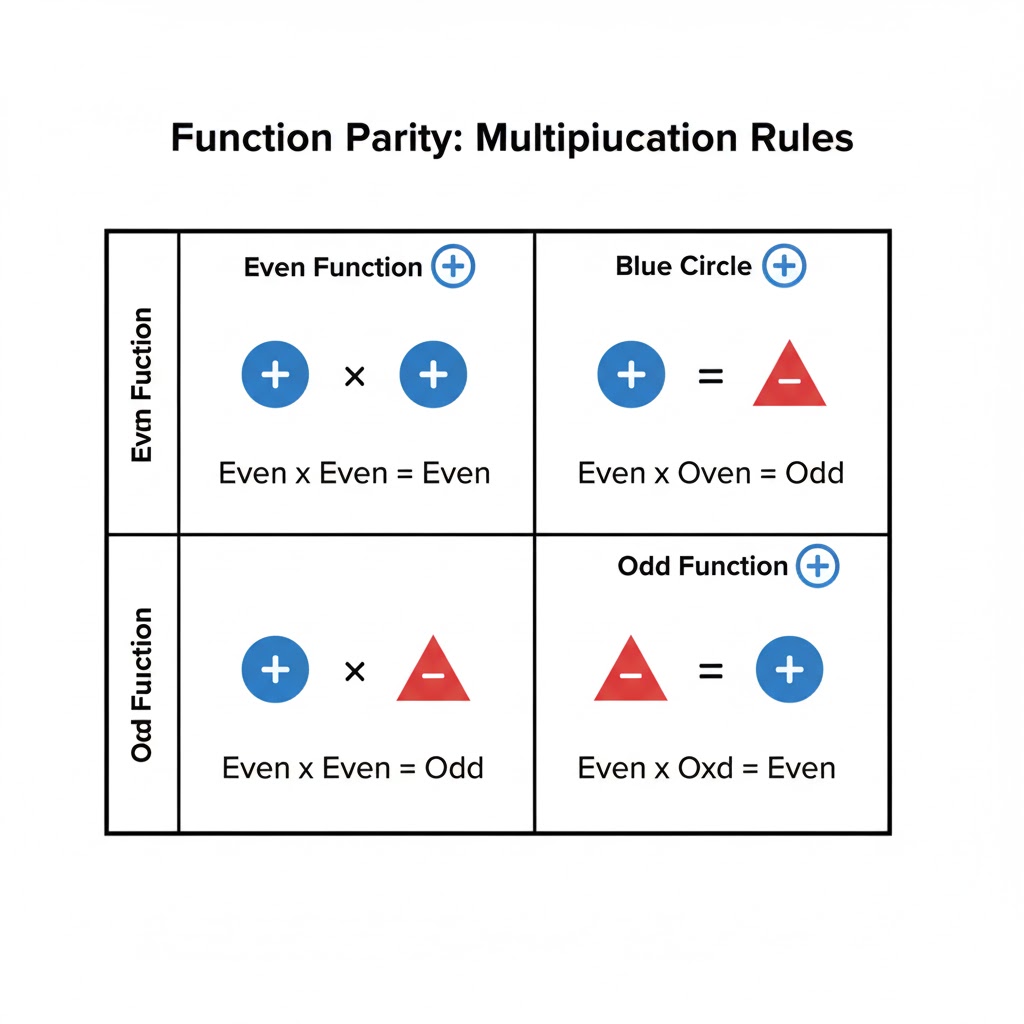
#### (2) Operational Properties (Quick Check)
* **Odd $\pm$ Odd = Odd**
* **Even $\pm$ Even = Even**
* **Odd $\times$ Odd = Even**
* **Even $\times$ Even = Even**
* **Odd $\times$ Even = Odd**
* **Composition**: If inner is even, composite is even. Inner odd + Outer even = Even. Inner odd + Outer odd = Odd.
 ---
---
3. Typical Examples
**Example 1: Definition Method**
Determine the parity of $f(x) = x^2 + \cos x$.
**Solution**:
1. **Domain**: $\mathbb{R}$, symmetric.
2. **Compute**: $f(-x) = (-x)^2 + \cos(-x)$.
Since $(-x)^2 = x^2$ and $\cos(-x) = \cos x$.
$f(-x) = x^2 + \cos x = f(x)$.
**Result**: **Even Function**.
**Example 2: The Domain Trap**
Determine the parity of $f(x) = \sqrt{x}$.
**Solution**:
1. **Domain**: $x \ge 0$, i.e., $[0, +\infty)$.
2. **Check**: Domain is NOT symmetric (e.g., $1$ is in, $-1$ is not).
**Result**: **Neither even nor odd**.
**Example 3: Applying Properties**
$f(x)$ is an odd function on $\mathbb{R}$. For $x>0$, $f(x)=x^2-2x$. Find $f(-1)$.
**Solution**:
Property of odd function: $f(-1) = -f(1)$.
Calculate $f(1) = 1^2 - 2(1) = -1$.
So $f(-1) = -(-1) = 1$.
---
4. Common Pitfalls
* **Ignoring Domain**: This is a common mistake. For $f(x) = x^2 + \sqrt{x-1}$, calculating $f(-x)$ is wrong because the domain $x \ge 1$ is not symmetric.
* **The Zero Property**: If an odd function is defined at $x=0$, then $f(0)$ MUST be $0$. This is often a key to solving problems.
* **Both Even and Odd**: The function $f(x) = 0$ (with a symmetric domain) is the only function that is both even and odd.