Range of a Function
CSCA Range of a Function study guide organized around the publicly available CSCA syllabus. Practice Mathematics questions on aicsca.com.
Before planning this topic, check the CSCA Exam Guide 2026 for exam dates, registration, fees, and subject requirements.
Syllabus Alignment
This study guide is organized around the publicly available CSCA syllabus for international undergraduate applicants.
Who It Is For
International students preparing for CSCA Math, Physics, Chemistry, or Chinese exams.
Related Practice
CSCA Practice · Go to questions
Past papers and worked video solutions · Timed mock exams · All subject video lessons
Practice by Topic
Jump from this tutorial to filtered practice questions for the same knowledge point.
Related formulas, concepts, and glossary terms
Mathematics Formula & Concept Reference
- Range of the Radical Function √(ax + b)
- Range of an Inverse Proportional Function
- Range of a Quadratic Function (Vertex Formula)
- Range of a Linear Function
- Definition of Range of a Function
Mathematics Exam Glossary
Tutorial Content
Range of a Function
1. Concept
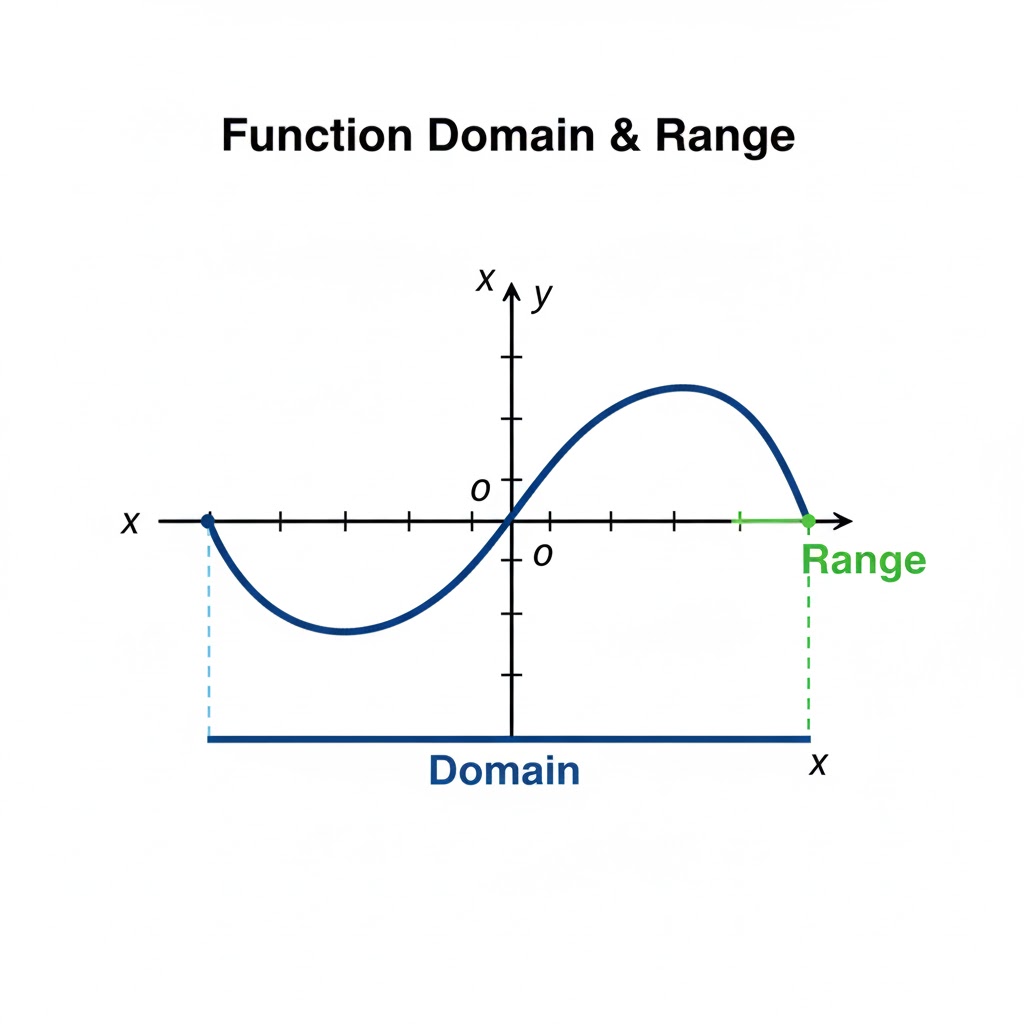
The **range** of a function $y=f(x)$ is the set of all possible output values $y$ corresponding to the input values $x$ in the domain $D$. It is denoted as $R_f = \{ f(x) | x \in D \}$.
**Intuitive Understanding**:
If you project the graph of a function horizontally onto the y-axis, the interval covered on the y-axis represents the range.
 ---
---
2. Four Common Methods for Finding Range
There is no single formula for finding the range; the method depends on the function's form.
#### (1) Completing the Square (For Quadratics)
**Target**: Quadratic functions or composite functions involving quadratics.
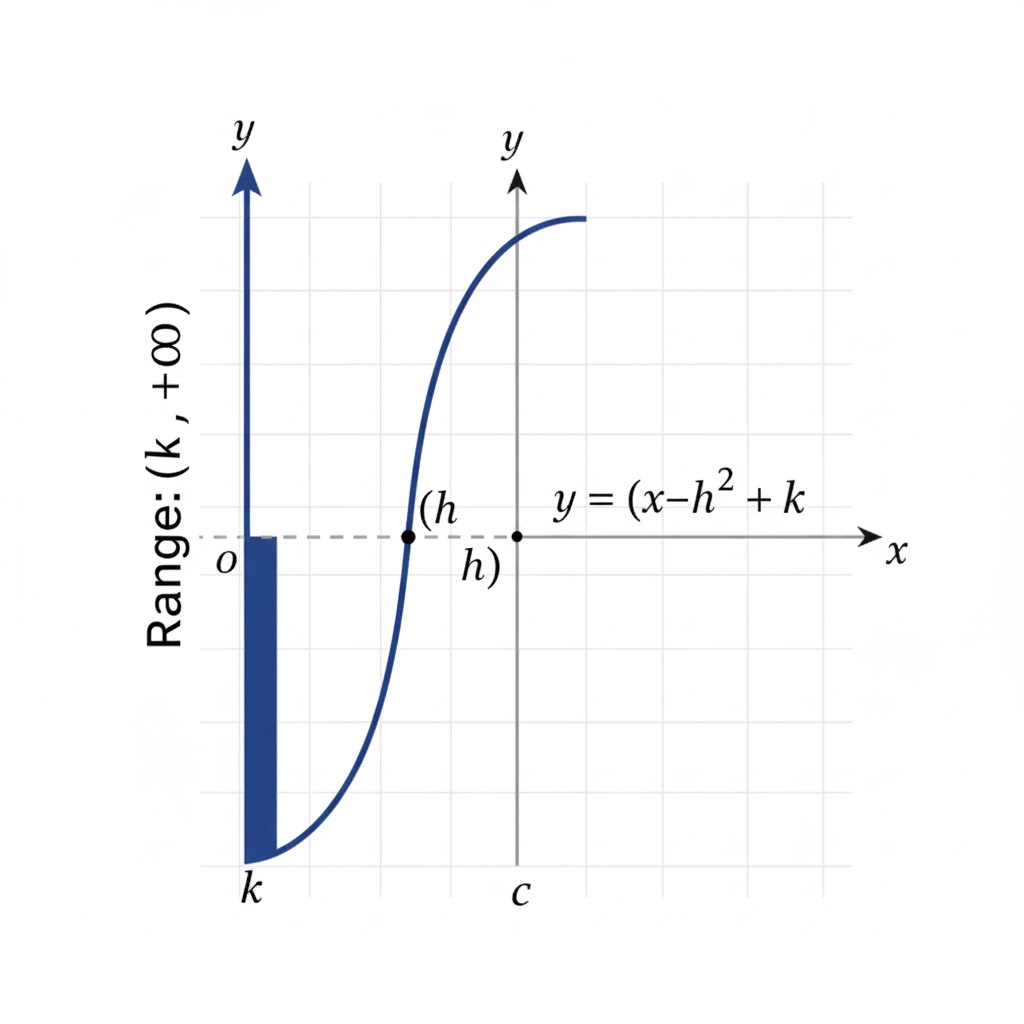
**Method**: Convert $ax^2+bx+c$ into the vertex form $a(x-h)^2+k$. Determine the range based on the sign of $a$ (opening direction) and the vertex.
 #### (2) Separation of Constants / Inverse Method
**Target**: Linear fractional functions $y = \frac{ax+b}{cx+d}$.
**Method**:
* **Separation**: Rewrite the numerator to match the denominator, e.g., $y = \frac{2x+3}{x-1} = 2 + \frac{5}{x-1}$. Since $\frac{5}{x-1} \neq 0$, $y \neq 2$.
* **Inverse Method**: Solve for $x$ in terms of $y$. The restriction on $y$ (usually denominator $\neq 0$) gives the range.
#### (3) Discriminant Method
**Target**: Rational functions with quadratic terms, like $y = \frac{x}{x^2+1}$.
**Principle**: Rearrange the function into a quadratic equation regarding $x$: $A(y)x^2 + B(y)x + C(y) = 0$. Since $x$ must be real, the discriminant $\Delta \ge 0$. Solve the resulting inequality for $y$.
#### (4) Monotonicity
**Target**: Functions that are strictly increasing or decreasing on a given interval.
**Method**: Evaluate the function at the endpoints of the interval. If $f(x)$ increases on $[a, b]$, the range is $[f(a), f(b)]$.
---
3. Classic Examples
**Example 1: Completing the Square**
Find the range of $f(x)=x^2-4x+5$ on $\mathbb{R}$.
**Solution**:
$f(x) = (x-2)^2 + 1$.
Since $(x-2)^2 \ge 0$, $f(x) \ge 1$.
**Range**: $[1, +\infty)$.
**Example 2: Discriminant Method**
Find the range of $y = \frac{x}{x^2+1}$.
**Solution**:
Rearrange to $yx^2 - x + y = 0$.
1. If $y=0$, then $x=0$ (Valid).
2. If $y \neq 0$, treat as quadratic in $x$. Since $x \in \mathbb{R}$, $\Delta \ge 0$.
$\Delta = 1 - 4y^2 \ge 0 \Rightarrow y^2 \le \frac{1}{4} \Rightarrow -\frac{1}{2} \le y \le \frac{1}{2}$.
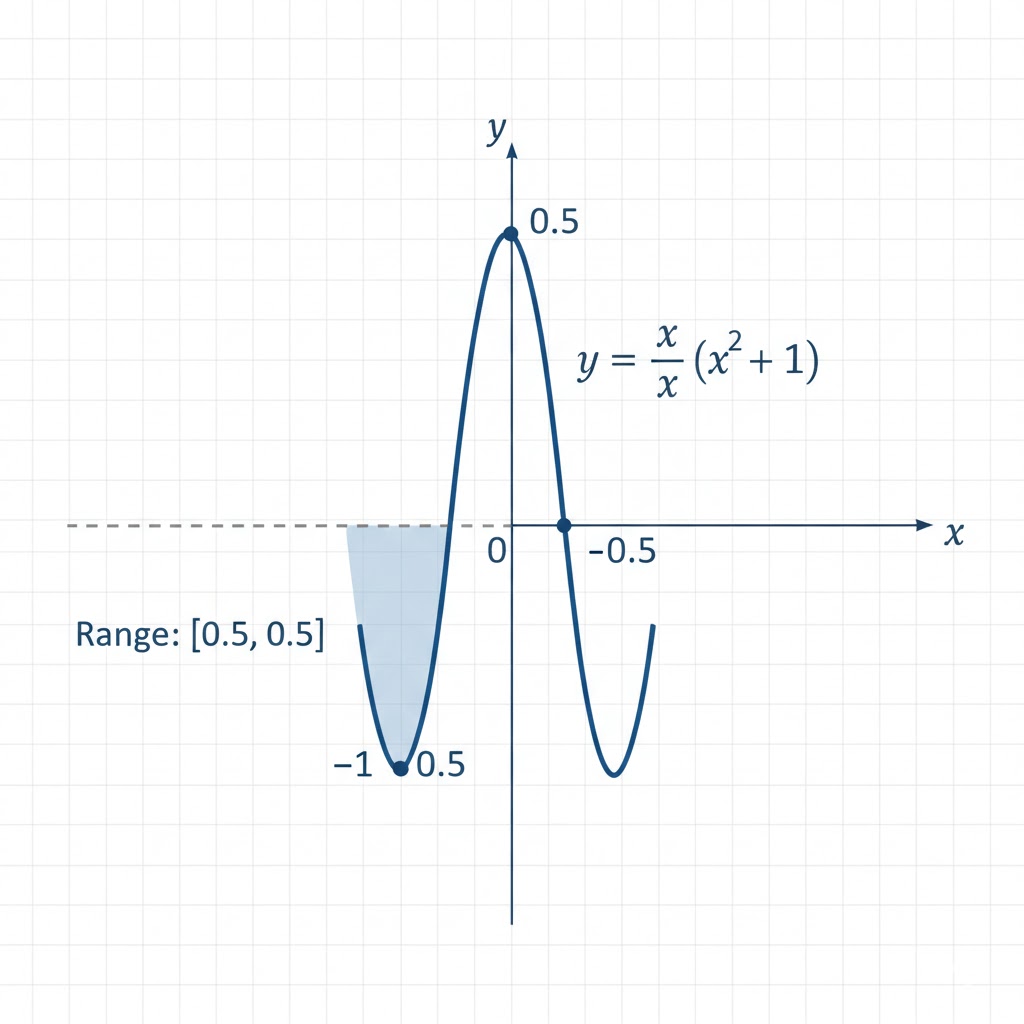 **Range**: $[-\frac{1}{2}, \frac{1}{2}]$.
**Example 3: Monotonicity**
Find the range of $f(x)=\sqrt{x-1} + 2$ on $[1, 5]$.
**Solution**:
The function is increasing on $[1, 5]$.
Min $f(1) = 2$, Max $f(5) = 4$.
**Range**: $[2, 4]$.
---
4. Common Pitfalls
* **Ignoring the Domain**: E.g., for $y=x^2-4x+5$ on $x \in [0, 1]$, the minimum is NOT at the vertex ($x=2$) because 2 is outside the domain. You must check the endpoints.
* **Discriminant Method Oversight**: Always check the case where the leading coefficient is 0 (i.e., when $y=0$ in the quadratic equation step).