Properties of Simple Solid Figures
CSCA Properties of Simple Solid Figures study guide organized around the publicly available CSCA syllabus. Practice Mathematics questions on aicsca.com.
Before planning this topic, check the CSCA Exam Guide 2026 for exam dates, registration, fees, and subject requirements.
Syllabus Alignment
This study guide is organized around the publicly available CSCA syllabus for international undergraduate applicants.
Who It Is For
International students preparing for CSCA Math, Physics, Chemistry, or Chinese exams.
Related Practice
CSCA Practice · Go to questions
Past papers and worked video solutions · Timed mock exams · All subject video lessons
Practice by Topic
Jump from this tutorial to filtered practice questions for the same knowledge point.
Related formulas, concepts, and glossary terms
Mathematics Formula & Concept Reference
- Volume Formula of a Cone
- Surface Area Formula of a Sphere
- Volume Formula of a Sphere
- Surface Area Formula of a Cube
- Volume Formula of a Rectangular Prism
- Volume Formula of a Cylinder
Mathematics Exam Glossary
Tutorial Content
Properties of Simple Solid Figures
In the CSCA exam, the focus of spatial geometry is on the **Equation of a Sphere** and the calculation of **Volume and Surface Area** for common solids (Cuboids, Cylinders, Cones).
1. Sphere
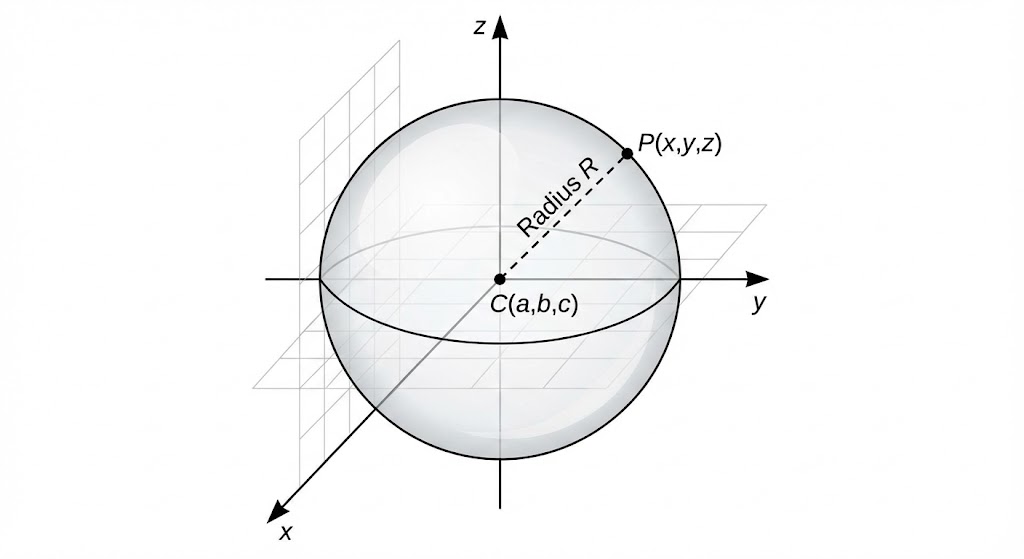
The sphere is the most frequently tested solid in analytic geometry. Definition: The set of points in space at a fixed distance (Radius) from a fixed point (Center).
#### 1.1 Equation of a Sphere
* **Standard Equation**:
Center $C(a, b, c)$, Radius $R$ ($R>0$):
$$(x-a)^2 + (y-b)^2 + (z-c)^2 = R^2$$
*Special Case*: Center at Origin $O(0,0,0)$, then $x^2 + y^2 + z^2 = R^2$.
* **General Equation**:
$$x^2 + y^2 + z^2 + Dx + Ey + Fz + G = 0$$
* **Condition**: $D^2 + E^2 + F^2 - 4G > 0$.
* **Center**: $(-\frac{D}{2}, -\frac{E}{2}, -\frac{F}{2})$.
* **Radius**: $R = \frac{1}{2}\sqrt{D^2 + E^2 + F^2 - 4G}$.
#### 1.2 Geometric Properties
* **Volume**: $V = \frac{4}{3}\pi R^3$
* **Surface Area**: $S = 4\pi R^2$
2. Cuboid & Cube
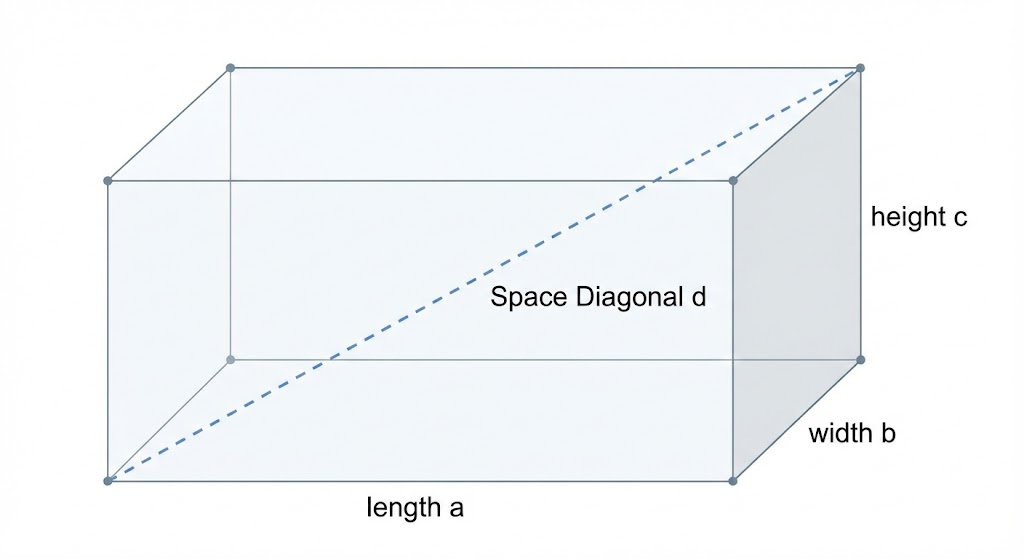
Let the length, width, and height be $a, b, c$ (or $l, w, h$).
* **Space Diagonal**: The segment connecting opposite vertices.
$$d = \sqrt{a^2 + b^2 + c^2}$$
* **Total Surface Area**: $S = 2(ab + bc + ca)$
* **Volume**: $V = abc$
* **Cube**: When $a=b=c$, Diagonal $d = \sqrt{3}a$, Surface Area $S=6a^2$, Volume $V=a^3$.
3. Cylinder & Cone
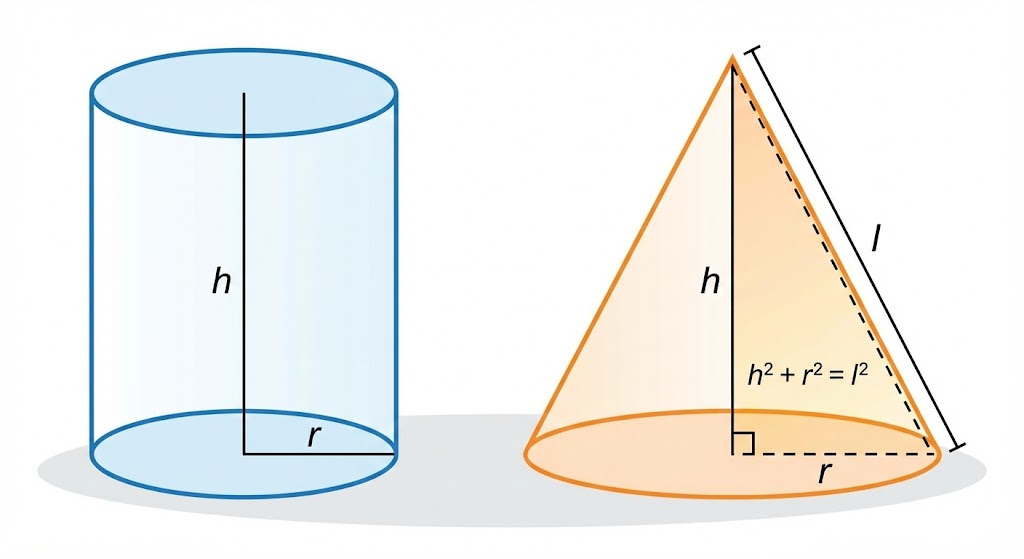
These are often formed by rotation (Solids of Revolution). The exam focuses on their lateral surface nets (unrolled shapes) and formulas.
#### 3.1 Right Circular Cylinder
Base radius $r$, Height $h$.
* **Lateral Area**: $S_{\text{lat}} = 2\pi rh$ (Unrolls to a rectangle)
* **Total Area**: $S_{\text{total}} = 2\pi rh + 2\pi r^2$
* **Volume**: $V = \pi r^2 h$ (Base Area $\times$ Height)
#### 3.2 Right Circular Cone
Base radius $r$, Height $h$, **Slant Height** $l$.
* **Basic Relation**: $l^2 = h^2 + r^2$ (Pythagorean Theorem)
* **Lateral Area**: $S_{\text{lat}} = \pi rl$ (Unrolls to a sector)
* **Total Area**: $S_{\text{total}} = \pi rl + \pi r^2$
* **Volume**: $V = \frac{1}{3}\pi r^2 h$ ($\frac{1}{3} \times$ Base Area $\times$ Height)
4. Typical Examples
**Example 1**: Find the equation of the sphere passing through $P(4, 0, -1)$ with center $C(1, -2, 3)$.
**Solution**:
Radius $R = |CP| = \sqrt{(4-1)^2 + (0-(-2))^2 + (-1-3)^2} = \sqrt{9 + 4 + 16} = \sqrt{29}$.
Equation: $(x-1)^2 + (y+2)^2 + (z-3)^2 = 29$.
**Example 2**: A cone has a base diameter of 6 and height 4. Find its lateral area and volume.
**Solution**:
Radius $r = 3$, Height $h = 4$.
Slant height $l = \sqrt{3^2 + 4^2} = 5$.
Lateral Area $S_{\text{lat}} = \pi rl = 15\pi$.
Volume $V = \frac{1}{3}\pi r^2 h = 12\pi$.
**Example 3**: The sum of all edges of a cuboid is 48, and its space diagonal is $5\sqrt{2}$. Find its total surface area.
**Solution**:
Let dimensions be $a, b, c$. $4(a+b+c) = 48 \Rightarrow a+b+c = 12$.
$d = \sqrt{a^2+b^2+c^2} = 5\sqrt{2} \Rightarrow a^2+b^2+c^2 = 50$.
Using $(a+b+c)^2 = (a^2+b^2+c^2) + S_{\text{total}}$:
$144 = 50 + S_{\text{total}} \Rightarrow S_{\text{total}} = 94$.
5. Study Tips
* **Formulas**: Cone has $\frac{1}{3}$, Cylinder does not. Sphere Volume is $\frac{4}{3}$, Area factor is 4.
* **Geometry**: The right triangle formed by $h, r, l$ in a cone is crucial.
* **Completing the Square**: Always convert general sphere equations to standard form to find the center and radius.