Definition of a Set
CSCA Definition of a Set study guide organized around the publicly available CSCA syllabus. Practice Mathematics questions on aicsca.com.
Before planning this topic, check the CSCA Exam Guide 2026 for exam dates, registration, fees, and subject requirements.
Syllabus Alignment
This study guide is organized around the publicly available CSCA syllabus for international undergraduate applicants.
Who It Is For
International students preparing for CSCA Math, Physics, Chemistry, or Chinese exams.
Related Practice
CSCA Practice · Go to questions
Past papers and worked video solutions · Timed mock exams · All subject video lessons
Practice by Topic
Jump from this tutorial to filtered practice questions for the same knowledge point.
Related formulas, concepts, and glossary terms
Mathematics Formula & Concept Reference
- Set Representation: Set-Builder Notation
- Definition of a Set
- Set Representation: Set-Builder Notation
- Set Representation: Roster Method
- Set Representation: Roster Method
Mathematics Exam Glossary
Tutorial Content
Definition of a Set
1. Core Concepts
In mathematics, a **Set** is a collection of **well-defined, distinct** objects. Each object in a set is called an **Element**.
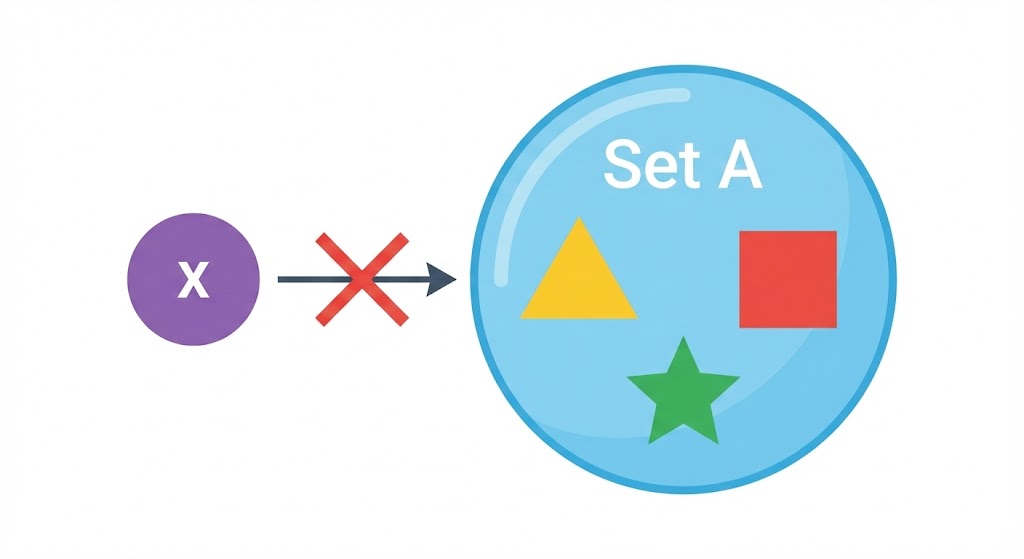
**Three Key Properties (Exam Focus)**:
1. **Well-definedness**:
* For any object, logic must clearly determine whether it belongs to the set. Ambiguity is not allowed.
* *Example*: "Tall people" implies ambiguity; "People taller than 180cm" is a set.
2. **Distinctness (Mutual Exclusivity) —— 🚩 Common Pitfall**:
* Every element in a set must be unique. **If a calculation results in duplicate elements, that solution must be rejected.**
* *Example*: $\{1, 2, 2\}$ is incorrect notation; it should be written as $\{1, 2\}$.
3. **Unorderedness**:
* The order of elements does not matter.
* *Example*: $\{1, 2, 3\}$ is the same set as $\{3, 1, 2\}$.
2. Notation & Number Sets
* **Relationship between Element and Set**:
* $a \in A$: $a$ belongs to set $A$ (is an element of).
* $a \notin A$: $a$ does not belong to set $A$.
* **Standard Number Set Symbols (Must Memorize)**:
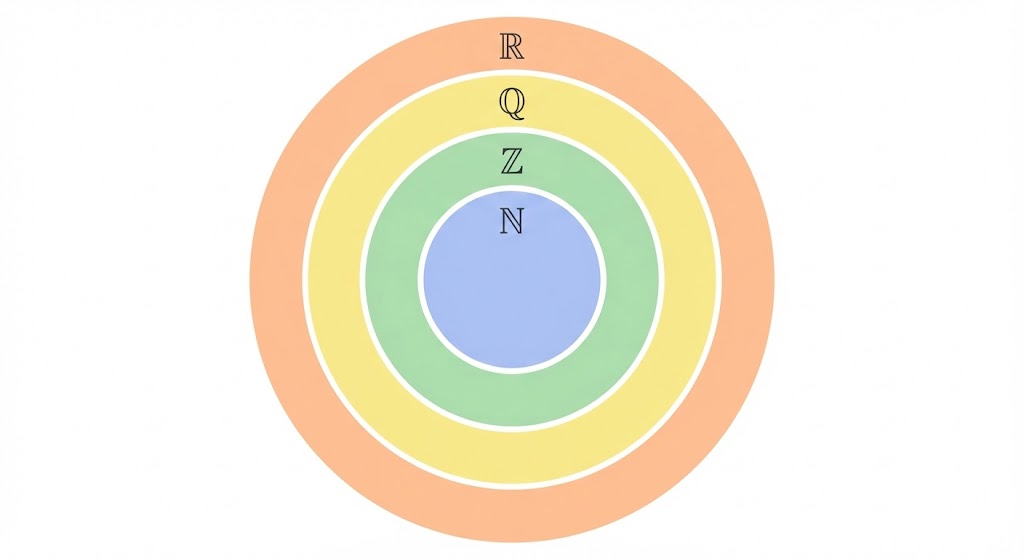
* **$\mathbb{N}$**: Natural Numbers, includes $0, 1, 2, ...$
* **$\mathbb{Z}$**: Integers, includes $..., -1, 0, 1, ...$
* **$\mathbb{Q}$**: Rational Numbers (fractions, terminating/repeating decimals).
* **$\mathbb{R}$**: Real Numbers.
* *Note*: Sometimes $\mathbb{N}^*$ or $\mathbb{N}_+$ represents **Positive Integers** (excluding 0).
3. Worked Examples
**Example 1: Determining Sets**
(1) Numbers very close to 0.
(2) The solution to $x^2 - 2x + 1 = 0$.
**Solution**:
(1) **No**. "Very close" is not well-defined.
(2) **Yes**. The solution is $x=1$. The set is $\{1\}$.
**Example 2: Testing Distinctness (Important)**
Given set $A = \{a, a^2, 2\}$ and $1 \in A$, find the value of real number $a$.
**Solution**:
Since $1 \in A$, $1$ must be equal to either $a$ or $a^2$ (obviously $1 \neq 2$).
**Case 1**: If $a = 1$.
Substitute into $A$: $A = \{1, 1^2, 2\} = \{1, 1, 2\}$. This creates duplicate elements, which **violates the property of Distinctness**. Therefore, **$a \neq 1$**.
>
**Case 2**: If $a^2 = 1$.
Solving gives $a = 1$ or $a = -1$.
From Case 1, we know $a \neq 1$.
Check $a = -1$: Substitute into $A$: $A = \{-1, (-1)^2, 2\} = \{-1, 1, 2\}$. All elements are distinct. This is valid.
>
**Final Answer**: $a = -1$.