Acids
CSCA Acids study guide organized around the publicly available CSCA syllabus. Practice Chemistry questions on aicsca.com.
Before planning this topic, check the CSCA Exam Guide 2026 for exam dates, registration, fees, and subject requirements.
Syllabus Alignment
This study guide is organized around the publicly available CSCA syllabus for international undergraduate applicants.
Who It Is For
International students preparing for CSCA Math, Physics, Chemistry, or Chinese exams.
Related Practice
CSCA Practice · Go to questions
Past papers and worked video solutions · Timed mock exams · All subject video lessons
Practice by Topic
Jump from this tutorial to filtered practice questions for the same knowledge point.
Related formulas, concepts, and glossary terms
Chemistry Formula & Concept Reference
- General Formula for Acid-Base Neutralization Reaction
- Ionization Equilibrium Constant (Ka) of Weak Acids
- Complete Ionization of Strong Acids in Water
- Approximate Calculation of Hydrogen Ion Concentration in a Monoprotic Weak Acid Solution
- Definition Formula of pH Value
- Definition of pH
Chemistry Exam Glossary
Tutorial Content
Acids
1. Core Definitions & Microscopic Essence
Acids are not just substances that "taste sour." In the CSCA exam, we must define them precisely from the perspective of **Ionization**:
* **Definition**: A compound that produces **only Hydrogen ions ($H^+$)** as cations when ionized in aqueous solution.
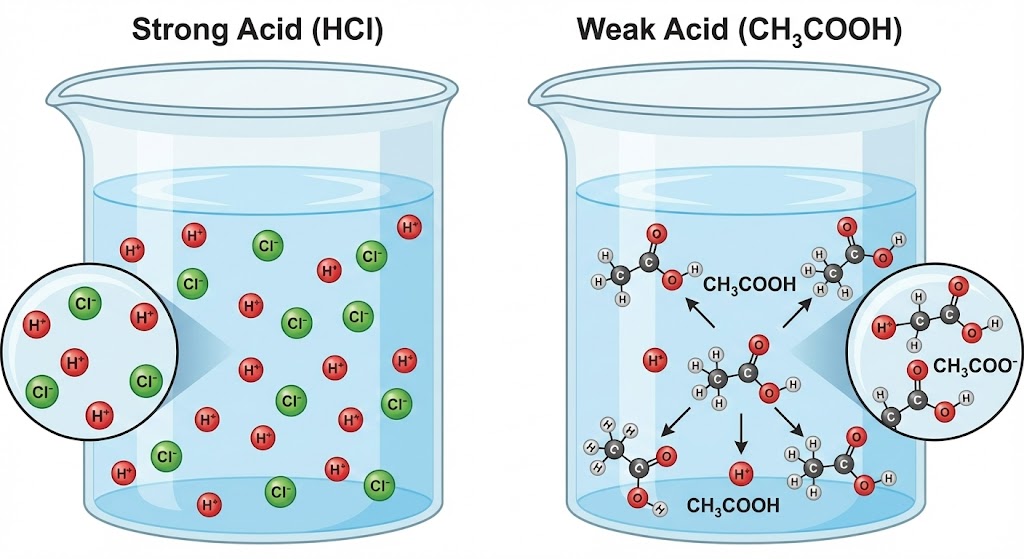
* **Core Distinction: Strong vs. Weak Acids**
This is the key criterion for writing **Ionic Equations**.
* **Strong Acid**: **Completely ionizes** in water. E.g., $HCl, H_2SO_4, HNO_3$.
* *Rule*: Split into ions (e.g., $H^+ + Cl^-$).
* **Weak Acid**: **Partially ionizes** in water; reversible equilibrium exists. E.g., $CH_3COOH$ (Acetic Acid), $H_2CO_3$.
* *Rule*: **Keep as molecule**, do NOT split (e.g., write as $CH_3COOH$).
 ---
---
2. The "Five Fingers" of Acid Properties
The chemical properties of acids are essentially the properties of $H^+$. We can memorize this using a "Star" model:
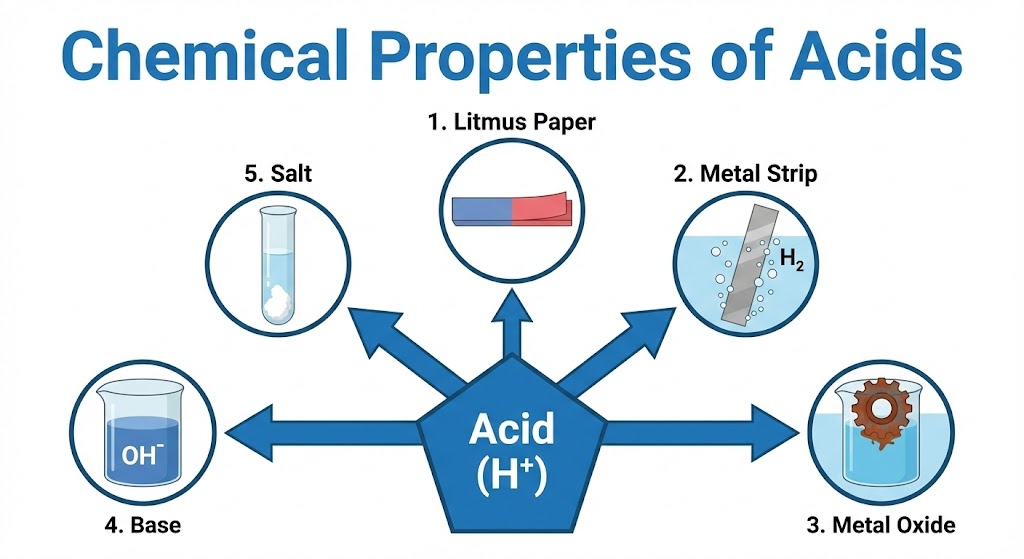 1. **Indicators**: Turns purple litmus **Red**, colorless phenolphthalein remains **Colorless**.
2. **Active Metals**:
* General: $Metal + Acid \rightarrow Salt + H_2\uparrow$
* *Condition*: Metal is before $H$; **Acid must be non-oxidizing** (e.g., dilute $HCl$, dilute $H_2SO_4$).
* *Exception*: $HNO_3$ and Concentrated $H_2SO_4$ are oxidizing acids; they **do NOT produce Hydrogen gas** with metals.
3. **Metal Oxides**:
* General: $Basic \ Oxide + Acid \rightarrow Salt + Water$
* App: Rust removal (e.g., $Fe_2O_3 + 6HCl \rightarrow 2FeCl_3 + 3H_2O$).
4. **Bases**:
* **Neutralization**: $H^+ + OH^- \rightarrow H_2O$
5. **Salts**:
* Condition: Produces gas ($CO_2$) or precipitate ($AgCl, BaSO_4$).
---
3. Exam Traps for the Three Strong Acids
| Acid | Properties | CSCA Exam Focus |
| :--- | :--- | :--- |
| **Hydrochloric** ($HCl$) | **Volatile** | **White Mist** when bottle opens. Test for $Cl^-$ using $AgNO_3$ (White precipitate). |
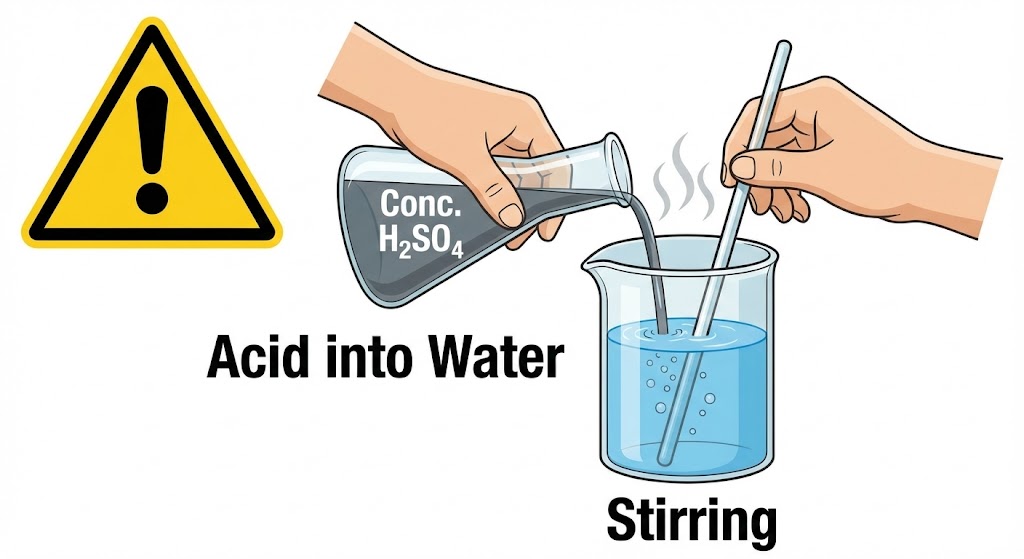
| **Sulfuric** ($H_2SO_4$) | **Hygroscopic, Dehydrating, Oxidizing** | **Dilution Safety**: Must pour **"Acid into Water"** while stirring!<br>**Test**: Use $BaCl_2$ solution (White precipitate $BaSO_4$, insoluble in acid). |
| **Nitric** ($HNO_3$) | **Strong Oxidizer, Unstable** | Decomposes in light (Store in brown bottles). Reaction with Copper:<br>Conc. $HNO_3$ $\rightarrow NO_2$ (Red-brown gas)<br>Dilute $HNO_3$ $\rightarrow NO$ (Colorless gas) |
 ### 4. Typical Examples & Common Mistakes
**Common Mistake: Writing Ionic Equations**
* **Question**: Reaction between Acetic Acid solution and Calcium Carbonate.
* **Wrong**: $2H^+ + CaCO_3 \rightarrow Ca^{2+} + H_2O + CO_2\uparrow$
* **Why**: Acetic acid is a **Weak Acid** and cannot be split into $H^+$.
* **Correct**: $2CH_3COOH + CaCO_3 \rightarrow Ca^{2+} + 2CH_3COO^- + H_2O + CO_2\uparrow$
**Thinking Question**: How to distinguish dilute HCl from dilute H2SO4?
* **Method**: Add $BaCl_2$ or $Ba(NO_3)_2$.
* **Result**: White precipitate indicates $H_2SO_4$ ($BaSO_4$); no reaction indicates $HCl$.