Bases (Alkalis)
CSCA Bases (Alkalis) study guide organized around the publicly available CSCA syllabus. Practice Chemistry questions on aicsca.com.
Before planning this topic, check the CSCA Exam Guide 2026 for exam dates, registration, fees, and subject requirements.
Syllabus Alignment
This study guide is organized around the publicly available CSCA syllabus for international undergraduate applicants.
Who It Is For
International students preparing for CSCA Math, Physics, Chemistry, or Chinese exams.
Related Practice
CSCA Practice · Go to questions
Past papers and worked video solutions · Timed mock exams · All subject video lessons
Practice by Topic
Jump from this tutorial to filtered practice questions for the same knowledge point.
Related formulas, concepts, and glossary terms
Chemistry Formula & Concept Reference
- General Equation for Neutralization Reaction between Base and Acid
- General Ionization Equation for Bases
- Complete Dissociation of Strong Bases in Water
- Definition of a Base (Arrhenius Theory)
- Ionization Equilibrium Constant for a Weak Base, Kb
- Ion Product Constant of Water, Kw
- pH Calculation Formula for Strong Base Solutions
- Relationship between pH and pOH
Chemistry Exam Glossary
Tutorial Content
Bases (Alkalis)
1. Core Definitions & Classification Logic
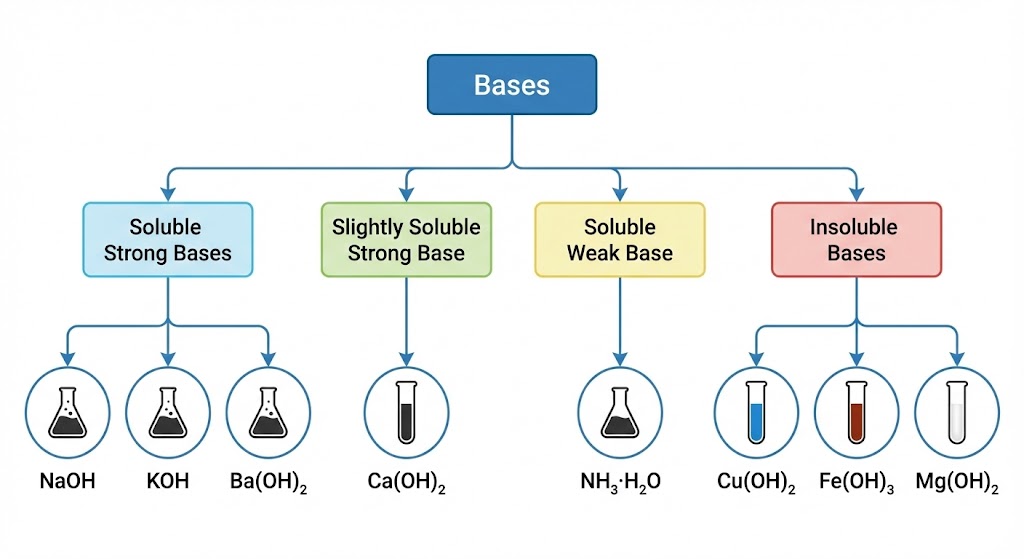
In the CSCA exam, the focus on Bases is the impact of **Solubility** on reactions and the distinction between **Strong and Weak Bases**.
* **Definition**: Compounds whose anions generated during ionization are **all** hydroxide ions ($OH^-$).
* *Counter-example*: Basic copper carbonate $Cu_2(OH)_2CO_3$ produces both $OH^-$ and $CO_3^{2-}$, so it is a **Basic Salt**, not a Base.
* **Solubility Rules** (Crucial for Metathesis Reactions):
* **Soluble Strong Bases**: $KOH, NaOH, Ba(OH)_2$ (Completely ionize).
* **Slightly Soluble Strong Base**: $Ca(OH)_2$ (Limewater).
* **Soluble Weak Base**: $NH_3\cdot H_2O$ (Ammonia water, partial ionization).
* **Insoluble Bases**: $Cu(OH)_2$ (Blue), $Fe(OH)_3$ (Red-brown), $Mg(OH)_2$ (White), $Al(OH)_3$ (White).
* **Key Deduction**: **Insoluble bases** do NOT change indicator colors and do NOT react with salt solutions.
 ---
---
2. General Properties of Bases
The properties of bases are essentially the properties of $OH^-$. Compare this with "Properties of Acids":
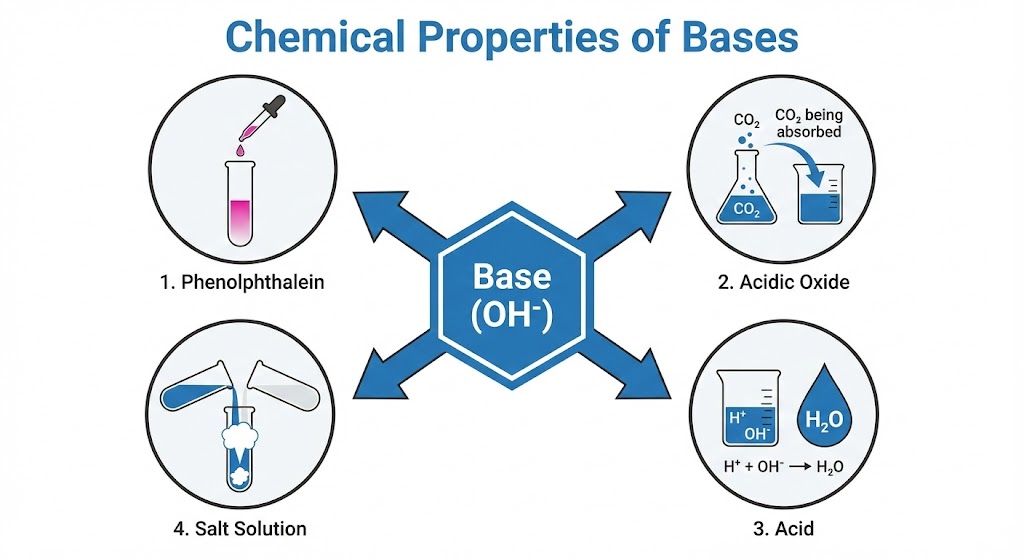 1. **Indicators**:
* Litmus $\rightarrow$ **Blue**
* Phenolphthalein $\rightarrow$ **Red**
2. **Acidic Oxides**:
* General: $Base + Acidic \ Oxide \rightarrow Salt + Water$
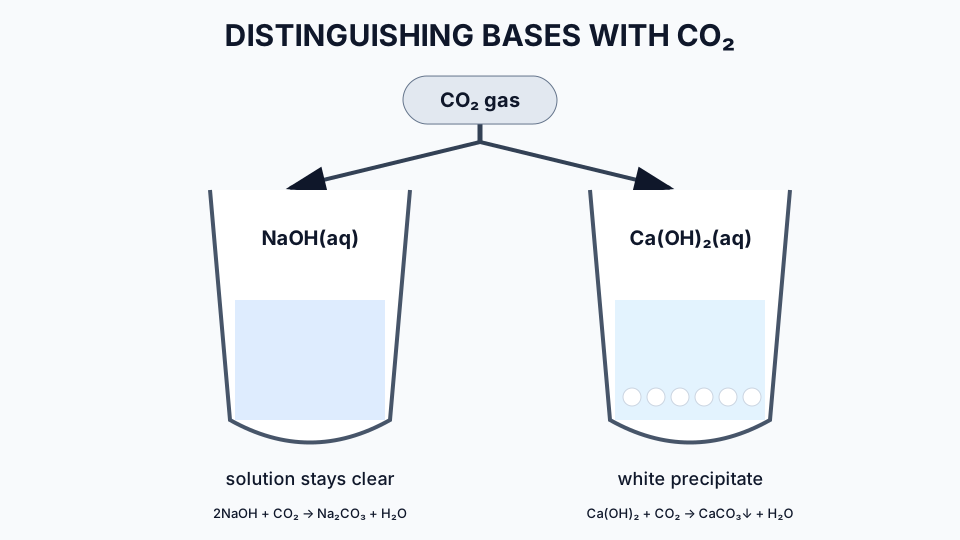
* **Remove $CO_2$**: $2NaOH + CO_2 \rightarrow Na_2CO_3 + H_2O$ (No visible change)
* **Test for $CO_2$**: $Ca(OH)_2 + CO_2 \rightarrow CaCO_3\downarrow + H_2O$ (Turns cloudy)
*  3. **Acids**:
* **Neutralization**: $OH^- + H^+ \rightarrow H_2O$ (Exothermic).
4. **Salts**:
* General: $Base(Soluble) + Salt(Soluble) \rightarrow New \ Base + New \ Salt$
* **Prep Insoluble Base**: $2NaOH + CuSO_4 \rightarrow Cu(OH)_2\downarrow + Na_2SO_4$
* **Test for Ammonium ($NH_4^+$)**: $NaOH + NH_4Cl \xrightarrow{\Delta} NaCl + NH_3\uparrow + H_2O$
---
3. Three High-Frequency Substances
#### A. Sodium Hydroxide (NaOH)
* **Common Names**: Caustic Soda, Lye.
* **Physical Properties**:
* White solid, **Deliquescent** $\rightarrow$ Must be weighed in glass containers (e.g., beakers), not on paper.
* Dissolving in water is **strongly exothermic**.
* **Storage Trap**:
* $NaOH$ reacts with $SiO_2$ in glass to form sodium silicate (adhesive), causing glass stoppers to get stuck. Therefore, **rubber stoppers must be used**.
#### B. Calcium Hydroxide ($Ca(OH)_2$)
* **Common Names**: Slaked Lime, Hydrated Lime.
* **Preparation**: $CaO + H_2O \rightarrow Ca(OH)_2$ (Exothermic, boiling egg experiment).
* **Application**: Neutralizing acidic soil, making Bordeaux mixture.
#### C. Ammonia Water ($NH_3\cdot H_2O$)
* **Weak Base**: $NH_3\cdot H_2O \rightleftharpoons NH_4^+ + OH^-$
* **Instability**: Decomposes upon heating to form Ammonia gas ($NH_3$).
* **Special Reaction**: $Al(OH)_3$ is insoluble in ammonia water (used for lab preparation of Aluminum Hydroxide) but dissolves in $NaOH$.
---
4. Typical Examples & Tips
**Question: Purification**
How to remove a small amount of $Na_2CO_3$ from $NaOH$ solution?
* **Wrong Method**: Add dilute HCl. (Reason: HCl will neutralize NaOH first).
* **Correct Method**: Add appropriate amount of **$Ca(OH)_2$ solution**, then filter.
* Equation: $Na_2CO_3 + Ca(OH)_2 \rightarrow CaCO_3\downarrow + 2NaOH$
* Advantage: Introduces no new impurities (Generates the target substance $NaOH$).
**Question: Identification**
Distinguish between $NaOH$ and $Ca(OH)_2$ solutions?
* **Method**: Bubble $CO_2$ or add $Na_2CO_3$ solution.
* **Result**: White precipitate indicates $Ca(OH)_2$; no reaction indicates $NaOH$.