Oxides
CSCA Oxides study guide organized around the publicly available CSCA syllabus. Practice Chemistry questions on aicsca.com.
Before planning this topic, check the CSCA Exam Guide 2026 for exam dates, registration, fees, and subject requirements.
Syllabus Alignment
This study guide is organized around the publicly available CSCA syllabus for international undergraduate applicants.
Who It Is For
International students preparing for CSCA Math, Physics, Chemistry, or Chinese exams.
Related Practice
CSCA Practice · Go to questions
Past papers and worked video solutions · Timed mock exams · All subject video lessons
Practice by Topic
Jump from this tutorial to filtered practice questions for the same knowledge point.
Related formulas, concepts, and glossary terms
Chemistry Formula & Concept Reference
- General Formula for Amphoteric Oxide Reaction with Strong Base
- General Formula for Reaction of Acidic Oxides with Bases
- Metallic Oxides and Non-metallic Oxides
- General Formula for Amphoteric Oxide Reaction with Strong Acid
- General Formula for Basic Oxide Reaction with Water
- General Formula for Reaction between Acidic Oxide and Basic Oxide
- General Formula for Reduction of Metal Oxides (using CO or H₂ as example)
- General Formula for Reaction of Basic Oxides with Acids
Chemistry Exam Glossary
Tutorial Content
Oxides
1. Core Classification System
Oxides are not just "Oxygen + Another Element." In chemistry, we classify them based on their **reaction behavior with acids or bases**. This is the logical starting point for solving inorganic inference problems.
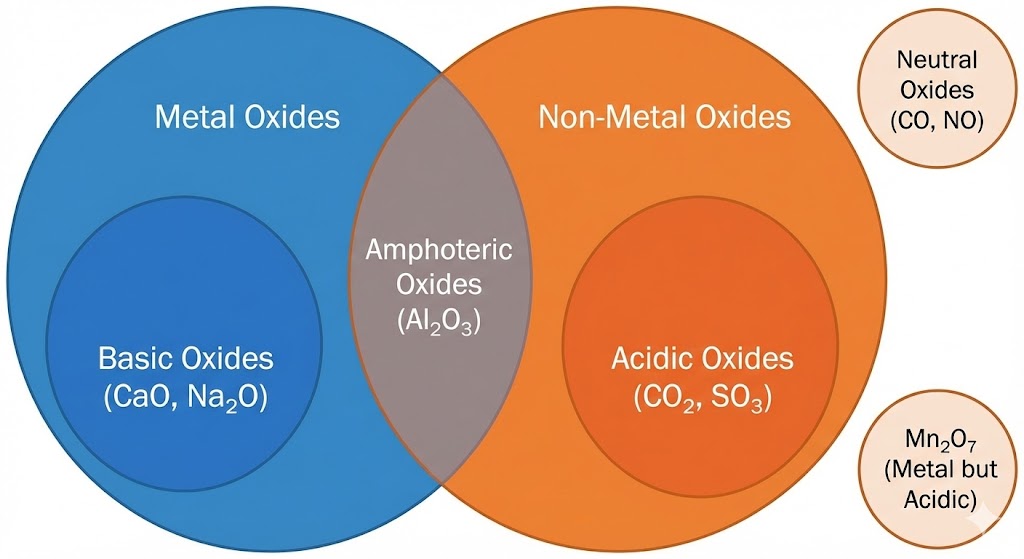
| Category | Definition | Key Property | Examples |
| :--- | :--- | :--- | :--- |
| **Acidic Oxide** | Reacts with base to form salt & water | Most react with water to form acid.<br>**Exception**: $SiO_2$ is insoluble and does not react with water. | $CO_2, SO_2, SO_3, P_2O_5, SiO_2$ |
| **Basic Oxide** | Reacts with acid to form salt & water | Only a few (Active Metals) react with water to form alkali.<br>**Note**: $CuO, Fe_2O_3$ do NOT react with water. | $Na_2O, CaO, MgO, CuO, Fe_2O_3$ |
| **Amphoteric Oxide** | Reacts with **BOTH** acid and strong base | Insoluble in water. | **$Al_2O_3$**, $ZnO$ |
| **Neutral Oxide** | Does not react with acid or base to form salt | Usually does not react with water. | $CO, NO$ |
2. Key Points & Traps
**Point 1: Concept Distinction**
This is the most confusing part of the CSCA exam. You must distinguish between "Element Category" and "Oxide Category."
* **Acidic Oxide $\neq$ Non-metal Oxide**
* Most acidic oxides are non-metal oxides, **BUT**:
* $Mn_2O_7$ is a metal oxide, yet it is an acidic oxide.
* $CO, NO$ are non-metal oxides, yet they are neutral oxides.
* $NO_2$ reacts with water to form $HNO_3$ and $NO$, but it is NOT an acidic oxide (because the reaction involves redox, and products are not just salt and water).
* **Basic Oxide $\neq$ Metal Oxide**
* Most basic oxides are metal oxides, **BUT**:
* $Al_2O_3$ is a metal oxide, yet it is an amphoteric oxide.
* $Na_2O_2$ (Sodium Peroxide) is a metal oxide, but it is a peroxide (produces $O_2$).
**Point 2: The Uniqueness of Silica ($SiO_2$)**
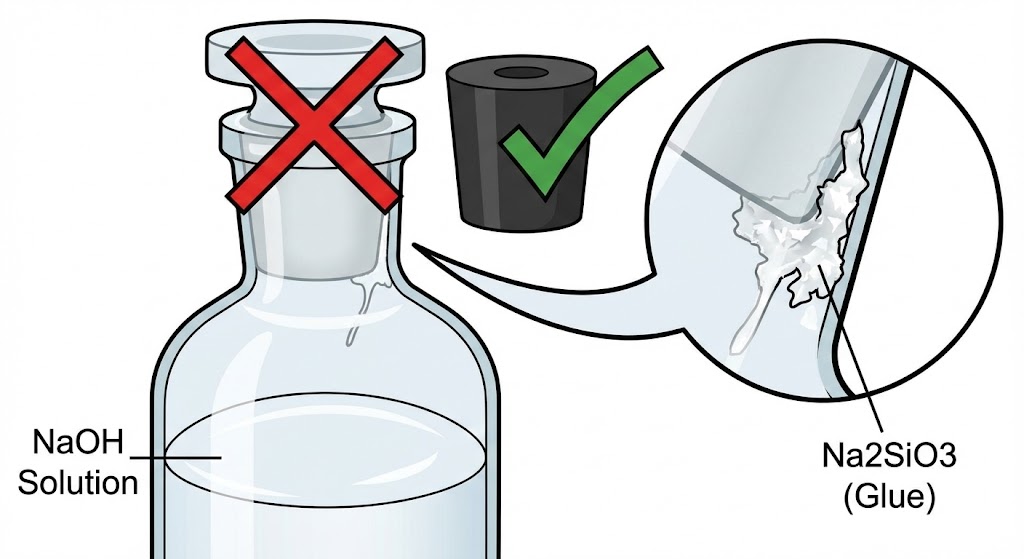
$SiO_2$ is an acidic oxide and reacts with alkali solutions:
$$SiO_2 + 2NaOH \rightarrow Na_2SiO_3 + H_2O$$
* **Lab Safety Warning**:
Reagent bottles containing alkali solutions (like $NaOH, Na_2CO_3$) **must NOT use glass stoppers**; rubber stoppers must be used. Since glass contains $SiO_2$, the reaction produces sodium silicate ($Na_2SiO_3$), a mineral glue (Water Glass), which will cement the stopper to the bottle neck.
**Point 3: Amphoteric Oxide ($Al_2O_3$)**
$Al_2O_3$ is the raw material for industrial aluminum smelting. Its "amphoteric nature" is a must-know.
* With Acid: $Al_2O_3 + 6HCl \rightarrow 2AlCl_3 + 3H_2O$
* **With Sodium Hydroxide** (Focus): $Al_2O_3 + 2NaOH \rightarrow 2NaAlO_2 + H_2O$
*(Note: The product can also be written as sodium tetrahydroxyaluminate $Na[Al(OH)_4]$, but $NaAlO_2$ is commonly used in concise tutorials)*
3. Typical Example Analysis
**Example: Purification**
How to remove a small amount of $SO_2$ from $CO_2$?
* **Wrong Method**: Pass through $NaOH$ solution. (Reason: Both $CO_2$ and $SO_2$ are acidic oxides and will be absorbed).
* **Correct Method**: Pass through **Saturated $NaHCO_3$ solution**, then dry.
* Principle: $SO_2 + 2NaHCO_3 \rightarrow Na_2SO_3 + H_2O + 2CO_2\uparrow$
* Analysis: Uses the principle that strong acids displace weak acids. $H_2SO_3$ is stronger than $H_2CO_3$.