Fundamental Chemical Concepts and Calculations
CSCA Fundamental Chemical Concepts and Calculations study guide organized around the publicly available CSCA syllabus. Practice Chemistry questions on aicsca.com.
Before planning this topic, check the CSCA Exam Guide 2026 for exam dates, registration, fees, and subject requirements.
Syllabus Alignment
This study guide is organized around the publicly available CSCA syllabus for international undergraduate applicants.
Who It Is For
International students preparing for CSCA Math, Physics, Chemistry, or Chinese exams.
Related Practice
CSCA Practice · Go to questions
Past papers and worked video solutions · Timed mock exams · All subject video lessons
Practice by Topic
Jump from this tutorial to filtered practice questions for the same knowledge point.
Related formulas, concepts, and glossary terms
Chemistry Formula & Concept Reference
- What is the definition formula for amount of substance (n)?
- What is the definition formula for molar volume of gas (Vm)?
- What is the definition formula for molar concentration (c)?
- Definition of Amount of Substance (n)
- Relationship between Amount of Substance (n) and Mass (m)
- How to calculate molar concentration (c) from mass fraction (w) and solution density (ρ)?
- Relationship between Amount of Gas (n) and Molar Volume of Gas (Vm)
- Ideal Gas Law
Chemistry Exam Glossary
Tutorial Content
Module 1: Fundamental Chemical Concepts and Calculations
Module Framework and Learning Objectives
This module serves as the cornerstone of your chemistry studies. In the CSCA exam, this section is not only tested through standalone calculation problems but also serves as the essential toolset for solving complex chemical problems (such as chemical equilibrium and reaction kinetics). We will establish a bridge between microscopic particles and macroscopic phenomena through five interconnected sub-modules.
Core Knowledge System
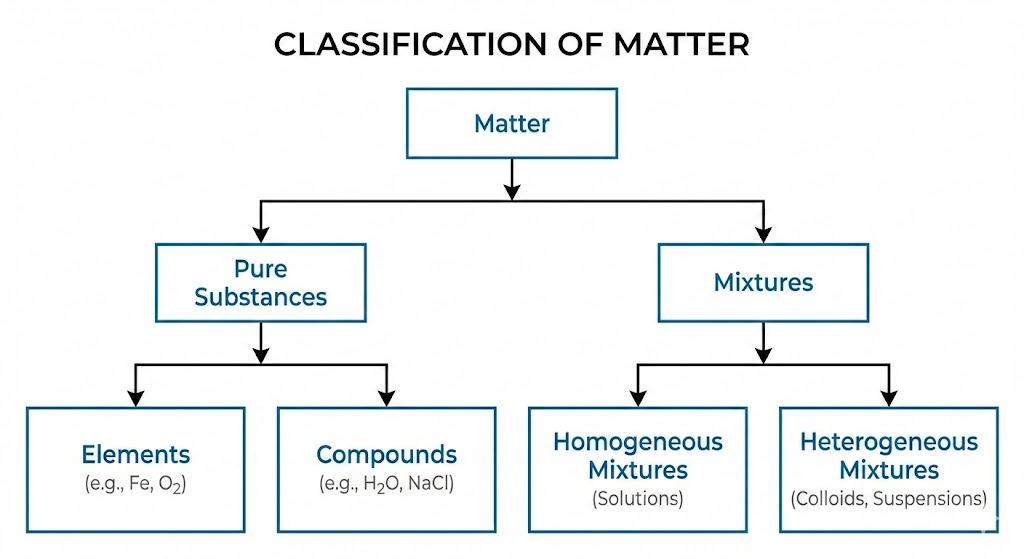
1. **Classification of Matter and State Changes**
* **Focus**: Learn to distinguish between pure substances and mixtures, elements and compounds, electrolytes and non-electrolytes. Understand the fundamental difference between physical and chemical changes.
* **Visual**: The classification logic tree of matter is your first map in chemistry.
2. **Chemical Nomenclature and Equation Writing**
* **Focus**: This is the "language" of chemistry. You must master element symbols, ion symbols, and chemical formulas, and proficiently balance chemical equations (especially redox reactions).
3. **Solution Concentration and pH Calculations**
* **Focus**: Quantitative description of solution composition. Master the calculation of Molarity ($c = n/V$), error analysis in solution preparation, and the definition of pH ($pH = -\log[H^+]$).
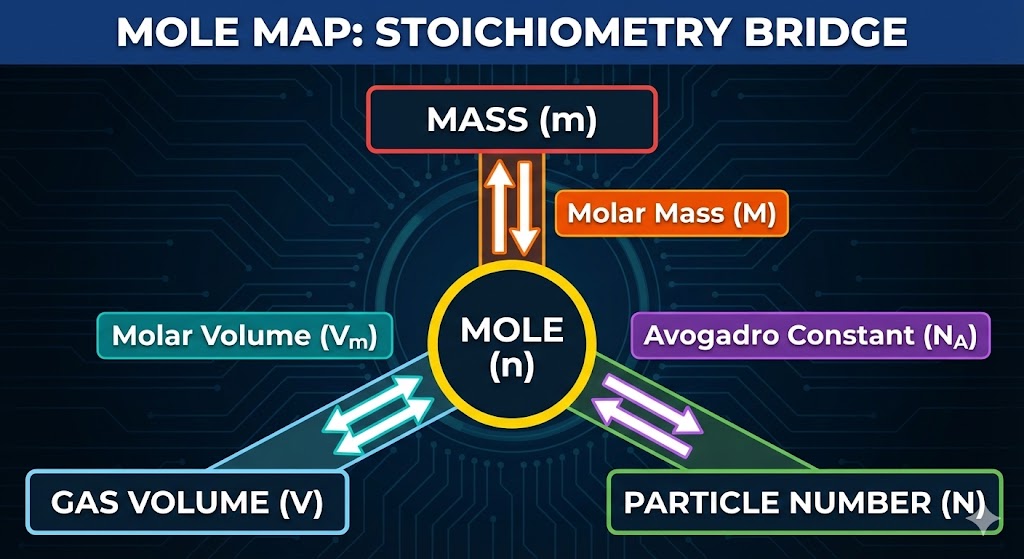
4. **Calculations Related to the Amount of Substance (The Mole)**
* **The Core**: This is the **sole bridge** connecting microscopic particles (atoms, molecules) with macroscopic measurable quantities (mass, volume). You must master the conversion relationships between "Molar Mass ($M$)", "Avogadro's Constant ($N_A$)", and "Molar Volume ($V_m$)".
5. **Application of the Ideal Gas Law**
* **Focus**: Understand the physical significance of $PV=nRT$ and use this equation to calculate gas density, molar mass, and partial pressure. Pay attention to the difference between Standard Temperature and Pressure (STP) and non-standard conditions.
---
Learning Objectives
Upon completing this module, you will be able to:
* **Classify**: Systematically identify and classify common substances and accurately determine the type of dispersion system (solution, colloid, suspension).
* **Express**: Correctly write and interpret chemical symbols and accurately write ionic equations.
* **Calculate**:
* Proficiently perform calculations related to solution preparation, dilution, and pH.
* **Core Skill**: Use "Amount of Substance ($n$)" as the central hub to freely interconvert Mass ($m$), Number of Particles ($N$), and Gas Volume ($V$).
* Apply the Ideal Gas Law to solve practical problems related to gas pressure, volume, and temperature.
This module forms the foundation for advanced topics such as Chemical Equilibrium, Reaction Kinetics, and Thermochemistry. Please ensure you grasp the definition and applicable conditions of every formula.