Chemical Nomenclature and Equation Writing
CSCA Chemical Nomenclature and Equation Writing study guide organized around the publicly available CSCA syllabus. Practice Chemistry questions on aicsca.com.
Before planning this topic, check the CSCA Exam Guide 2026 for exam dates, registration, fees, and subject requirements.
Syllabus Alignment
This study guide is organized around the publicly available CSCA syllabus for international undergraduate applicants.
Who It Is For
International students preparing for CSCA Math, Physics, Chemistry, or Chinese exams.
Related Practice
CSCA Practice · Go to questions
Past papers and worked video solutions · Timed mock exams · All subject video lessons
Practice by Topic
Jump from this tutorial to filtered practice questions for the same knowledge point.
Related formulas, concepts, and glossary terms
Chemistry Formula & Concept Reference
- Law of Conservation of Mass
- Molar Mass Calculation Formula
- Stoichiometric Coefficients and Equation Coefficients
- Chemical Reaction Rate (Average Rate)
- Amount of Substance Formula
- Rules for Writing Chemical Equations
- Mass Fraction of Solute in Solution
- Molar Volume of Gas Formula
Chemistry Exam Glossary
Tutorial Content
Core Concepts: Chemical Nomenclature and Equation Writing
This section is the "grammar" of chemistry. In the CSCA exam, **writing and evaluating Ionic Equations** is a mandatory topic, often combined with Redox reactions. Mastering this section is crucial to avoid losing points on "non-intellectual factors."
#### 1. Anatomy of Chemical Symbols
Understanding the meaning of the numbers surrounding a symbol is fundamental.
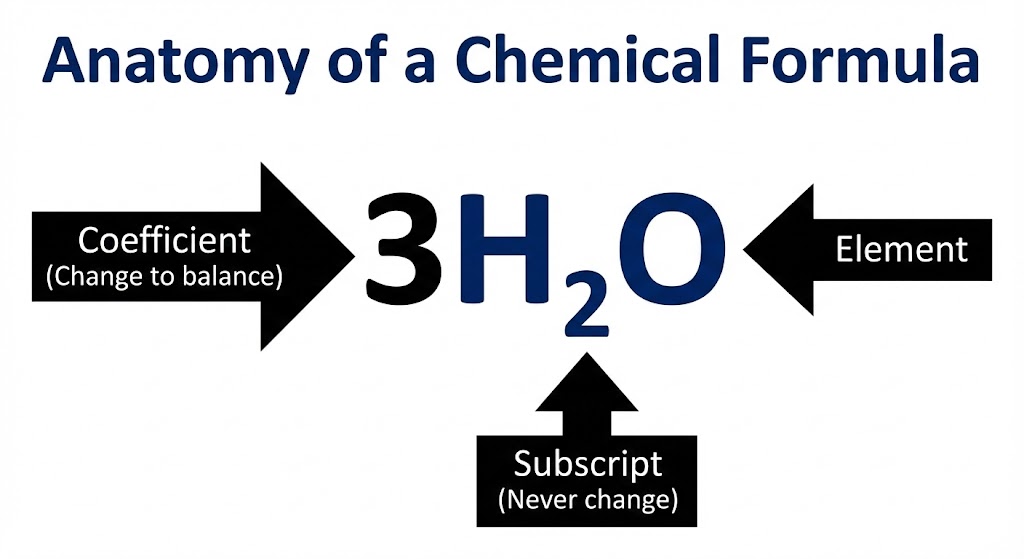
* **Coefficient**: The number *in front* of the formula. It represents the number of molecules or moles. **You change ONLY the coefficient when balancing.**
* **Subscript**: The number *bottom-right* of an element. It represents the number of atoms in a single molecule. **NEVER change the subscript**, or you change the substance itself.
* **Charge/Valence**: Top-right indicates ion charge (e.g., $Fe^{3+}$). Top-center indicates oxidation state.
#### 2. Must-Memorize: Polyatomic Ions
You won't have time to derive these during the exam. Memorize them:
* **+1 Charge**: Ammonium ($NH_4^+$)
* **-1 Charge**: Hydroxide ($OH^-$), Nitrate ($NO_3^-$), Bicarbonate ($HCO_3^-$), Permanganate ($MnO_4^-$)
* **-2 Charge**: Sulfate ($SO_4^{2-}$), Carbonate ($CO_3^{2-}$), Sulfite ($SO_3^{2-}$)
* **-3 Charge**: Phosphate ($PO_4^{3-}$)
#### 3. Balancing Chemical Equations
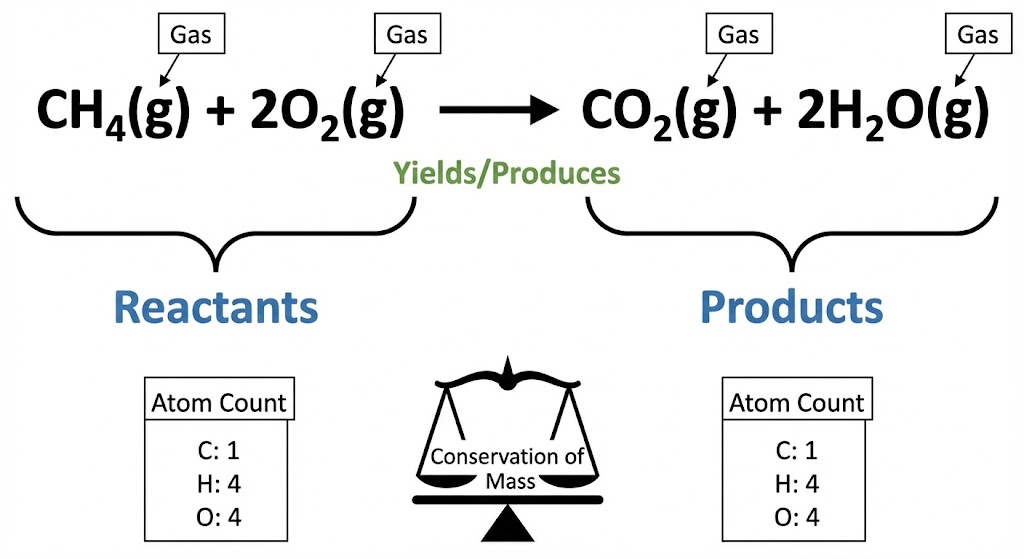
Besides the basic **Observation Method**, you should master the **Odd-Even Method** (when an element count is odd on one side and even on the other, double the species with the odd count first).
#### 4. Core Difficulty: Ionic Equations
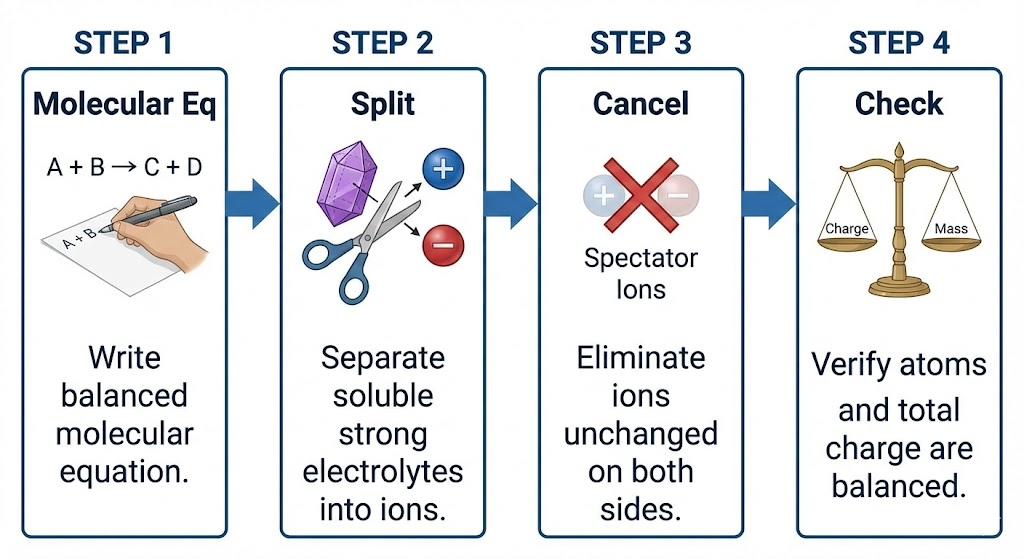
This is a high-frequency topic in CSCA multiple-choice questions. Remember the 4-step rule: "Write, Split, Cancel, Check".
1. **Write**: Write the correct balanced molecular equation.
2. **Split (Crucial)**:
* **Split**: Soluble Strong Electrolytes (Strong Acids, Strong Bases, Soluble Salts).
* *Strong Acids*: $HCl, H_2SO_4, HNO_3$
* *Strong Bases*: $NaOH, KOH, Ba(OH)_2$
* *Soluble Salts*: All K, Na, Ammonium salts; All Nitrates.
* **Do NOT Split**: Gases, Precipitates (Solids), Weak Electrolytes (Weak acids/bases, Water), Elements, Oxides.
3. **Cancel**: Remove ions that appear unchanged on both sides (**Spectator Ions**).
4. **Check**: Verify **Mass Balance** (atoms) and **Charge Balance**.
**Common Traps**:
* Iron + Hydrochloric Acid: $2Fe + 6H^+ \rightarrow 2Fe^{3+} + 3H_2\uparrow$ (**Wrong**! Fe produces $Fe^{2+}$ with non-oxidizing acids).
* Marble (Calcium Carbonate) + Hydrochloric Acid: $CO_3^{2-} + 2H^+ \rightarrow CO_2\uparrow + H_2O$ (**Wrong**! $CaCO_3$ is insoluble and cannot be split).
---
#### Sample Problem Analysis
**Example 1: Balancing**
Balance: $C_2H_2 + O_2 \xrightarrow{\text{ignite}} CO_2 + H_2O$
**Solution**:
1. **Set to 1**: Assume coefficient of $C_2H_2$ is 1.
2. **Derive**: C balance $\rightarrow 2CO_2$; H balance $\rightarrow 1H_2O$.
3. **Count Oxygen**: Right side total O $= 2\times2 + 1 = 5$.
4. **Balance Oxygen**: Left side $O_2$ coefficient is $5/2$.
5. **Whole Numbers**: Multiply all by 2 $\rightarrow$ $2C_2H_2 + 5O_2 = 4CO_2 + 2H_2O$
**Example 2: Ionic Equation**
Write the ionic equation for the reaction between Barium Hydroxide solution and Dilute Sulfuric Acid.
**Solution**:
1. **Write**: $Ba(OH)_2 + H_2SO_4 = BaSO_4\downarrow + 2H_2O$
2. **Split**: $Ba^{2+} + 2OH^- + 2H^+ + SO_4^{2-} = BaSO_4\downarrow + 2H_2O$
* *Note*: $BaSO_4$ is a precipitate (Don't split); $H_2O$ is a weak electrolyte (Don't split).
3. **Cancel**: No spectator ions to cancel in this specific case.
4. **Check**: Atoms and Charge balanced.
* *Final Answer*: $Ba^{2+} + 2OH^- + 2H^+ + SO_4^{2-} = BaSO_4\downarrow + 2H_2O$