Mole Calculations
CSCA Mole Calculations study guide organized around the publicly available CSCA syllabus. Practice Chemistry questions on aicsca.com.
Before planning this topic, check the CSCA Exam Guide 2026 for exam dates, registration, fees, and subject requirements.
Syllabus Alignment
This study guide is organized around the publicly available CSCA syllabus for international undergraduate applicants.
Who It Is For
International students preparing for CSCA Math, Physics, Chemistry, or Chinese exams.
Related Practice
CSCA Practice · Go to questions
Past papers and worked video solutions · Timed mock exams · All subject video lessons
Practice by Topic
Jump from this tutorial to filtered practice questions for the same knowledge point.
Related formulas, concepts, and glossary terms
Chemistry Formula & Concept Reference
- What is the definition formula for amount of substance (n)?
- What is the definition formula for molar volume of gas (Vm)?
- What is the definition formula for molar concentration (c)?
- Definition of Amount of Substance (n)
- Relationship between Amount of Substance (n) and Mass (m)
- How to calculate molar concentration (c) from mass fraction (w) and solution density (ρ)?
- Relationship between Amount of Gas (n) and Molar Volume of Gas (Vm)
- Ideal Gas Law
Chemistry Exam Glossary
Tutorial Content
Core Concepts: Mole Calculations
This section is the "heart" of chemical calculations. Whether the question asks for mass, volume, or particle count, the path to the solution almost always requires **finding the Amount of Substance ($n$) first**. Remember the golden rule: **"Convert everything to Moles first."**
#### 1. Core Concepts: The Bridge between Micro and Macro
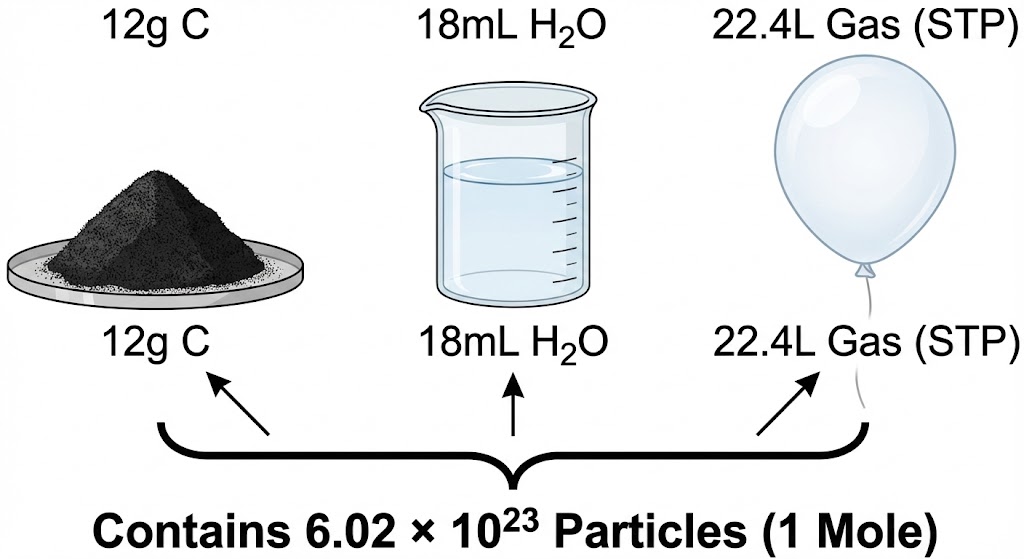
* **Amount of Substance ($n$)**: Measures the number of microscopic particles (atoms, molecules, ions). Unit: **Mole (mol)**.
* **Avogadro Constant ($N_A$)**: The number of particles in $1 \text{ mol}$. Value $\approx \mathbf{6.02 \times 10^{23} \text{ mol}^{-1}}$.
* *Analogy*: Just as "1 Dozen" = 12, "1 Mole" = $6.02 \times 10^{23}$.
* **Molar Mass ($M$)**: The mass of $1 \text{ mol}$ of a substance. Numerically equal to the relative atomic/molecular mass. Unit: **g/mol**.
* *Example*: Relative molecular mass of $H_2O$ is 18, so $M(H_2O) = 18 \text{ g/mol}$.
#### 2. The Four Key Formulas (The Mole Network)
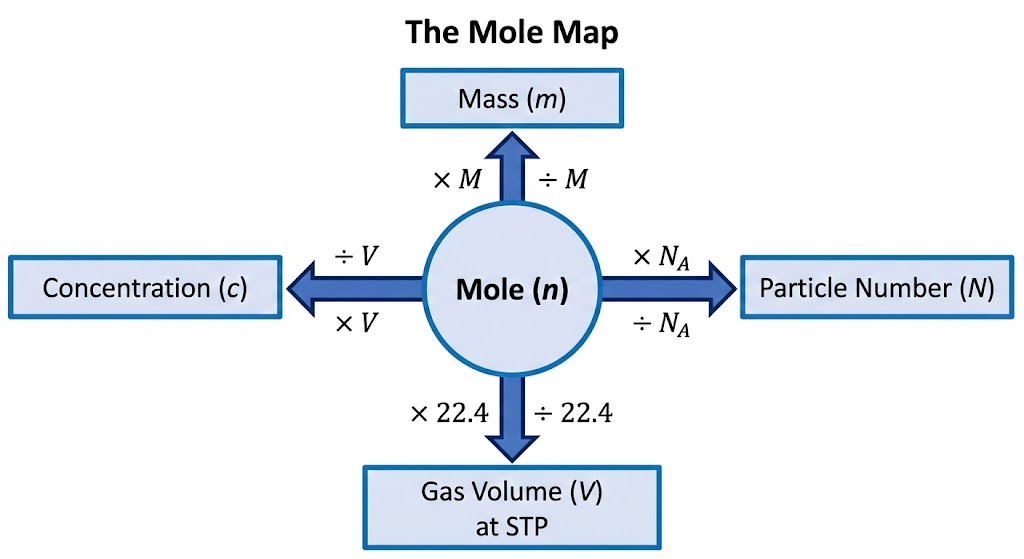
Place Amount of Substance ($n$) in the center and connect it to four physical quantities. Mastering these conversions is key to CSCA calculation questions.
1. **Mass $\leftrightarrow$ Moles**:
$$n = \frac{m}{M}$$
($m$: Mass, in **g**)
2. **Particle Count $\leftrightarrow$ Moles**:
$$n = \frac{N}{N_A}$$
($N$: Number of particles)
3. **Gas Volume $\leftrightarrow$ Moles (STP Only)**:
$$n = \frac{V}{V_m}$$
* **STP Definition**: $0^\circ\text{C} (273.15 \text{ K})$ and $101.3 \text{ kPa} (1 \text{ atm})$.
* **Value**: $V_m \approx 22.4 \text{ L/mol}$.
* *Trap*: If the substance is a **Liquid** (like water) or **Solid**, or under **Non-Standard Conditions**, **NEVER use 22.4**!
4. **Solution Concentration $\leftrightarrow$ Moles**:
$$n = c \cdot V_{\text{solution}}$$
($c$: Molarity in mol/L; $V$: Volume in **L**)
#### 3. The "Three-Step" Strategy
**Example**: At STP, $11.2 \text{ L}$ of $CO_2$ is passed into excess limewater. What is the mass of the precipitate formed?
* **Step 1: Known to Moles**
Given $V(CO_2) = 11.2 \text{ L}$ (STP).
$$n(CO_2) = \frac{11.2 \text{ L}}{22.4 \text{ L/mol}} = 0.5 \text{ mol}$$
* **Step 2: Use Stoichiometry (The Ratio)**
Reaction: $CO_2 + Ca(OH)_2 \rightarrow CaCO_3\downarrow + H_2O$
Ratio $n(CO_2) : n(CaCO_3) = 1 : 1$.
Therefore, $n(CaCO_3) = 0.5 \text{ mol}$.
* **Step 3: Moles to Target**
Target is mass $m$. $M(CaCO_3) = 100 \text{ g/mol}$.
$$m = n \cdot M = 0.5 \text{ mol} \times 100 \text{ g/mol} = 50 \text{ g}$$
---
#### Common Traps
1. **Unit Trap**: In $n=m/M$, $m$ must be in **grams**. In $n=c\cdot V$, $V$ must be in **Liters** (divide mL by 1000).
2. **Condition Trap**: If the problem states "Room Temperature", gas molar volume is usually NOT 22.4 L/mol (often 24 or 24.5). Check the given data or use $PV=nRT$.
3. **State Trap**: $H_2O$ at STP ($0^\circ\text{C}$) is liquid/ice, **NOT a gas**. You cannot use 22.4 L/mol for water.