Classification of Matter and State Changes
CSCA Classification of Matter and State Changes study guide organized around the publicly available CSCA syllabus. Practice Chemistry questions on aicsca.com.
Before planning this topic, check the CSCA Exam Guide 2026 for exam dates, registration, fees, and subject requirements.
Syllabus Alignment
This study guide is organized around the publicly available CSCA syllabus for international undergraduate applicants.
Who It Is For
International students preparing for CSCA Math, Physics, Chemistry, or Chinese exams.
Related Practice
CSCA Practice · Go to questions
Past papers and worked video solutions · Timed mock exams · All subject video lessons
Practice by Topic
Jump from this tutorial to filtered practice questions for the same knowledge point.
Related formulas, concepts, and glossary terms
Chemistry Formula & Concept Reference
- Mass Fraction Calculation Formula
- Molar Volume of Gas (at Standard Conditions)
- Molarity Calculation Formula
- Definition of Molarity
- Definition of Mass Fraction
Chemistry Exam Glossary
Tutorial Content
Core Concepts: Classification of Matter and State Changes
This section marks the starting point of chemistry. The CSCA exam frequently tests your ability to distinguish concepts (e.g., Physical vs. Chemical changes) and interpret Phase Diagrams.
#### 1. Classification System of Matter
We must understand matter from both macroscopic composition and microscopic particle perspectives.
* **Pure Substance**: Composed of a single species of matter, possessing fixed physical properties (like melting/boiling points) and a distinct chemical formula.
* **Element**: A pure substance made of only one type of atom. E.g., $Fe, O_2, He$.
* *Note*: A substance containing only one element is **not necessarily** a pure substance. For example, a mixture of Oxygen ($O_2$) and Ozone ($O_3$) contains only the element Oxygen, but it is a **mixture**.
* **Compound**: A pure substance formed by different elements bonded in a fixed mass ratio. E.g., $H_2O, CO_2, NaCl$.
* **Mixture**: A physical blend of two or more pure substances. It has no fixed melting/boiling points, and components retain their original chemical properties.
* **Homogeneous Mixture**: Also known as a **Solution**. Uniform composition throughout. E.g., Saltwater, Air, Stainless Steel (Alloy).
* **Heterogeneous Mixture**: Non-uniform composition with visible interfaces. E.g., Oil and water, Muddy water.
#### 2. Physical Change vs. Chemical Change
This is a high-frequency trap in exams.
* **Physical Change**: **No new substance is formed**. Usually involves changes in state, shape, or separation of mixtures.
* *Special Case*: Isotope separation (e.g., separating $^{235}U$ from $^{238}U$) is a physical change.
* **Chemical Change**: **New substances are formed**. Essentially involves the breaking of old chemical bonds and the formation of new ones.
* *Special Case*: Conversion between Allotropes (e.g., Graphite $\rightarrow$ Diamond, or $3O_2 \rightarrow 2O_3$) is a **Chemical Change**.
#### 3. Changes of State
States of matter are primarily determined by Temperature and Pressure. You must memorize the six processes and their energy relationships (Endothermic/Exothermic).
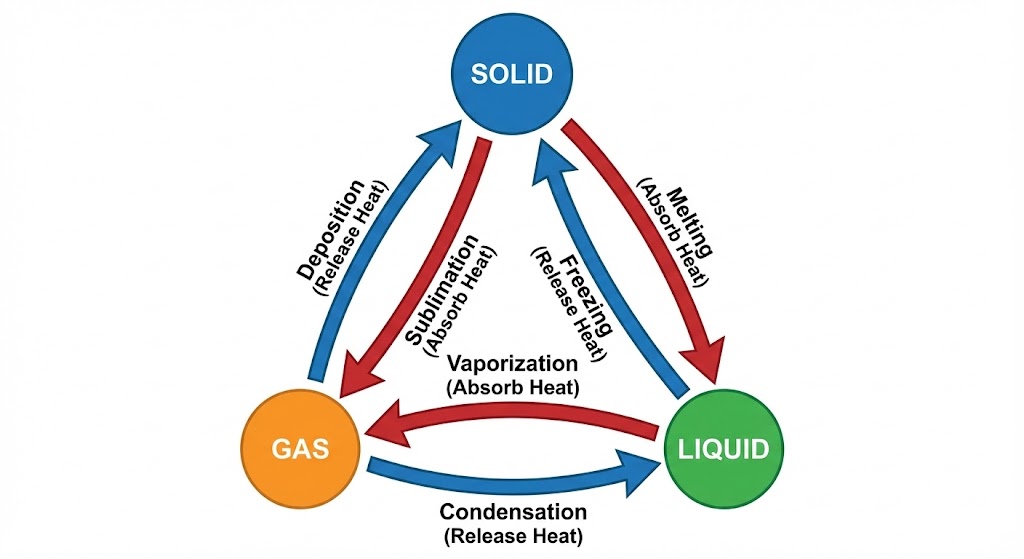
* **Endothermic Processes**: Absorb energy to overcome intermolecular forces. Include: **Melting**, **Vaporization**, and **Sublimation**.
* **Exothermic Processes**: Release energy as particles come closer. Include: **Freezing**, **Condensation**, and **Deposition**.
#### 4. Phase Diagrams
A Phase Diagram describes the stable states of a substance at different Pressures ($P$) and Temperatures ($T$). This is a key tool for calculation and analysis questions in the CSCA.
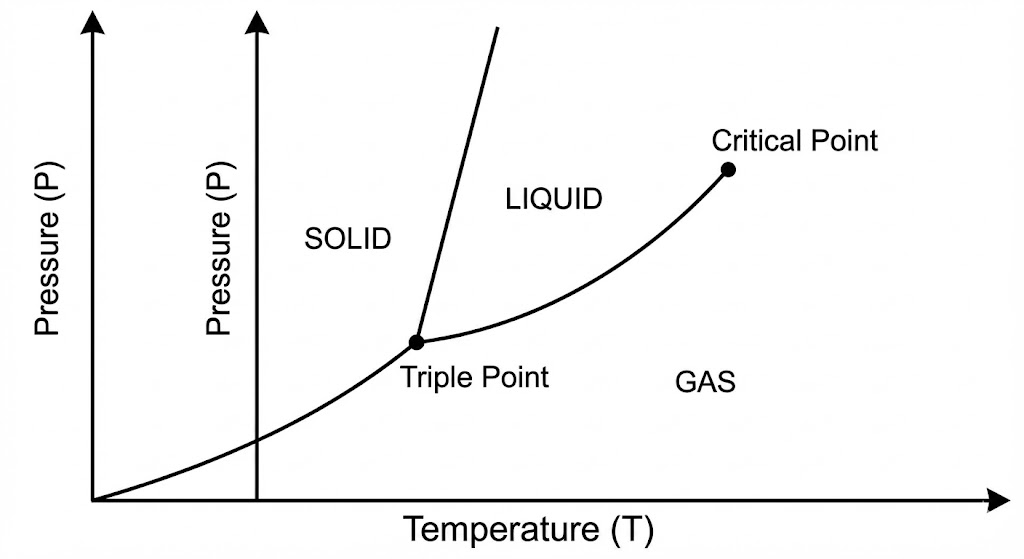
* **Triple Point**: The specific temperature and pressure where solid, liquid, and gas phases coexist in equilibrium.
* **Critical Point**: The end point of the liquid-gas boundary. Beyond this point, gas and liquid properties merge into a Supercritical Fluid, which cannot be liquefied by pressure alone.
* **Meaning of Curves**:
* Solid-Liquid Line (Melting curve): Usually has a positive slope; **Water is an exception** with a negative slope (meaning pressure lowers the melting point of ice).
* Liquid-Gas Line (Vapor pressure curve): Shows how boiling point changes with pressure.
---
#### Sample Problem Analysis
**Question**: Which of the following statements is correct?
1. Matter containing only one type of element is always a pure substance.
2. $NaCl$ solution conducts electricity, so $NaCl$ solution is an electrolyte.
3. The sublimation of dry ice (solid $CO_2$) is a physical change accompanied by heat absorption.
**Analysis**:
1. **False**. A mixture of $O_2$ and $O_3$ is a mixture.
2. **False**. $NaCl$ (the compound) is an electrolyte. The **solution** is a mixture; mixtures are defined as neither electrolytes nor non-electrolytes.
3. **True**. Sublimation is a state change (molecules remain $CO_2$), and breaking intermolecular forces requires absorbing heat.