Electrolyte Solution Theory
CSCA Electrolyte Solution Theory study guide organized around the publicly available CSCA syllabus. Practice Chemistry questions on aicsca.com.
Before planning this topic, check the CSCA Exam Guide 2026 for exam dates, registration, fees, and subject requirements.
Syllabus Alignment
This study guide is organized around the publicly available CSCA syllabus for international undergraduate applicants.
Who It Is For
International students preparing for CSCA Math, Physics, Chemistry, or Chinese exams.
Related Practice
CSCA Practice · Go to questions
Past papers and worked video solutions · Timed mock exams · All subject video lessons
Practice by Topic
Jump from this tutorial to filtered practice questions for the same knowledge point.
Related formulas, concepts, and glossary terms
Chemistry Formula & Concept Reference
- Ionization Constant of Weak Electrolyte ( K_a or K_b )
- Ionization Constant of a Weak Base (Kb)
- Common Ion Effect and pH Calculation for Buffer Solutions (using weak acid and its salt as an example)
- Ostwald's Dilution Law (for Weak Electrolytes)
- Definition of pH
- Ion Product Constant of Water (Kw)
- Definition and Calculation of pH
- Ionization Constant of a Weak Acid (Ka)
Chemistry Exam Glossary
Tutorial Content
Electrolyte Solution Theory
Core Concepts and Learning Objectives
This section focuses on chemical reactions in aqueous solutions, centering on the behavior of ions (Ionization, Hydrolysis, Precipitation). This is a high-frequency topic for calculation questions (pH, Ksp) and logical reasoning questions (Ion coexistence) in the CSCA exam.
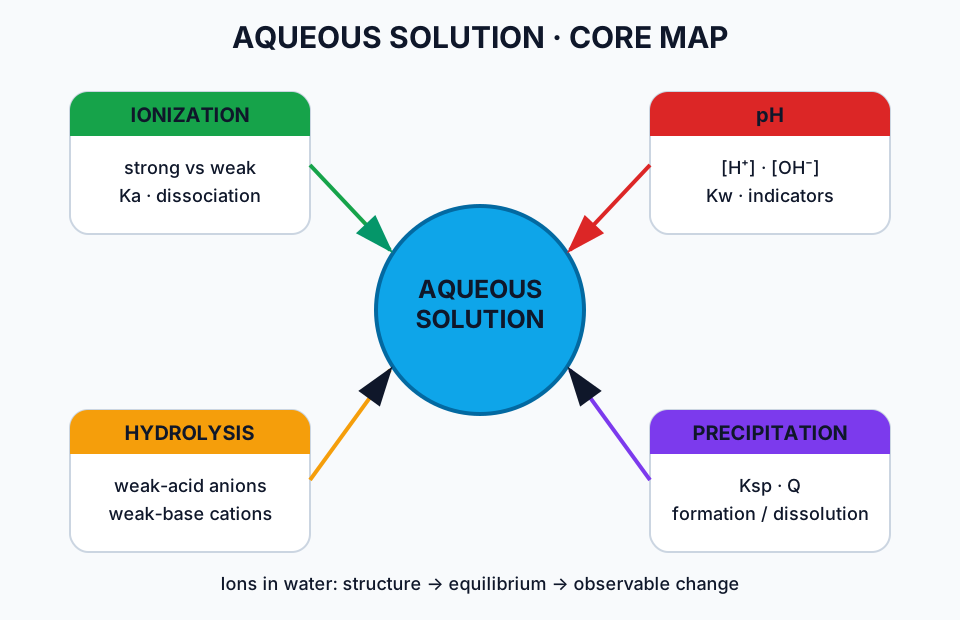 **Learning Objectives:**
1. **Distinguish**: Understand the microscopic difference between strong and weak electrolytes.
2. **Calculate**: Master calculations for pH, $K_a$, $K_w$, and $K_{sp}$.
3. **Hydrolysis Rules**: Master the rule "The weaker one hydrolyzes".
4. **Precipitation**: Use the relationship between $Q_c$ and $K_{sp}$ to predict precipitation.
---
I. Electrolytes and Ionization Equilibrium
#### 1. Strong vs. Weak Electrolytes
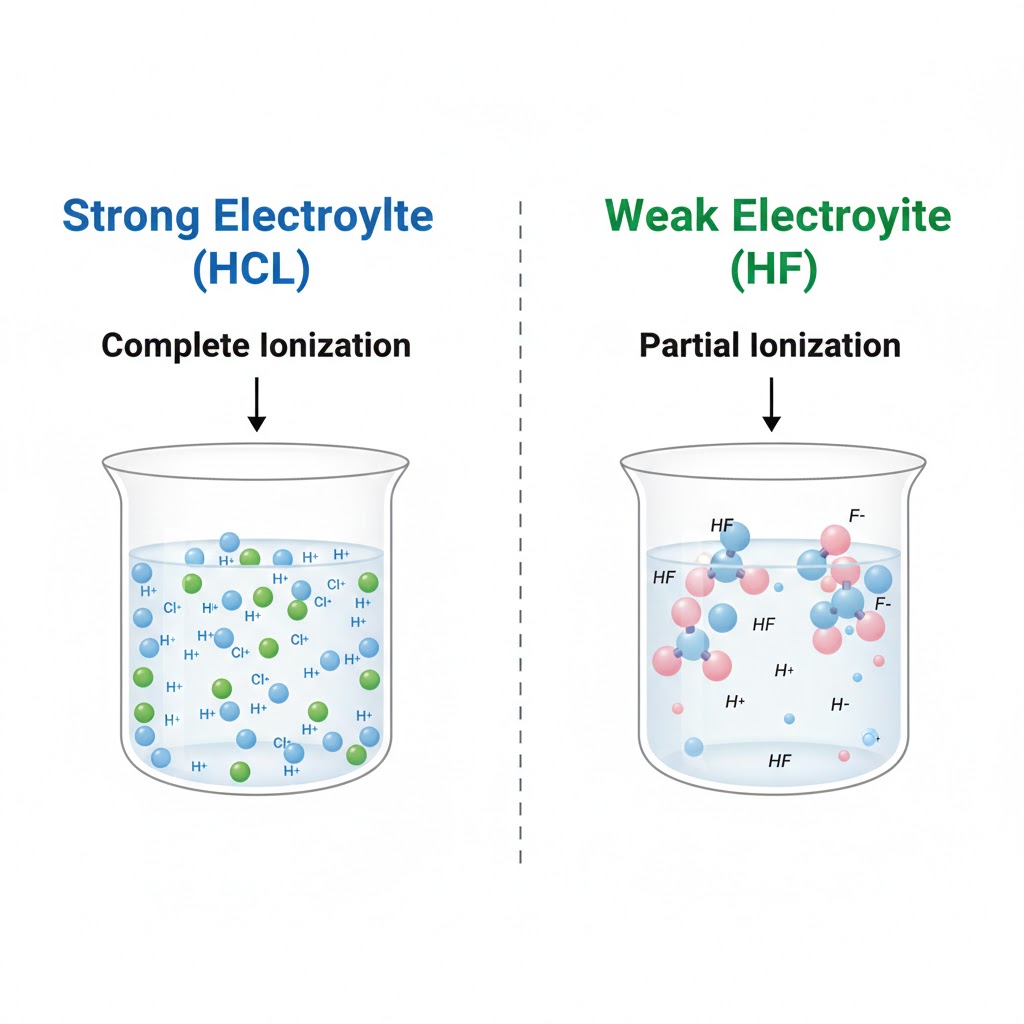
* **Strong Electrolyte**: **Completely ionizes** in water.
* Includes: Strong acids ($HCl, H_2SO_4$), strong bases ($NaOH$), and most salts ($NaCl, BaSO_4$).
* **Note**: $BaSO_4$ is insoluble, but the dissolved part ionizes completely, so it is a strong electrolyte.
* **Weak Electrolyte**: **Partially ionizes** in water, establishing a reversible equilibrium.
* Includes: Weak acids ($CH_3COOH, HF$), weak bases ($NH_3\cdot H_2O$), water ($H_2O$).
 #### 2. Calculation Formulas for Weak Electrolytes
For a monoprotic weak acid $HA \rightleftharpoons H^+ + A^-$:
* **Ionization Constant ($K_a$)**: $K_a = \frac{[H^+][A^-]}{[HA]}$ (Depends only on Temperature).
* **Approximation**: When $c/K_a \ge 500$, $[H^+] \approx \sqrt{K_a \cdot c}$.
---
II. Ionization of Water and pH Calculation
#### 1. Ion Product of Water ($K_w$)
* Water is a very weak electrolyte: $H_2O \rightleftharpoons H^+ + OH^-$ .
* **Formula**: $K_w = [H^+][OH^-]$.
* **Value**: At room temperature ($25^\circ C$), $K_w = 1.0 \times 10^{-14}$.
* **Key Point**: $K_w$ depends only on temperature. **Heating promotes ionization**, increasing $K_w$.
#### 2. pH and pOH
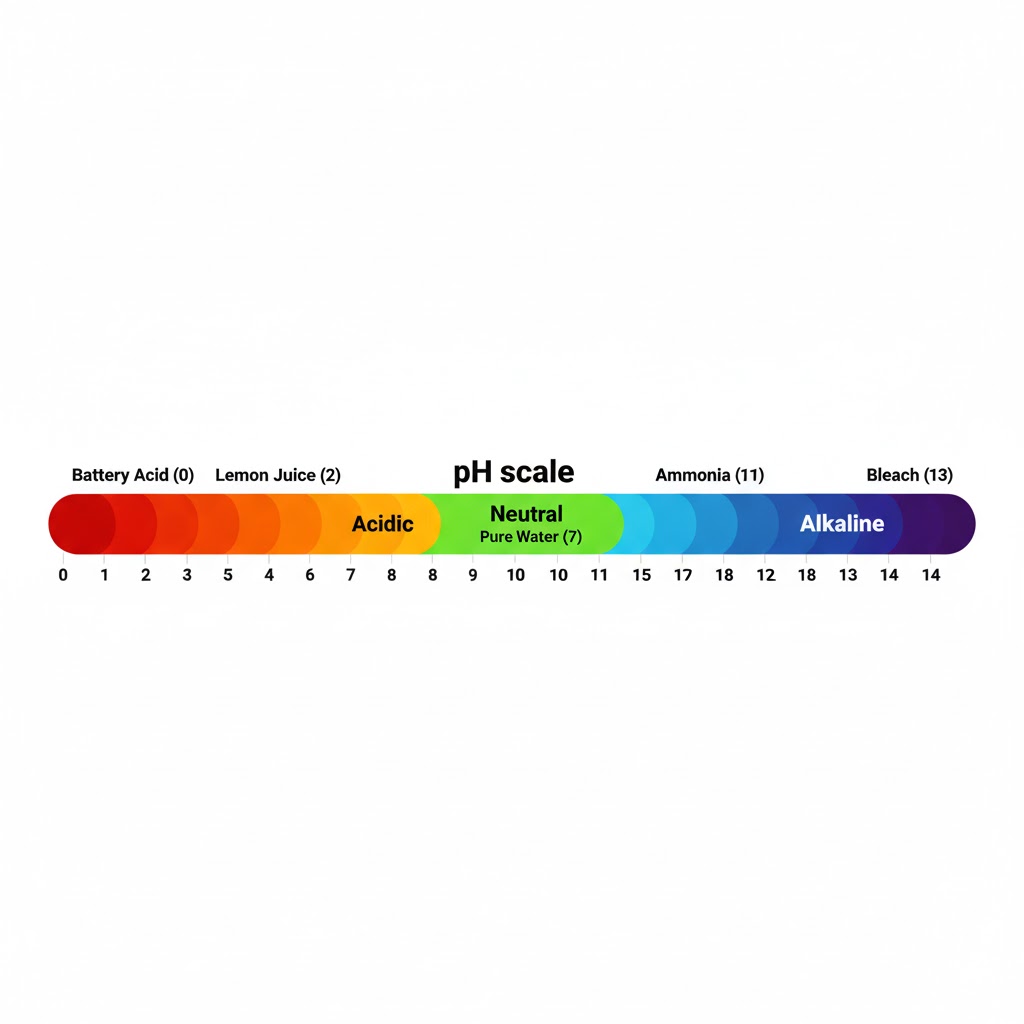
* **Definition**: $pH = -\lg[H^+]$, $pOH = -\lg[OH^-]$.
* **Relation**: At $25^\circ C$, $pH + pOH = 14$.
 ---
---
III. Salt Hydrolysis
#### 1. Essence
Weak ions from the salt (weak acid anions or weak base cations) combine with $H^+$ or $OH^-$ from water, disrupting the water ionization equilibrium and changing the pH.
#### 2. Rule: "The Weaker One Hydrolyzes"
| Salt Type | Example | Hydrolyzing Ion | Acidity/Alkalinity | Rule |
| :--- | :--- | :--- | :--- | :--- |
| **Strong Acid + Weak Base** | $NH_4Cl$ | $NH_4^+$ | **Acidic** | Stronger part dominates |
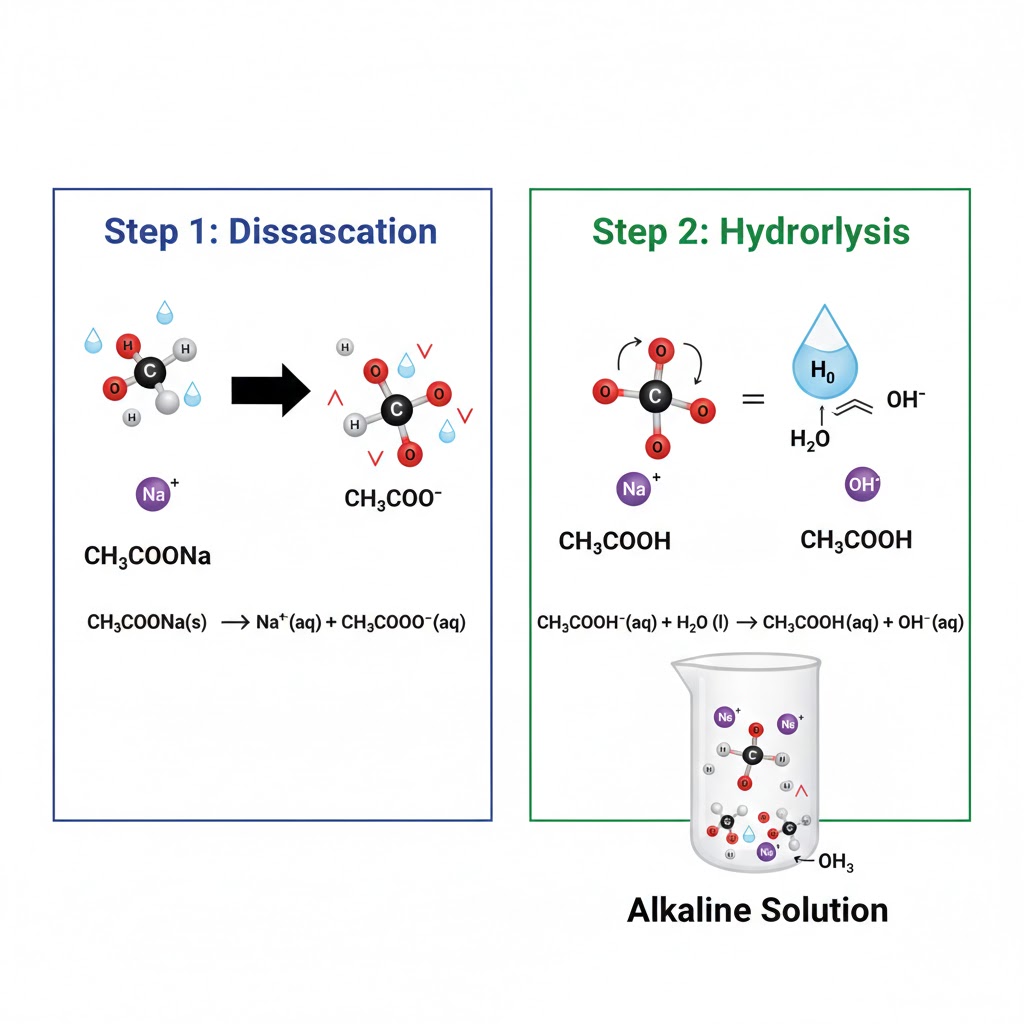
| **Strong Base + Weak Acid** | $CH_3COONa$ | $CH_3COO^-$ | **Alkaline** | Stronger part dominates |
| **Strong Acid + Strong Base** | $NaCl$ | None | **Neutral** | No weak part, no hydrolysis |
 #### 3. Buffer Solutions
* **Composition**: Weak Acid + Weak Acid Salt (e.g., $CH_3COOH + CH_3COONa$) or Weak Base + Salt.
* **Function**: Resists pH change upon addition of small amounts of acid or base.
---
IV. Solubility Equilibrium
#### 1. Solubility Product Constant ($K_{sp}$)
For a sparingly soluble salt $A_mB_n(s) \rightleftharpoons mA^{n+}(aq) + nB^{m-}(aq)$:
$$K_{sp} = [A^{n+}]^m [B^{m-}]^n$$
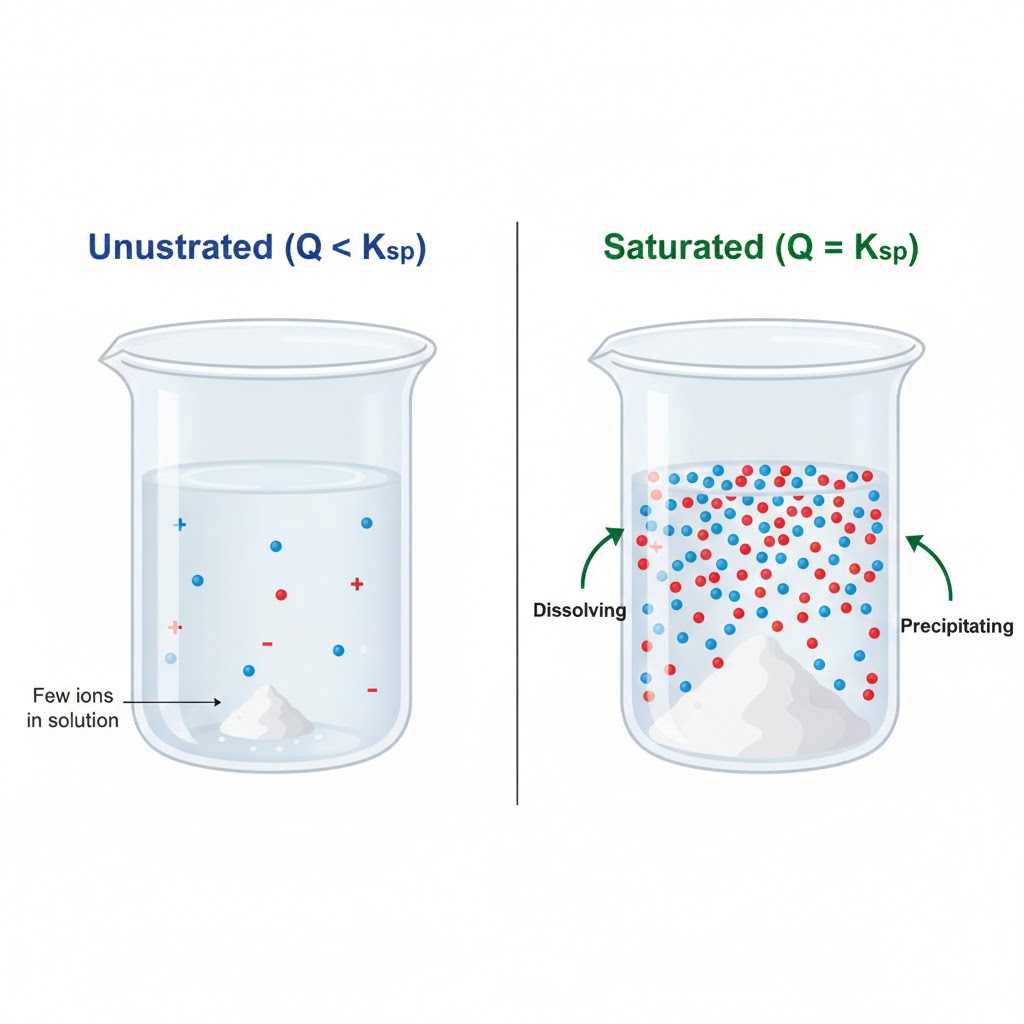
#### 2. Solubility Rules ($Q_c$ vs $K_{sp}$)
Use Ion Product $Q_c$ to predict precipitation:
* $Q_c < K_{sp}$ : **Unsaturated**, no precipitate (solid dissolves).
* $Q_c = K_{sp}$ : **Saturated**, equilibrium.
* $Q_c > K_{sp}$ : **Supersaturated**, precipitate **forms** until $Q_c = K_{sp}$.
 ---
---
V. Typical Examples
**Ex 1: pH of Mixture**
At 25°C, mix equal volumes of $0.01\, mol/L$ $NaOH$ and $HCl$ ($pH=2$). Calculate final pH.
* **Sol**:
* $NaOH$: $[OH^-] = 0.01\, mol/L$.
* $HCl$ ($pH=2$): $[H^+] = 0.01\, mol/L$.
* Equal volume and concentration $\rightarrow$ Complete neutralization.
* Result is Neutral, $pH = 7$.
**Ex 2: Precipitation Prediction**
Given $K_{sp}(AgCl) = 1.8 \times 10^{-10}$. Mix $2.0\, mL$ of $0.01\, M$ $AgNO_3$ with $3.0\, mL$ of $0.01\, M$ $NaCl$. Will precipitate form?
* **Sol**:
1. **New Concentrations** (Total Vol = 5.0 mL):
$[Ag^+] = \frac{0.01 \times 2.0}{5.0} = 4.0 \times 10^{-3}\, M$
$[Cl^-] = \frac{0.01 \times 3.0}{5.0} = 6.0 \times 10^{-3}\, M$
2. **Calculate $Q_c$**:
$Q_c = (4.0 \times 10^{-3})(6.0 \times 10^{-3}) = 2.4 \times 10^{-5}$
3. **Compare**:
$2.4 \times 10^{-5} > 1.8 \times 10^{-10}$ ($Q_c > K_{sp}$)
4. **Conclusion**: **Precipitate forms**.
**Ex 3: Ion Concentration Ranking**
Rank ion concentrations in $0.1\, M$ $CH_3COONa$.
* **Sol**:
* Major Ions: $Na^+, CH_3COO^-$ (Complete ionization).
* Hydrolysis: $CH_3COO^-$ consumes $H_2O$ to form $OH^-$ (making it alkaline), so $[CH_3COO^-]$ decreases slightly.
* Minor Ions: $[OH^-]$ (from hydrolysis) > $[H^+]$ (from water).
* **Order**: $[Na^+] > [CH_3COO^-] > [OH^-] > [H^+]$.