Atomic Structure and Periodic Law
CSCA Atomic Structure and Periodic Law study guide organized around the publicly available CSCA syllabus. Practice Chemistry questions on aicsca.com.
Before planning this topic, check the CSCA Exam Guide 2026 for exam dates, registration, fees, and subject requirements.
Syllabus Alignment
This study guide is organized around the publicly available CSCA syllabus for international undergraduate applicants.
Who It Is For
International students preparing for CSCA Math, Physics, Chemistry, or Chinese exams.
Related Practice
CSCA Practice · Go to questions
Past papers and worked video solutions · Timed mock exams · All subject video lessons
Practice by Topic
Jump from this tutorial to filtered practice questions for the same knowledge point.
Related formulas, concepts, and glossary terms
Chemistry Formula & Concept Reference
- De Broglie Relation
- Bohr Atomic Model: Hydrogen Atom Energy Level Formula
- Bohr Atomic Model: Electron Orbital Energy Formula
- De Broglie Relation: Matter Wave Wavelength
- Ionization Energy (Definition Equation)
- Effective Nuclear Charge (Estimation by Slater's Rules)
- Electron Affinity (Definition Equation)
- Heisenberg Uncertainty Principle (Position and Momentum)
Chemistry Exam Glossary
Tutorial Content
Atomic Structure and Periodic Law
Core Concepts and Learning Objectives
This section is the microscopic starting point of chemical theory. We will start from the internal structure of atoms, understand the fundamental reasons for periodic changes in elemental properties, and master the use of the Periodic Table for prediction.
**Learning Objectives:**
1. **Atomic Model**: Understand the relationship between protons, neutrons, and electrons, and the concept of isotopes.
2. **Electron Configuration**: Master writing electron configurations for elements 1-36 (especially transition metals).
3. **Periodic Law**: Infer elemental properties using the "Position-Structure-Property" relationship.
 ---
---
I. Basic Model of Atomic Structure
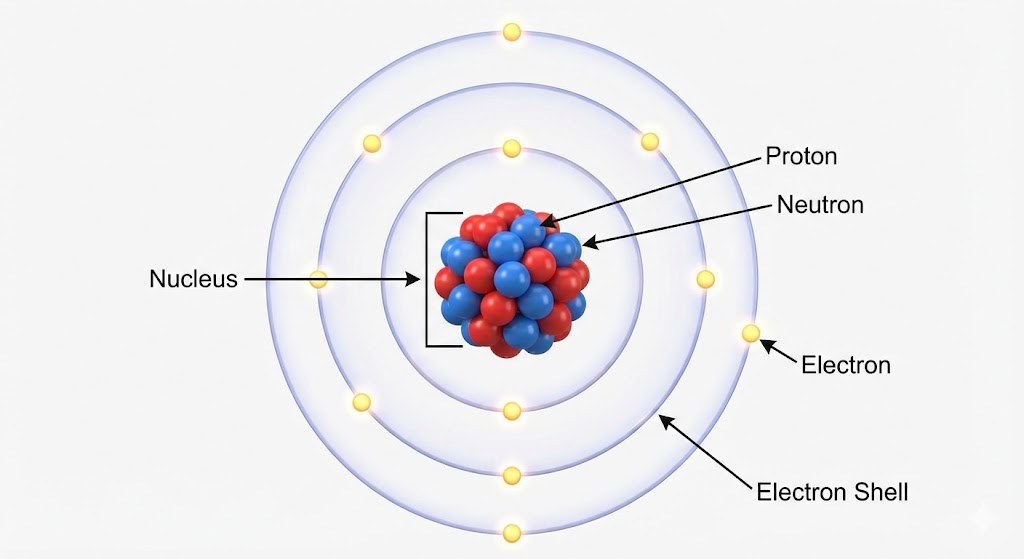
The modern atomic model posits that an atom consists of a positively charged **Nucleus** and negatively charged **Electrons**.
* **Atomic Number ($Z$)**: $Z = \text{Protons} = \text{Nuclear Charge} = \text{Electrons}$ (for neutral atoms).
* **Mass Number ($A$)**: $A = Z + N$ (where $N$ is the number of neutrons).
* **Isotopes**: Atoms with the same number of protons but different numbers of neutrons. Example: $^{12}\text{C}, ^{13}\text{C}, ^{14}\text{C}$.
---
II. Rules for Electron Configuration
Electrons are arranged in shells, following an order from low to high energy.
#### 1. Shells and Subshells
* **Electron Shell ($n$)**: $n=1, 2, 3...$ (K, L, M...), larger $n$ means further from the nucleus and higher energy.
* **Subshell ($l$)**: Each shell contains orbitals of different shapes, labeled $s, p, d, f$.
* $s$: 1 orbital (spherical).
* $p$: 3 orbitals (dumbbell).
* $d$: 5 orbitals.
#### 2. Three Configuration Principles
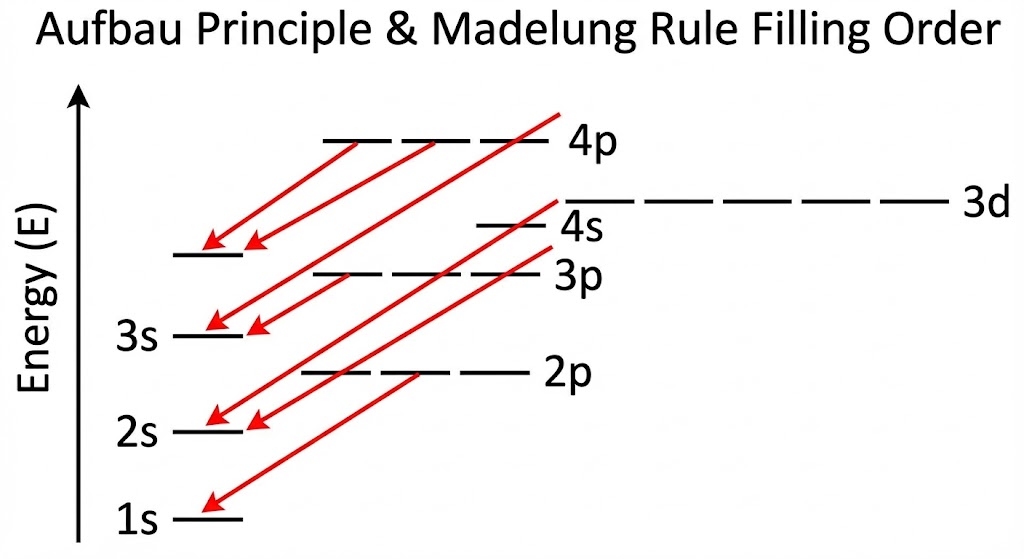
1. **Aufbau Principle**: Electrons occupy the lowest energy orbitals first. **Note the energy overlap**:
$$1s < 2s < 2p < 3s < 3p < \mathbf{4s} < \mathbf{3d} < 4p$$
2. **Pauli Exclusion Principle**: An orbital can hold at most 2 electrons with opposite spins.
3. **Hund's Rule**: In degenerate orbitals (like the three $p$ orbitals), electrons occupy separate orbitals with parallel spins first (half-filled and fully-filled states are more stable).
 **Examples:**
* Sodium (Na, $Z=11$): $1s^2 2s^2 2p^6 3s^1$ or $[Ne] 3s^1$
* **Exceptions**: Chromium (Cr) is $[Ar] 3d^5 4s^1$ (half-filled stability); Copper (Cu) is $[Ar] 3d^{10} 4s^1$ (fully-filled stability).
---
III. The Periodic Table and Periodic Law
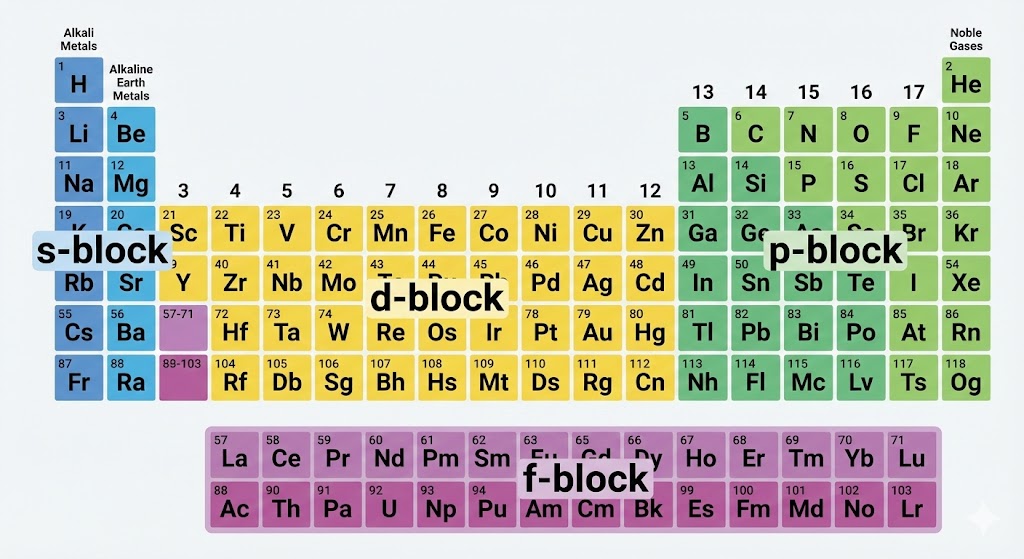
The Periodic Table is the map of chemistry. Mastering blocks and trends is key.
 #### 1. Structure of the Periodic Table
* **Period**: 7 horizontal rows. Period number = Number of electron shells.
* **Group**: 18 vertical columns.
* **Main Group (A)**: Valence electrons = Group number (IA - VIIA).
* **Transition Elements**: Includes B groups and Group VIII, mainly in the $d$ and $ds$ blocks.
#### 2. Periodic Trends
This is a **high-frequency topic** in CSCA. Memorize these trends:
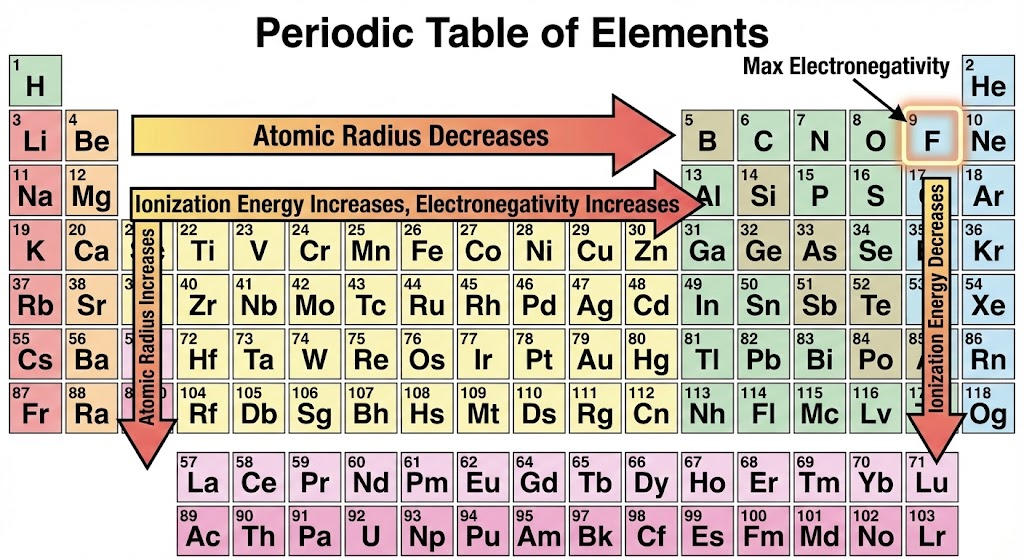 | Property | Across a Period (L $\rightarrow$ R) | Down a Group (Top $\rightarrow$ Bottom) | Reason |
| :--- | :--- | :--- | :--- |
| **Atomic Radius** | **Decreases** | **Increases** | Increased nuclear charge increases attraction (L$\rightarrow$R); Added shells increase size (Top$\rightarrow$Btm) |
| **Ionization Energy ($I_1$)**| **Generally Increases**| **Decreases** | Smaller radius makes it harder to remove electrons. *(Note anomalies: IIA>IIIA, VA>VIA)* |
| **Electronegativity ($\chi$)**| **Increases** | **Decreases** | Fluorine ($F$) is max, Cesium ($Cs$) is min |
| **Metallic Character** | **Decreases** | **Increases** | Ability to lose electrons |
| **Non-metallic Character**| **Increases** | **Decreases** | Ability to gain electrons |
---
IV. Typical Examples
**Ex 1: Isotopes and Symbols**
A nuclide $X$ has mass number 37 and 20 neutrons. Write its symbol and position in the Periodic Table.
* **Solution**: Protons $Z = 37 - 20 = 17$. Element 17 is Chlorine ($Cl$). Symbol: $^{37}_{17}Cl$. Position: Period 3, Group VIIA.
**Ex 2: Radius Comparison**
Compare radii: (1) $r(Na)$ vs $r(Mg)$ (2) $r(Cl^-)$ vs $r(Ca^{2+})$
* **Solution**:
(1) $r(Na) > r(Mg)$. Same period, higher $Z$ means smaller radius.
(2) $r(Cl^-) > r(Ca^{2+})$. Isoelectronic (same electron arrangement), higher nuclear charge ($Ca=20$) attracts electrons more strongly, shrinking the radius.
**Ex 3: Element Deduction**
Short-period elements X, Y, Z, W have increasing atomic numbers.
* X is the most abundant element in the crust.
* Y has the largest radius in the short periods (excluding noble gases).
* Z is a common semiconductor.
* W is in the same group as X.
Questions: (1) Ionic diagram of Y? (2) Which hydride has a higher boiling point, X or W?
* **Solution**:
* **Deduction**: X=**O**, Y=**Na**, Z=**Si**, W=**S**.
* (1) Y is $Na^+$. Diagram: Circle (+11), arcs 2, 8.
* (2) $H_2O > H_2S$. Due to **Hydrogen Bonding** in water.
---
V. Common Mistakes
1. **Electron Config**: For $Fe^{2+}$, remove $4s$ electrons first: $[Ar]3d^6$, NOT $[Ar]4s^2 3d^4$.
2. **Ionization Anomalies**: $N$ ($2p^3$ half-full) $> O$ ($2p^4$); $Mg$ ($3s^2$ full) $> Al$ ($3p^1$).
3. **Isoelectronic Species**: For ions with the same electron config, the one with the larger atomic number ($Z$) has the smaller radius.