Properties of Substances and Reactions
CSCA Properties of Substances and Reactions study guide organized around the publicly available CSCA syllabus. Practice Chemistry questions on aicsca.com.
Before planning this topic, check the CSCA Exam Guide 2026 for exam dates, registration, fees, and subject requirements.
Syllabus Alignment
This study guide is organized around the publicly available CSCA syllabus for international undergraduate applicants.
Who It Is For
International students preparing for CSCA Math, Physics, Chemistry, or Chinese exams.
Related Practice
CSCA Practice · Go to questions
Past papers and worked video solutions · Timed mock exams · All subject video lessons
Practice by Topic
Jump from this tutorial to filtered practice questions for the same knowledge point.
Related formulas, concepts, and glossary terms
Chemistry Formula & Concept Reference
- General Formula of Alkenes
- General Formula of Alkanes
- What is the general formula for alkenes?
- Esterification Reaction of Carboxylic Acids and Alcohols
- What is the functional group of alcohols? How is their general formula expressed?
- What is the general formula for alkynes?
- Combustion Reaction of Alcohols
- What is the general formula for benzene and its homologues?
Chemistry Exam Glossary
Tutorial Content
Module 1: Properties of Substances and Reactions
1. Module Framework and Core Logic
This module is the cornerstone of the CSCA Chemistry examination. If chemistry is compared to a language, **Properties of Substances** are the "vocabulary," and **Chemical Reactions** are the "grammar." Only by mastering the characteristics of substances and the rules of reactions can you excel in subsequent calculation and inference questions.
We will build a knowledge system through the following four dimensions:
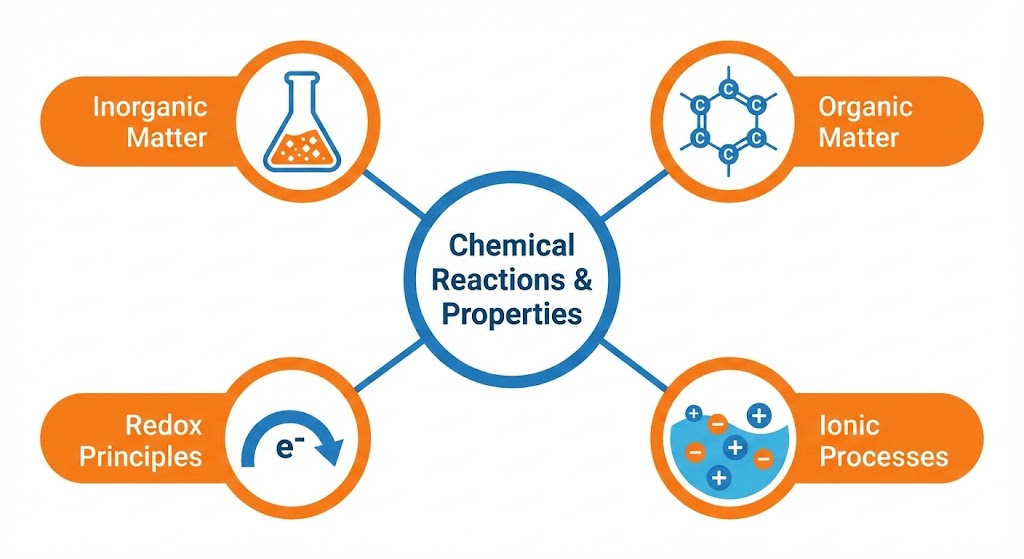
1. **Common Inorganic Substances**:
* Core: Elements, oxides, acids, bases, and salts.
* Key Point: Trends in properties guided by the Periodic Law.
2. **Basic Organic Compounds**:
* Core: Typical functional groups (C=C double bonds, hydroxyl groups, carboxyl groups, etc.).
* Key Point: Structure determines properties (Isomers and characteristic reactions).
3. **Reaction Principle I: Redox Reactions**:
* Essence: Transfer of electrons.
* Skill: Identifying oxidizing/reducing agents and balancing equations.
4. **Reaction Principle II: Ionic Reactions**:
* Essence: Exchange or combination of ions in solution.
* Skill: Determining ion coexistence, writing net ionic equations, and testing for common ions.
These four parts are not isolated: **Inorganic and Organic substances** provide the "protagonists" of the reactions, while **Redox and Ionic theories** provide the "tools" for analyzing the reaction mechanisms.
---
2. Learning Objectives
Upon completing this module, you need to achieve the following levels required by the CSCA exam:
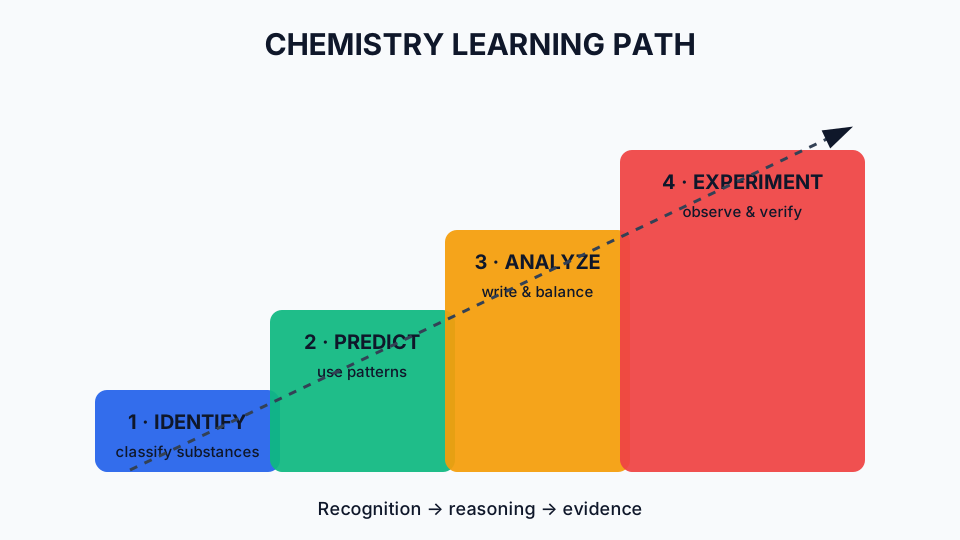
* **Level 1: Identify & Classify**
* Quickly determine the category of a substance based on its chemical formula (e.g., $H_2SO_4$) or structural formula (e.g., $CH_3CH_2OH$).
* Distinguish between electrolytes and non-electrolytes.
* **Level 2: Predict & Pattern**
* Predict the oxidizing or reducing nature of a substance based on "Valence State."
* Predict reaction types (e.g., substitution, addition, oxidation) of organic compounds based on "Functional Groups."
* **Level 3: Analyze & Write**
* Proficiently write complex redox reaction equations (Conservation of Electrons method).
* Correctly write net ionic equations (Splitting and Cancellation rules).
* **Level 4: Experiment & Distinguish**
* Design experimental plans to identify common ions (e.g., $Cl^-, SO_4^{2-}, Fe^{3+}$).
* Describe reaction phenomena (precipitation, gas evolution, color change).
**Exam Tip:** "Properties determine reactions, and structure determines properties" is the core thought throughout this module. When reviewing, be sure to summarize specific chemical equations into general reaction rules.