Elements (Substances)
CSCA Elements (Substances) study guide organized around the publicly available CSCA syllabus. Practice Chemistry questions on aicsca.com.
Before planning this topic, check the CSCA Exam Guide 2026 for exam dates, registration, fees, and subject requirements.
Syllabus Alignment
This study guide is organized around the publicly available CSCA syllabus for international undergraduate applicants.
Who It Is For
International students preparing for CSCA Math, Physics, Chemistry, or Chinese exams.
Related Practice
CSCA Practice · Go to questions
Past papers and worked video solutions · Timed mock exams · All subject video lessons
Practice by Topic
Jump from this tutorial to filtered practice questions for the same knowledge point.
Related formulas, concepts, and glossary terms
Chemistry Formula & Concept Reference
- Standard Molar Volume
- Law of Partial Pressures (Dalton's Law)
- Avogadro's Law
- Molar Mass Calculation for Gases
- Molar Volume of Gas (Standard Conditions)
Chemistry Exam Glossary
Tutorial Content
Elements (Substances)
1. Core Tool: The Metal Activity Series
This is the "master key" for solving metal reaction problems. You must master not just the order, but the **boundary lines**.
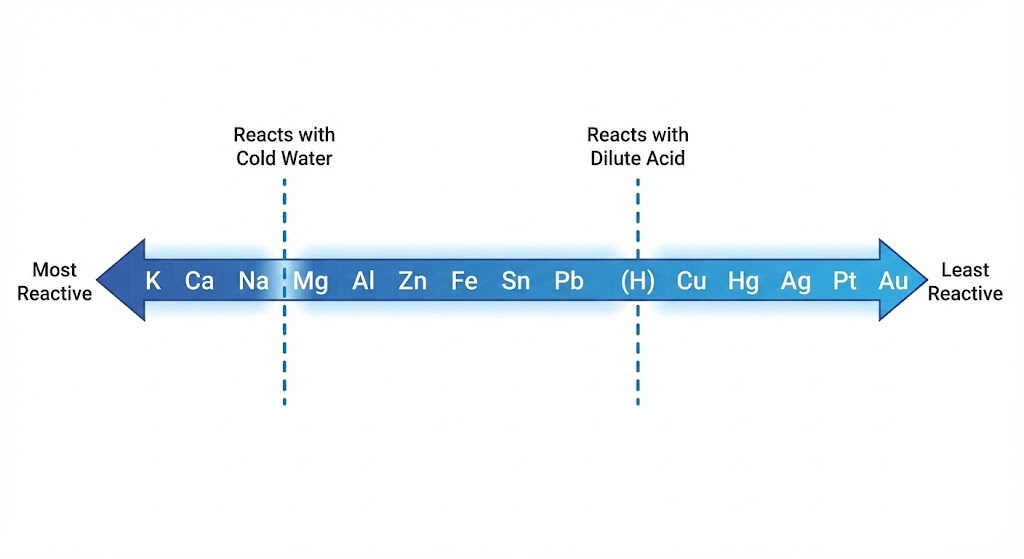
**Key Rules & Exam Traps:**
1. **Reaction with Acids (Boundary: H)**:
* Metals **before H** can displace Hydrogen gas from dilute HCl or dilute $H_2SO_4$.
* **Exception Warning**: **Nitric Acid ($HNO_3$)** and **Concentrated Sulfuric Acid** are strong oxidizing agents. They react with metals to produce water and nitrogen/sulfur oxides, **NOT Hydrogen**.
2. **Reaction with Water (Boundary: Mg)**:
* **K, Ca, Na**: Extremely active. React violently with cold water to form alkali and $H_2$.
* **Mg**: Reacts slowly with cold water, noticeably with boiling water.
* **Al and beyond**: Do not react with water at room temperature.
3. **Reaction with Salt Solutions**:
* Rule: **"Left displaces Right"** (More active metal displaces less active metal).
* **Trap**: If you put K, Ca, or Na into a $CuSO_4$ solution, they will **NOT** displace Cu directly. They react with the water first.
---
2. High-Frequency Metal Topics
#### A. Sodium (Na) - Representative Active Metal
* **Phenomenon**: When Na is dropped into water (with phenolphthalein), remember: "**Float, Melt, Swim, Hiss, Red**".
* **Float**: Density < Water.
* **Melt**: Exothermic reaction + low melting point $\rightarrow$ forms a ball.
* **Swim & Hiss**: Generated gas ($H_2$) pushes the ball.
* **Red**: Forms $NaOH$ (alkaline).
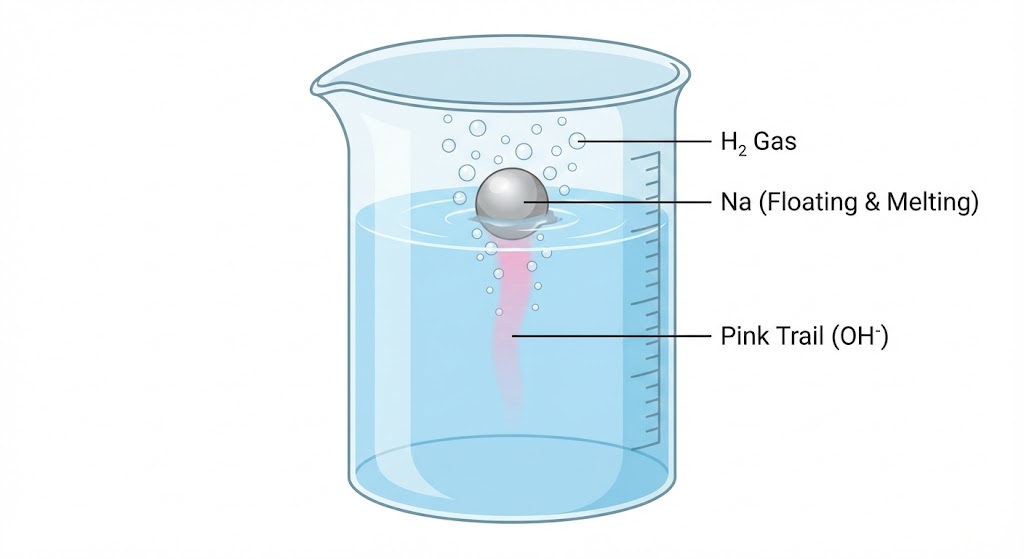
* **Equation**: $2Na + 2H_2O \rightarrow 2NaOH + H_2\uparrow$
#### B. Aluminum (Al) - Amphoteric Metal
This is a critical differentiation point in CSCA exams. Al reacts with both strong acids and strong bases.
* With Acid: $2Al + 6HCl \rightarrow 2AlCl_3 + 3H_2\uparrow$
* **With Base (Focus)**: $2Al + 2NaOH + 2H_2O \rightarrow 2NaAlO_2 + 3H_2\uparrow$
#### C. Iron (Fe) - Variable Valency
The exam often tests whether Fe forms +2 or +3 valency states.
| Oxidizer Strength | Product Valency | Typical Equation |
| :--- | :--- | :--- |
| **Weak** ($H^+, Cu^{2+}, S, I_2$) | **+2 ($Fe^{2+}$)** | $Fe + 2HCl \rightarrow FeCl_2 + H_2\uparrow$ |
| **Strong** ($Cl_2, Br_2, HNO_3$) | **+3 ($Fe^{3+}$)** | $2Fe + 3Cl_2 \xrightarrow{ignite} 2FeCl_3$ |
---
3. High-Frequency Non-Metal Topics
#### A. Chlorine ($Cl_2$) - Strong Oxidizer
* **Properties**: Yellow-green, toxic gas.
* **Reaction with Alkali (Bleach Production)**:
* $Cl_2 + 2NaOH \rightarrow NaCl + NaClO + H_2O$
* Point: $Cl_2$ acts as both oxidizer and reducer (Disproportionation).
#### B. Carbon (C) & Silicon (Si)
* **Carbon**: Reducing agent at high temps (used to smelt metals from oxides).
* **Silicon (Si)**: Semiconductor material. Chemically stable, but dissolves in Hydrofluoric acid ($HF$) and strong bases ($NaOH$).