Salts
CSCA Salts study guide organized around the publicly available CSCA syllabus. Practice Chemistry questions on aicsca.com.
Before planning this topic, check the CSCA Exam Guide 2026 for exam dates, registration, fees, and subject requirements.
Syllabus Alignment
This study guide is organized around the publicly available CSCA syllabus for international undergraduate applicants.
Who It Is For
International students preparing for CSCA Math, Physics, Chemistry, or Chinese exams.
Related Practice
CSCA Practice · Go to questions
Past papers and worked video solutions · Timed mock exams · All subject video lessons
Practice by Topic
Jump from this tutorial to filtered practice questions for the same knowledge point.
Related formulas, concepts, and glossary terms
Chemistry Formula & Concept Reference
- Solubility Rules for Common Salts
- Conditions for Salt Formation via Double Displacement Reaction
- Conditions for Ionic Reactions to Occur (Formation of Precipitate)
- Definition and General Formula of Salt
- General Formula for Salt Hydrolysis (Salt of Weak Acid and Strong Base)
- Displacement Reaction between Salt and Metal
- General Formula for Salt Hydrolysis
- Solubility Product Constant ( K(sp) ) Expression for Slightly Soluble Salts
Chemistry Exam Glossary
Tutorial Content
Salts
1. Core Definitions & Classification System
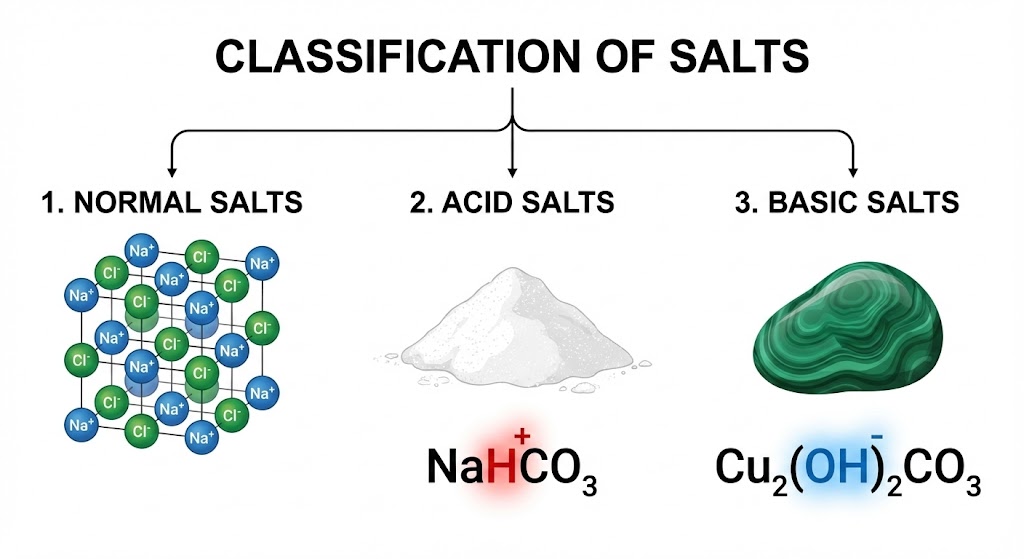
In the CSCA exam, salts are more than just "table salt." You need to master their broad definitions and classifications, especially the properties of **Acid Salts**, which is a difficult point.
* **Definition**: Compounds composed of metal ions (or ammonium ions $NH_4^+$) and acid radical ions.
* **Classification**:
* **Normal Salt**: Product of complete neutralization (e.g., $Na_2CO_3, NaCl$).
* **Acid Salt**: Salt containing ionizable $H^+$ (e.g., $NaHCO_3, NaHSO_4$).
* *Exam Point*: $NaHCO_3$ reacts with both acids (forming $CO_2$) and bases (forming $Na_2CO_3$).
* **Basic Salt**: Salt containing $OH^-$ (e.g., $Cu_2(OH)_2CO_3$ Malachite).
---
2. Core Tool: Solubility Rules
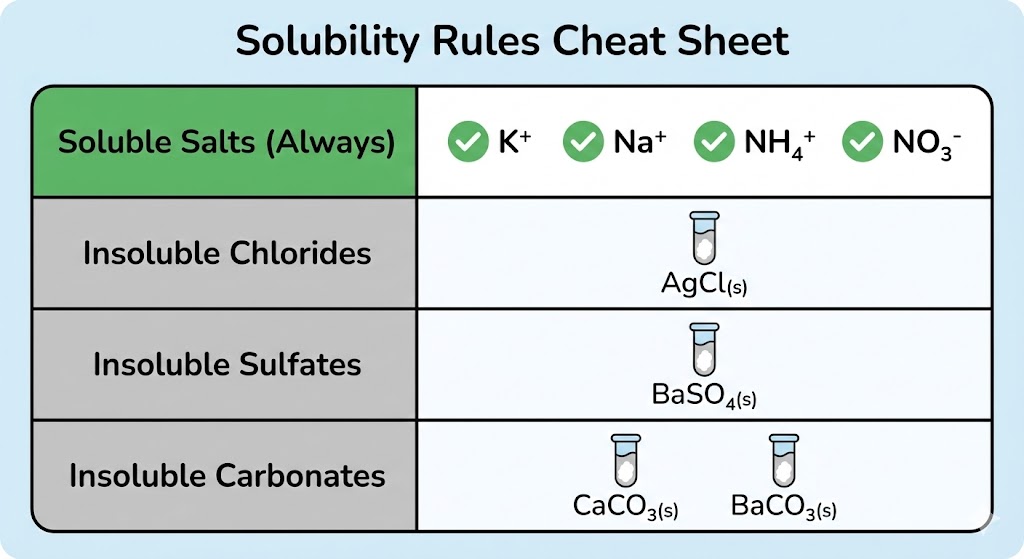
This is the "Judge" determining if a **Metathesis Reaction** can occur. Don't memorize everything, just the **CSCA High-Frequency Rules**:
* **Always Soluble**: **Potassium ($K^+$), Sodium ($Na^+$), Ammonium ($NH_4^+$), and Nitrates ($NO_3^-$)** are ALL soluble.
* **Chlorides ($Cl^-$)**: Only **$AgCl$** is insoluble (White precipitate, insoluble in acid).
* **Sulfates ($SO_4^{2-})$**: Only **$BaSO_4$** is insoluble (White precipitate, insoluble in acid); $CaSO_4, Ag_2SO_4$ are slightly soluble.
* **Carbonates ($CO_3^{2-})$**: **Mostly Insoluble** except for K, Na, $NH_4$ (e.g., $CaCO_3, BaCO_3$ are white precipitates, soluble in acid).
---
3. Four Chemical Properties of Salts
| Reaction Type | General Formula | Key Conditions | Typical Equation |
| :--- | :--- | :--- | :--- |
| **1. Salt + Metal** | $Salt + Metal \rightarrow New\ Salt + New\ Metal$ | ① Salt is **Soluble**<br>② Metal is **more reactive** than salt's metal (Except K, Ca, Na) | $Fe + CuSO_4 \rightarrow FeSO_4 + Cu$<br>(Wet copper smelting) |
| **2. Salt + Acid** | $Salt + Acid \rightarrow New\ Salt + New\ Acid$ | Produces **Gas** or **Precipitate** | $AgNO_3 + HCl \rightarrow AgCl\downarrow + HNO_3$<br>$CaCO_3 + 2HCl \rightarrow CaCl_2 + H_2O + CO_2\uparrow$ |
| **3. Salt + Base** | $Salt + Base \rightarrow New\ Salt + New\ Base$ | ① Both reactants **Soluble**<br>② Produces **Precipitate** or **Gas** | $CuSO_4 + 2NaOH \rightarrow Cu(OH)_2\downarrow + Na_2SO_4$<br>$NH_4Cl + NaOH \xrightarrow{\Delta} NaCl + NH_3\uparrow + H_2O$ |
| **4. Salt + Salt** | $Salt_1 + Salt_2 \rightarrow Salt_3 + Salt_4$ | ① Both reactants **Soluble**<br>② Produces **Precipitate** | $NaCl + AgNO_3 \rightarrow AgCl\downarrow + NaNO_3$ |
---
4. Typical Examples & Purification
**Topic: Purification of Crude Salt**
How to remove soluble impurities ($Ca^{2+}, Mg^{2+}, SO_4^{2-}$) from $NaCl$?
This is a classic **Multi-step Purification** process. The order of reagents is an exam focus.
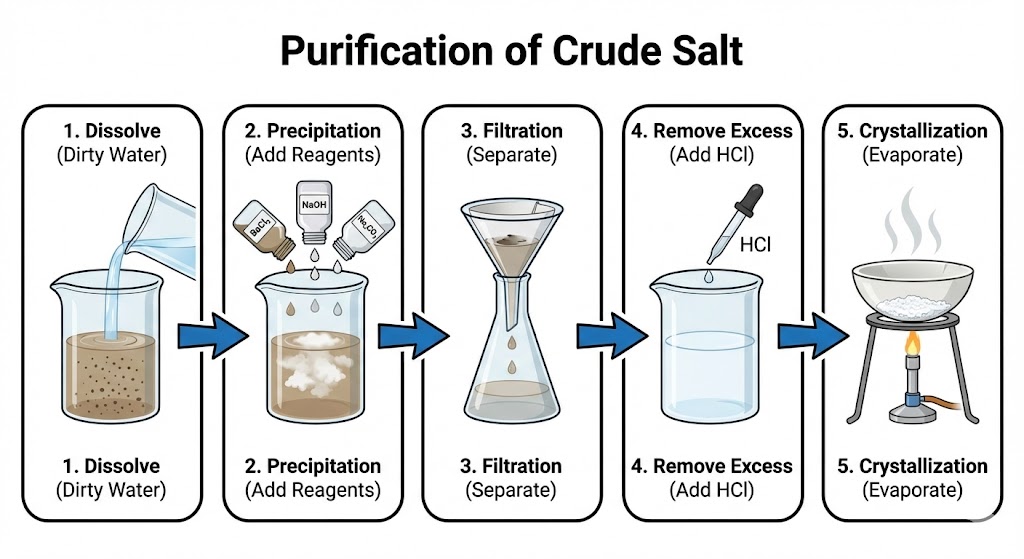
**Key Logic**:
1. **$BaCl_2$** removes $SO_4^{2-}$.
2. **$NaOH$** removes $Mg^{2+}$.
3. **$Na_2CO_3$** removes $Ca^{2+}$ AND **excess $Ba^{2+}$** (So $Na_2CO_3$ MUST be added after $BaCl_2$).
4. **Filter** to remove all precipitates.
5. **Dilute HCl** removes excess $NaOH$ and $Na_2CO_3$.
6. **Evaporate** to remove $HCl$ and water.
**Thinking Question**:
Why is there no reaction when $KNO_3$ and $NaCl$ are mixed?
* **Answer**: Because the products ($KCl$ and $NaNO_3$) are both soluble after exchanging ions. No precipitate, gas, or water is formed, so the conditions for metathesis are not met.