Solution Concentration and pH Calculations
Calculate molarity, mass-fraction conversions, dilution, and pH. Worked examples explain strong-base mixtures, very dilute acids, and temperature assumptions.
Before planning this topic, check the CSCA Exam Guide 2026 for exam dates, registration, fees, and subject requirements.
Syllabus Alignment
This study guide is organized around the publicly available CSCA syllabus for international undergraduate applicants.
Who It Is For
International students preparing for CSCA Math, Physics, Chemistry, or Chinese exams.
Related Practice
CSCA Practice · Go to questions
Past papers and worked video solutions · Timed mock exams · All subject video lessons
Practice by Topic
Jump from this tutorial to filtered practice questions for the same knowledge point.
Related formulas, concepts, and glossary terms
Chemistry Formula & Concept Reference
- pH Calculation for Strong Acid Solutions (Monoprotic)
- pH Calculation for Strong Base Solutions (Monoprotic)
- Definition of pH
- Mass Fraction Formula
- Ion Product Constant of Water
- Relationship between pH and pOH
- Molarity Formula
Chemistry Exam Glossary
Tutorial Content
Solution Concentration and pH Calculations
Concentration calculations describe how much solute is present in a given amount of solution. pH calculations describe acidity on a logarithmic scale. Keep these two ideas separate: the concentration of an acid is not always equal to the hydrogen-ion concentration.
1. Molar concentration and mass fraction
Molar concentration, also called molarity, is
Here is the amount of solute in moles and is the final solution volume in liters. The volume of water added is not necessarily the final volume of the solution.
If the solution density is in g/mL, the solute molar mass is in g/mol, and the mass fraction is a decimal, then
For a mass percentage of 98%, enter , not . The factor converts a one-liter sample to milliliters: its mass is grams, of which grams is solute.
Example: converting a mass percentage
A sulfuric acid solution has density and mass fraction . Using a molar mass of ,
This gives the analytical concentration of sulfuric acid. It does not give the solution's pH, and the example is a calculation rather than a procedure for handling concentrated acid.
2. Preparing a measured solution volume
For a solution of accurately known concentration, a volumetric flask provides a calibrated final volume. Follow the laboratory's procedure and safety instructions.
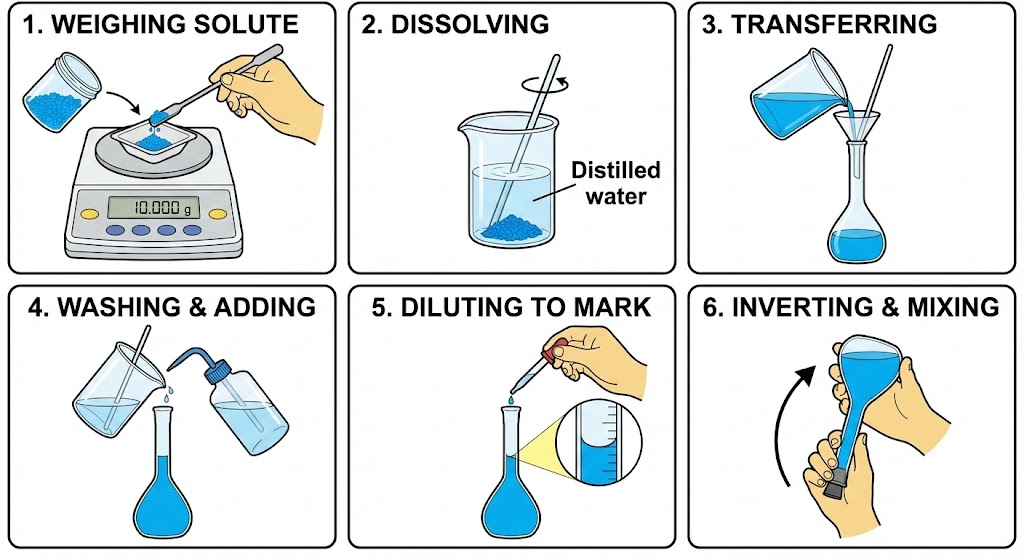
For a suitable solid solute, the usual sequence is to weigh it, dissolve it in some solvent, transfer the solution quantitatively, add the rinsings, make up to the mark, and mix. Let the solution reach the appropriate calibration temperature before setting the final volume.
Read the bottom of a clear, concave meniscus at eye level. With the amount of solute fixed, filling above the mark makes the concentration too low; filling below it makes the concentration too high.
For dilution without loss or reaction of the solute,
Here is the final solution volume, not the volume of solvent added.
3. What pH and pOH mean
Formally, pH is defined using the dimensionless hydrogen-ion activity:
For dilute solutions, introductory problems often approximate activity using the numerical concentration in mol/L and write . In water, is shorthand for hydrated hydrogen ions, commonly represented as .
Similarly, . At , the usual dilute-solution approximation gives
| Solution at | Ion concentrations | pH |
|---|---|---|
| Acidic | Below 7 | |
| Neutral | Approximately 7 | |
| Basic | Above 7 |
The neutral pH depends on temperature because water's ionization equilibrium changes. Also, 0–14 is a familiar teaching range, not an absolute limit on pH.
4. Mixing strong acids and bases
Do not average pH values. First convert concentrations to amounts, account for neutralization, and then calculate the concentration of the excess ions in the final volume.
For the simple formulas below, assume strong acids or bases dissociate as specified, the solution volumes add, and other reactions and water's contribution are negligible.
- Mixing acids: add the amounts of supplied, then divide by the total volume.
- Mixing bases: add the amounts of supplied, divide by the total volume, and find pOH before pH.
- Mixing an acid and a base: subtract the reacting amounts. If acid is in excess, use . If base is in excess, use the corresponding excess amount of .
Use liters when converting mol/L to moles. At exact neutralization of a strong acid and strong base, water's equilibrium determines the pH. Weak acids, weak bases, buffers, and extremely dilute mixtures need an equilibrium calculation rather than these simple excess-ion formulas.
Example: equal volumes of two NaOH solutions
At , mix equal volumes of NaOH solutions with pH 12 and pH 10. In the dilute-solution approximation,
The concentration after mixing is
Thus and , not the arithmetic mean of 12 and 10.
Example: an extremely dilute acid
For HCl at , taking gives 8, but that calculation neglects the hydrogen ions supplied by water.
Using charge balance and water's ionization equilibrium, with concentrations entered numerically in mol/L,
where and . This gives and pH approximately 6.98. The solution is slightly acidic, not basic.
Further reading
Content reviewed: 9 September 2026.