Chemical Bonding and Intermolecular Forces
CSCA Chemical Bonding and Intermolecular Forces study guide organized around the publicly available CSCA syllabus. Practice Chemistry questions on aicsca.com.
Before planning this topic, check the CSCA Exam Guide 2026 for exam dates, registration, fees, and subject requirements.
Syllabus Alignment
This study guide is organized around the publicly available CSCA syllabus for international undergraduate applicants.
Who It Is For
International students preparing for CSCA Math, Physics, Chemistry, or Chinese exams.
Related Practice
CSCA Practice · Go to questions
Past papers and worked video solutions · Timed mock exams · All subject video lessons
Practice by Topic
Jump from this tutorial to filtered practice questions for the same knowledge point.
Related formulas, concepts, and glossary terms
Chemistry Formula & Concept Reference
- Bond Energy (Average bond energy)
- van der Waals Force (London Dispersion Force) Potential Energy
- Lattice Energy of Ionic Bond (Born-Lande equation)
- Hydrogen Bond Energy Range
- Lattice Energy of Ionic Bond (Born-Landé equation)
- van der Waals Equation (Real gases)
- Bond Energy of Covalent Bond
- Coulomb's Law (Force between charges)
Chemistry Exam Glossary
Tutorial Content
Chemical Bonding and Intermolecular Forces
Core Concepts and Learning Objectives
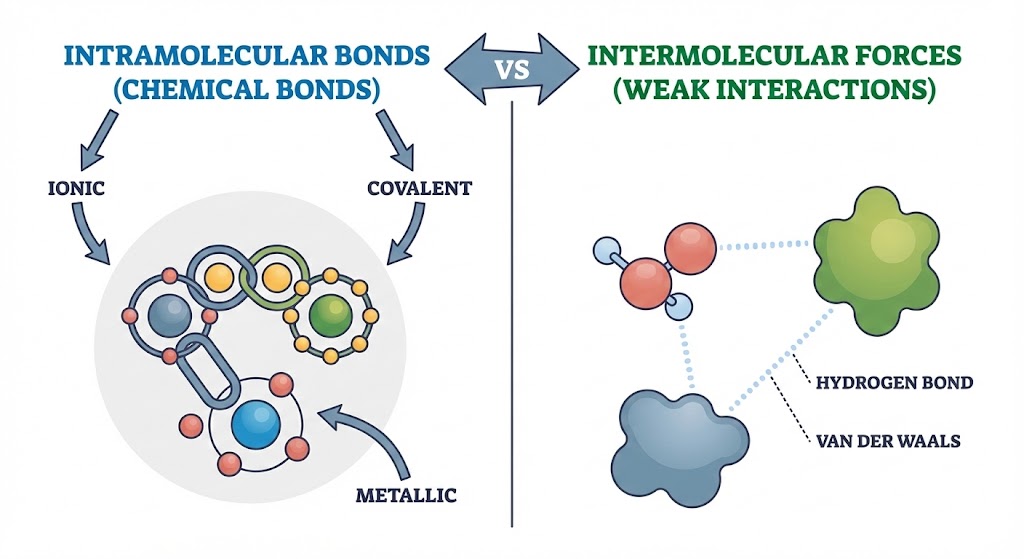
This section explains how atoms combine to form molecules or crystals (**Chemical Bonds**) and how molecules interact with each other (**Intermolecular Forces**). This is key to understanding physical properties (melting point, boiling point, solubility) and chemical properties.
 **Learning Objectives:**
1. **Distinguish Strength**: Understand the fundamental difference between chemical bonds (strong) and intermolecular forces (weak).
2. **Master Types**: Deeply understand Ionic, Covalent, and Metallic bonds, and the specificity of Hydrogen bonding.
3. **Infer Properties**: Compare melting points and hardness based on bond type and force strength.
---
I. Chemical Bonds
Strong interactions between **adjacent** atoms or ions (Bond energy usually >100 kJ/mol).
#### 1. Ionic Bond
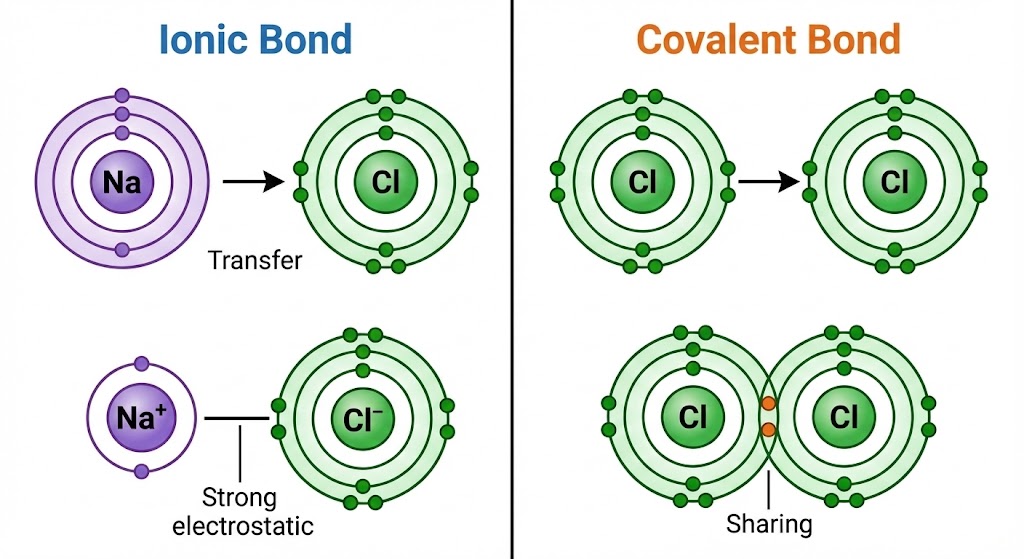
* **Definition**: Formed by **electrostatic attraction** between cations and anions.
* **Formation**: Electron transfer from reactive metals (e.g., Na, Mg) to reactive non-metals (e.g., Cl, O).
* **Characteristics**:
* **Non-directional, Non-saturable**.
* Forms **Ionic Crystals**: Hard, high melting point. Conducts electricity only when **molten or dissolved in water**.
* **Examples**: $NaCl$, $MgO$, $K_2SO_4$.
#### 2. Covalent Bond
* **Definition**: Formed by **sharing electron pairs** between atoms.
* **Formation**: Typically between non-metal elements (e.g., H-Cl, C-C).
* **Characteristics**:
* **Directional, Saturable**.
* **Classification**:
* **Non-polar**: Equal sharing (e.g., $Cl-Cl$).
* **Polar**: Unequal sharing (e.g., $H-Cl$).
* **Coordinate (Dative)**: Shared pair comes from one atom (e.g., in $NH_4^+$).
* **Examples**: $H_2O$, $CO_2$, $CH_4$.
 #### 3. Metallic Bond
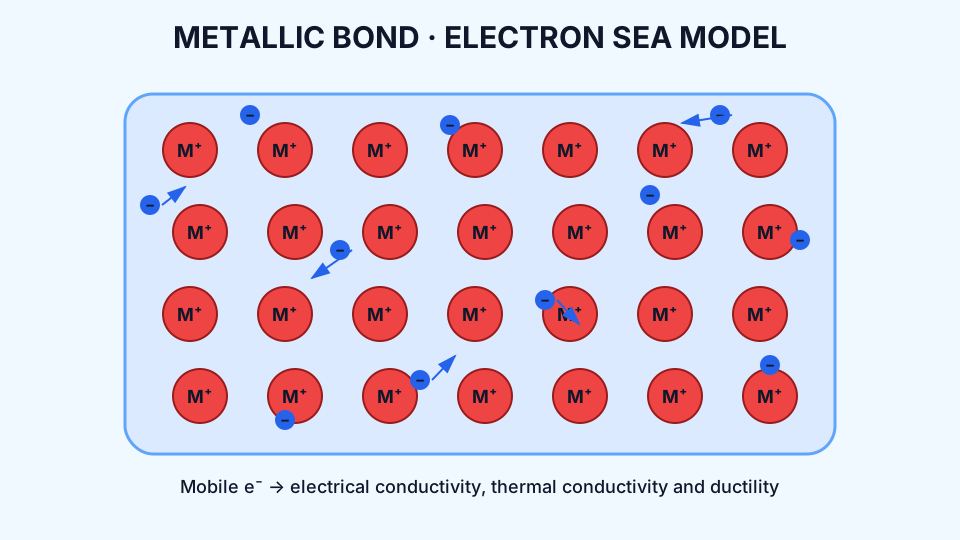
* **Definition**: Strong electrostatic attraction between metal cations and **delocalized electrons** (electron sea).
* **Characteristics**:
* Free-moving electrons give metals **conductivity, heat transfer, and ductility**.
* **Examples**: $Fe$, $Cu$, Alloys.
 ---
---
II. Intermolecular Forces
**Weak interactions** between molecules, affecting **physical properties** (Melting/Boiling points).
#### 1. Van der Waals Forces
Universal among molecules. For most non-polar molecules ($He, N_2, CH_4$), **London Dispersion Force** is dominant.
* **Trend**: Similar structure $\rightarrow$ Higher molecular mass $\rightarrow$ More polarizable electron cloud $\rightarrow$ Stronger VdW force $\rightarrow$ Higher MP/BP (e.g., $F_2 < Cl_2 < Br_2 < I_2$).
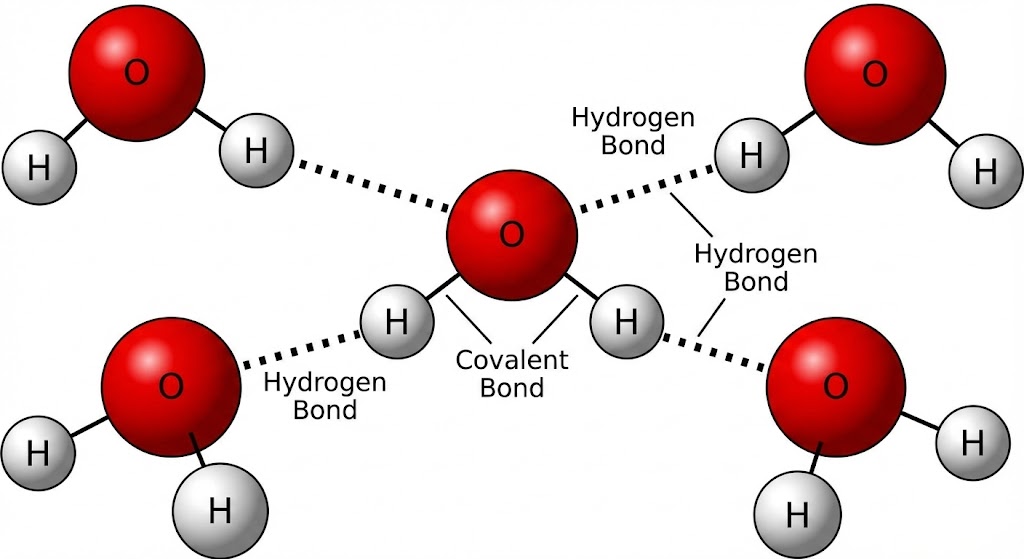
#### 2. Hydrogen Bond
* **Definition**: A special, strong intermolecular force. H bonded to high electronegativity atoms (**N, O, F**) attracts another electronegative atom.
* **Notation**: $X—H \cdots Y$ ($X, Y$ = $N, O, F$).
* **Impact**: Abnormally high BP (e.g., $H_2O > H_2S$); High solubility (e.g., $NH_3$ in water).
 ---
---
III. Summary and Comparison
| Type | Particles | Strength | Main Impact | Example |
| :--- | :--- | :--- | :--- | :--- |
| **Ionic** | Ions | Strong | Crystal stability, MP/BP | $NaCl$ |
| **Covalent** | Atoms | Strong | Molecular stability | $HCl$ |
| **Metallic** | Cations + Electrons | Variable | Conductivity, Ductility | $Cu$ |
| **H-Bond** | Molecules (H-N/O/F) | Weak (10-40 kJ) | High MP/BP, Solubility | $H_2O$ |
| **VdW** | Molecules | Very Weak (<10 kJ) | MP/BP, Liquefaction | $Ar, CO_2$ |
---
IV. Typical Examples
**Ex 1: Identifying Bonds**
Identify bonds in $NH_4Cl$.
* **Solution**: Ionic compound ($NH_4^+$ and $Cl^-$). Contains **Ionic Bonds**. Within $NH_4^+$, N and H are linked by **Covalent Bonds** (including Coordinate Covalent). Total: **Ionic & Covalent**.
**Ex 2: BP Comparison**
Compare BP of $H_2O$ vs $H_2S$. Why?
* **Solution**: $H_2O > H_2S$. Despite smaller mass, water has **Hydrogen Bonds**, which are much stronger than standard Van der Waals forces.
**Ex 3: Molecular Geometry (VSEPR)**
Analyze the geometry and polarity of $NH_3$.
* **Solution**:
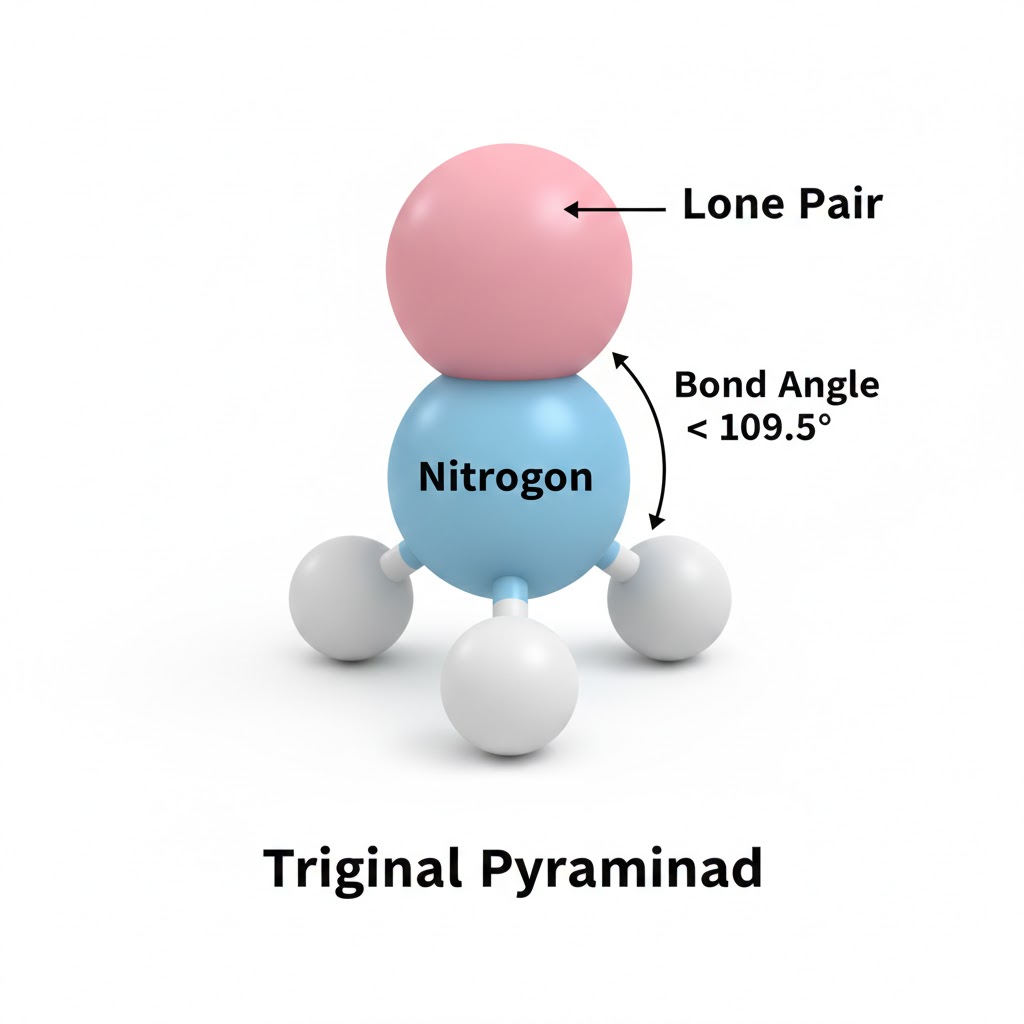
1. N has 5 valence e-, forms 3 bonds, has 1 **Lone Pair**.
2. Lone pair repulsion pushes bonds down.
3. Shape: **Trigonal Pyramidal**.
4. Asymmetric $\rightarrow$ **Polar Molecule**.