Judgment of Redox Reactions
CSCA Judgment of Redox Reactions study guide organized around the publicly available CSCA syllabus. Practice Chemistry questions on aicsca.com.
Before planning this topic, check the CSCA Exam Guide 2026 for exam dates, registration, fees, and subject requirements.
Syllabus Alignment
This study guide is organized around the publicly available CSCA syllabus for international undergraduate applicants.
Who It Is For
International students preparing for CSCA Math, Physics, Chemistry, or Chinese exams.
Related Practice
CSCA Practice · Go to questions
Past papers and worked video solutions · Timed mock exams · All subject video lessons
Practice by Topic
Jump from this tutorial to filtered practice questions for the same knowledge point.
Related formulas, concepts, and glossary terms
Chemistry Formula & Concept Reference
- Using Oxidation Number Change to Identify Redox Reactions
- Common Oxidizing Agents and Reducing Agents
- Identifying Oxidizing and Reducing Agents
- Electron Transfer in Redox Reactions
- Oxidizing Agent and Reducing Agent
Chemistry Exam Glossary
Tutorial Content
Judgment of Redox Reactions
1. Core Logic & Definitions
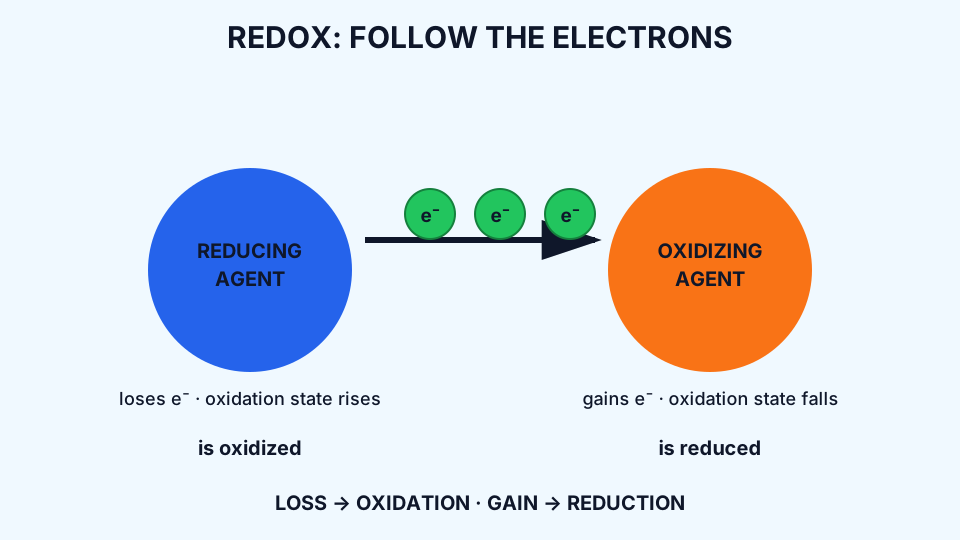
Redox reactions are high-frequency topics in the CSCA exam. We need to identify reaction types and roles quickly by tracking changes in **Oxidation State**.
* **Essence**: Electron Transfer.
* **Feature**: Change in Oxidation State.
* **Mnemonic**:
* **LEO says GER** (Loss of Electrons is Oxidation; Gain of Electrons is Reduction).
* **Rise-Lose-Oxidation, Reducing Agent**.
* **Drop-Gain-Reduction, Oxidizing Agent**.
*Explanation*:
* **Rise**: Oxidation state increases $\rightarrow$ **Lose**: Loses electrons $\rightarrow$ **Oxidation** $\rightarrow$ Acts as **Reducing Agent**.
* **Drop**: Oxidation state decreases $\rightarrow$ **Gain**: Gains electrons $\rightarrow$ **Reduction** $\rightarrow$ Acts as **Oxidizing Agent**.
2. Double-Line Bridge Method
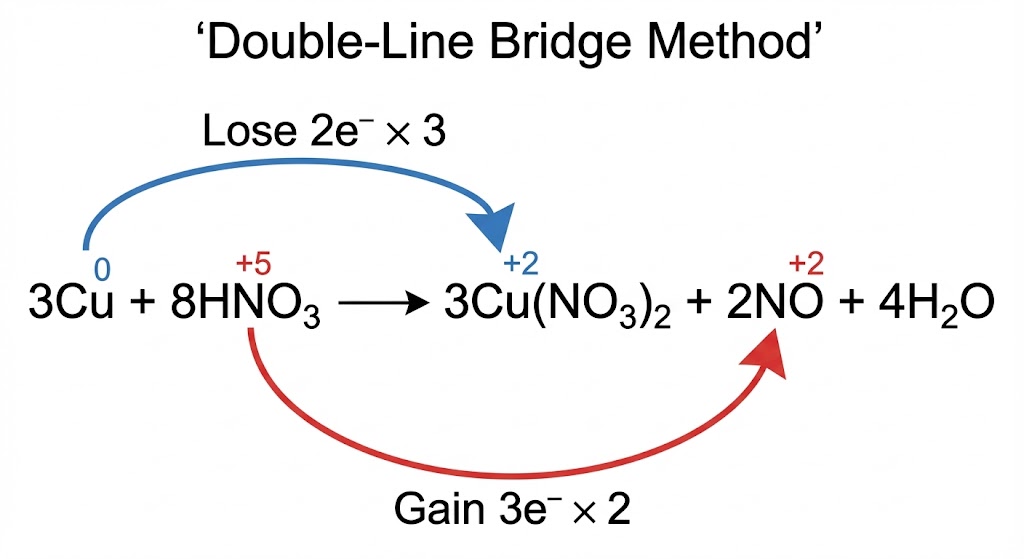
This is the most intuitive method to visualize electron transfer direction and quantity.
**Steps**:
1. **Label**: Mark oxidation states of elements that change.
2. **Connect**: Draw lines from reactant to product for the same element.
3. **Annotate**: Mark "Lose/Gain" electron count (Format: $a \times b\ e^-$).
**Typical Example**: Copper + Dilute Nitric Acid
$$3Cu + 8HNO_3(dilute) \rightarrow 3Cu(NO_3)_2 + 2NO\uparrow + 4H_2O$$
* **Analysis**:
* $Cu$: $0 \rightarrow +2$ (Rise 2, Lose $2e^-$).
* $N$ (in $HNO_3$): $+5 \rightarrow +2$ (in $NO$, Drop 3, Gain $3e^-$).
* *Note*: Some $N$ remains $+5$ in $Cu(NO_3)_2$, acting as acid, not participating in redox.
3. Common Oxidizing & Reducing Agents
| Role | Typical Substance | Product |
| :--- | :--- | :--- |
| **Strong Oxidizing Agents** | $KMnO_4$ ($H^+$) | $Mn^{2+}$ (Colorless) |
| | $HNO_3$ (Conc/Dil) | $NO_2$ (Red-brown gas) / $NO$ (Colorless) |
| | $Cl_2, Br_2$ | $Cl^-, Br^-$ |
| | $Fe^{3+}$ | $Fe^{2+}$ (Pale green) |
| **Strong Reducing Agents** | Active Metals ($Na, Mg, Al$) | Metal Cations ($Na^+, Mg^{2+}...$) |
| | $C, CO, H_2$ | $CO_2, H_2O$ (High temp reduction) |
| | $I^-, S^{2-}$ | $I_2, S$ (Precipitate) |
4. Typical Example Analysis
**Example 1: Identification**
Which of the following is a Redox reaction?
* A. $CaCO_3 \xrightarrow{\Delta} CaO + CO_2\uparrow$
* B. $2NaOH + Cl_2 \rightarrow NaCl + NaClO + H_2O$
* C. $AgNO_3 + NaCl \rightarrow AgCl\downarrow + NaNO_3$
**Analysis**:
* A is Decomposition, valences of Ca(+2), C(+4), O(-2) unchanged $\rightarrow$ Non-Redox.
* B involves Cl changing from 0 to -1 ($NaCl$) and +1 ($NaClO$) $\rightarrow$ **Redox** (Disproportionation).
* C is Double Displacement, no valence change $\rightarrow$ Non-Redox.
**Answer: B**
**Example 2: Electron Transfer Calculation**
In reaction $MnO_2 + 4HCl(conc.) \xrightarrow{\Delta} MnCl_2 + Cl_2\uparrow + 2H_2O$, if 1 mol $Cl_2$ is produced, how many electrons are transferred?
**Analysis**:
1. Check change: $Cl$ goes from -1 $\rightarrow$ 0 (in $Cl_2$).
2. Calculate: To form 1 molecule of $Cl_2$, 2 $Cl^-$ ions each lose 1 electron.
3. Total: $1 \text{ mol} \times 2 = 2 \text{ mol } e^-$ transferred.
* *Trap*: 4 mol HCl are consumed, but only 2 mol are oxidized (to $Cl_2$). The other 2 mol provide acidity (for $MnCl_2$).