Application of the Ideal Gas Law
Apply the ideal gas law to density, molar mass, and compression problems. Check units, absolute pressure, kelvin temperatures, and STP conventions.
Before planning this topic, check the CSCA Exam Guide 2026 for exam dates, registration, fees, and subject requirements.
Syllabus Alignment
This study guide is organized around the publicly available CSCA syllabus for international undergraduate applicants.
Who It Is For
International students preparing for CSCA Math, Physics, Chemistry, or Chinese exams.
Related Practice
CSCA Practice · Go to questions
Past papers and worked video solutions · Timed mock exams · All subject video lessons
Practice by Topic
Jump from this tutorial to filtered practice questions for the same knowledge point.
Related formulas, concepts, and glossary terms
Chemistry Formula & Concept Reference
- Dalton's Law of Partial Pressures
- Common Value of the Molar Gas Constant R
- Density Form of the Ideal Gas Law
- Relationship between Partial Pressure and Mole Fraction
- Value of the Molar Gas Constant R (Common Units)
Chemistry Exam Glossary
Tutorial Content
Application of the Ideal Gas Law
The ideal gas law connects pressure, volume, temperature, and amount of gas. It can also be used to estimate gas density or molar mass. Before substituting numbers, check the temperature scale, the pressure definition, and the units of the gas constant.
1. What the equation means
Here, is absolute pressure, is volume, is the amount of gas in moles, is thermodynamic temperature in kelvin, and is the gas constant.
Convert Celsius temperatures using . Use only when that approximation is appropriate to the question.
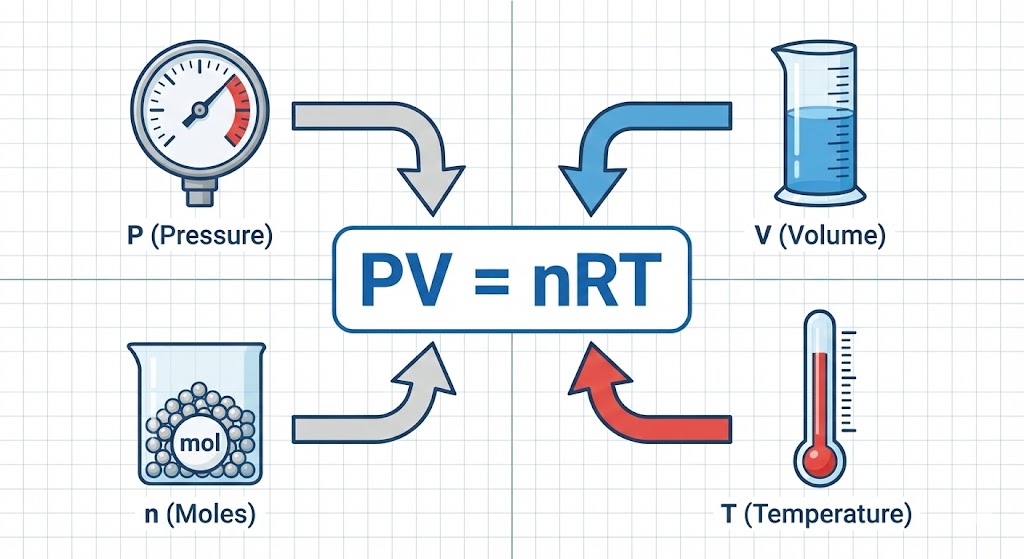
The illustration identifies the four variables; it does not specify measurement conditions. If a pressure gauge gives pressure relative to the atmosphere, convert it to absolute pressure before using the equation.
Real gases often approximate ideal behavior at low pressure and at temperatures well above condensation. The approximation becomes less reliable at high pressure or near condensation.
2. Choose a consistent set of units
| Approximate value and units of | Pressure | Volume |
|---|---|---|
| atm | L | |
| Pa | m³ | |
| kPa | L |
The last two rows have the same numerical value because . In every row, use moles for and kelvin for .
Do not combine pressure in Pa with volume in L and substitute without converting one of those units.
3. Density and molar mass
Substitute , where is mass and is molar mass:
Since density is ,
For example, density in g/L with in L·atm·mol⁻¹·K⁻¹ and pressure in atm gives molar mass in g/mol.
Example 1: Estimating molar mass
A gas has density at and . Assuming ideal behavior, estimate its molar mass.
Use and :
This is close to the molar mass of sulfur dioxide, about , but density alone does not identify a gas. Measurement uncertainty and the ideal-gas approximation also matter.
4. Comparing two states of the same gas sample
If the amount of gas stays constant,
A sealed container alone is not sufficient to guarantee constant : a reaction or condensation could change the amount of gas present. Check the conditions in the problem.
Example 2: Compression and heating
A fixed amount of gas occupies at and . It is compressed to and heated to . Find the final pressure, assuming ideal behavior and no loss or reaction of the gas.
Convert the temperatures to and :
To two significant figures, this is . The pressure rises by slightly more than a factor of two because the gas is both compressed and heated.
5. Check what “standard conditions” means
Do not assume that STP always means 1 atm. IUPAC defines standard conditions for gases as and (1 bar); some textbooks use the older convention of and 1 atm.
The ideal molar volume is approximately under the 1 bar convention and under the 1 atm convention. At and 1 bar, a commonly used ambient reference, it is about .
Use the temperature and pressure stated in the question. A memorized molar volume is only appropriate when those conditions match.
Further reading
- OpenStax Chemistry: The ideal gas law
- OpenStax Chemistry: Gas density and molar mass
- IUPAC Gold Book: Standard conditions for gases
Content reviewed: 9 September 2026.