Properties of Common Inorganic Substances
CSCA Properties of Common Inorganic Substances study guide organized around the publicly available CSCA syllabus. Practice Chemistry questions on aicsca.com.
Before planning this topic, check the CSCA Exam Guide 2026 for exam dates, registration, fees, and subject requirements.
Syllabus Alignment
This study guide is organized around the publicly available CSCA syllabus for international undergraduate applicants.
Who It Is For
International students preparing for CSCA Math, Physics, Chemistry, or Chinese exams.
Related Practice
CSCA Practice · Go to questions
Past papers and worked video solutions · Timed mock exams · All subject video lessons
Practice by Topic
Jump from this tutorial to filtered practice questions for the same knowledge point.
Related formulas, concepts, and glossary terms
Chemistry Formula & Concept Reference
- Standard Molar Volume
- Law of Partial Pressures (Dalton's Law)
- Avogadro's Law
- Molar Mass Calculation for Gases
- Molar Volume of Gas (Standard Conditions)
- Solubility Rules for Common Salts
- Conditions for Salt Formation via Double Displacement Reaction
- Conditions for Ionic Reactions to Occur (Formation of Precipitate)
Chemistry Exam Glossary
Tutorial Content
Properties of Common Inorganic Substances
1. The "Genetic" Relationship (Transformation Rules)
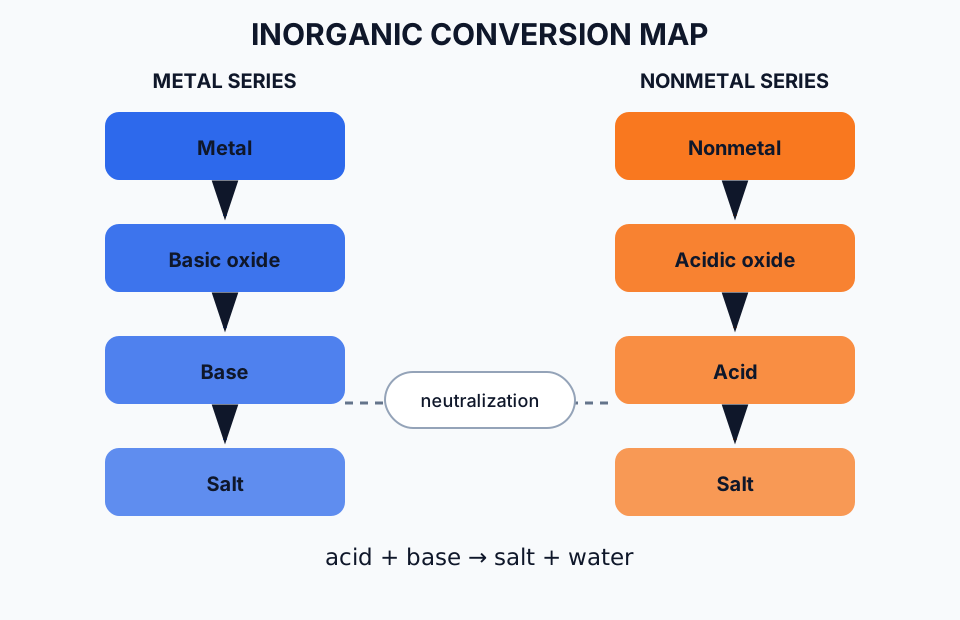
The key to mastering inorganic chemistry lies in understanding the transformation rules between different categories of substances. This is the foundation for solving Inference Questions.
 * **Vertical Series**:
* **Metal Series**: Metal $\rightarrow$ Basic Oxide $\rightarrow$ Base (Alkali) $\rightarrow$ Salt
* **Non-Metal Series**: Non-Metal $\rightarrow$ Acidic Oxide $\rightarrow$ Acid $\rightarrow$ Salt
* **Horizontal Reactions**: Reactions between Acid & Base, or Acidic Oxide & Basic Oxide usually produce **Salt**.
---
2. Key Properties Detail
#### 2.1 Elements
* **Metal Activity Series**:
$$K, Ca, Na, Mg, Al, Zn, Fe, Sn, Pb, (H), Cu, Hg, Ag, Pt, Au$$
* **Displacing Hydrogen**: Metals before $(H)$ can displace hydrogen from **dilute HCl** or **dilute H2SO4**.
* **CSCA Warning**: **Nitric acid ($HNO_3$)** and **Concentrated Sulfuric acid ($H_2SO_4$)** are strong oxidizing agents. They react with metals to produce water and oxides of Nitrogen/Sulfur, **NOT Hydrogen**.
* **Displacing Metals**: A metal can displace any metal following it from its **salt solution** (Exceptions: $K, Ca, Na$ react with water first).
#### 2.2 Oxides
| Category | Definition | Examples | General Equation |
| :--- | :--- | :--- | :--- |
| **Acidic Oxide** | Reacts with base to form salt & water | $CO_2, SO_2, SO_3$ | $CO_2 + 2NaOH \rightarrow Na_2CO_3 + H_2O$ |
| **Basic Oxide** | Reacts with acid to form salt & water | $CaO, CuO, Fe_2O_3$ | $CuO + 2HCl \rightarrow CuCl_2 + H_2O$ |
| **Amphoteric Oxide** | Reacts with both acid and strong base | **$Al_2O_3$** (Important) | $Al_2O_3 + 2NaOH \rightarrow 2NaAlO_2 + H_2O$ |
#### 2.3 Acids, Bases, and Salts
**A. Indicators**
* **Litmus**: Acid $\rightarrow$ Red, Base $\rightarrow$ Blue.
* **Phenolphthalein**: **Acid/Neutral $\rightarrow$ Colorless, Base $\rightarrow$ Red** (Crucial for identifying alkalis).
**B. Conditions for Metathesis (Double Displacement) Reactions**
For a reaction to occur between Acids, Bases, and Salts, one of the following must be produced:
1. **Precipitate** ($\downarrow$)
2. **Gas** ($\uparrow$)
3. **Water**
**C. Colors of Common Precipitates (Must Memorize)**
In CSCA exams, color is often the breakthrough point for inference problems.
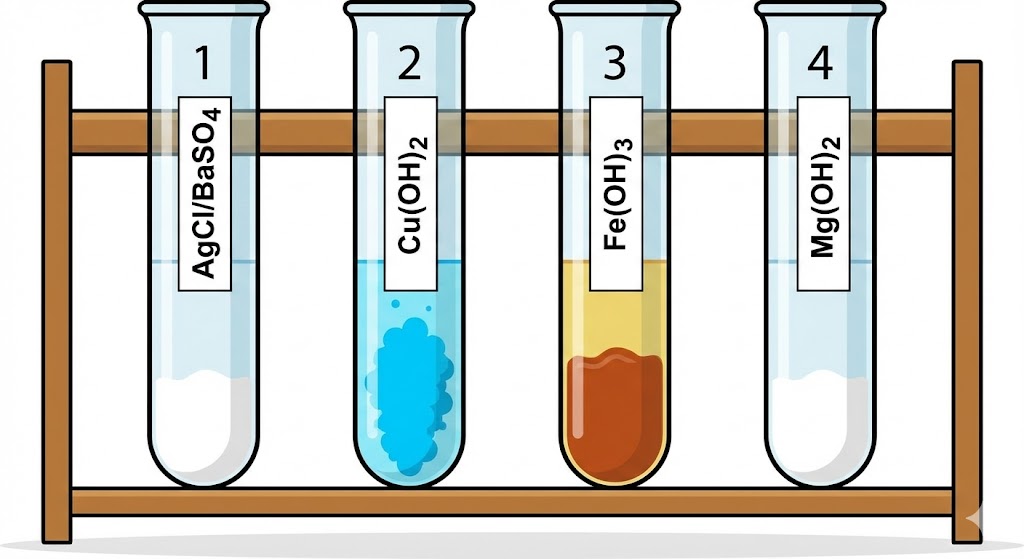 * **White**: $AgCl$ (insoluble in acid), $BaSO_4$ (insoluble in acid), $CaCO_3$ (soluble in acid), $Mg(OH)_2$, $Al(OH)_3$.
* **Blue**: $Cu(OH)_2$
* **Red-Brown**: $Fe(OH)_3$
---
3. Typical Example Analysis
**Example: Purification**
How to remove a small amount of $CuSO_4$ from a $Na_2SO_4$ solution?
**Analysis**:
1. **Goal**: Remove $Cu^{2+}$, keep $Na^+$ and $SO_4^{2-}$.
2. **Method**: Convert $Cu^{2+}$ into a precipitate using a base.
3. **Reagent**: Add appropriate amount of **$NaOH$ solution**.
* *Wrong choices*: $Ba(OH)_2$ (introduces $Ba^{2+}$ and precipitates sulfate), $KOH$ (introduces impurity $K^+$).
4. **Equation**: $CuSO_4 + 2NaOH \rightarrow Cu(OH)_2\downarrow + Na_2SO_4$.
5. **Operation**: After adding reagent, perform **Filtration**.
4. Common Mistakes
1. **Solubility of Bases**: Insoluble bases (like $Cu(OH)_2$) **do not** change indicator colors and **do not** react with salt solutions.
2. **The Sodium ($Na$) Trap**: When $Na$ is added to $CuSO_4$ solution, it does **not** displace $Cu$. It reacts with water first ($NaOH + H_2$), then the $NaOH$ reacts with $CuSO_4$.
3. **Definition**: $NaHSO_4$ ionizes to give $H^+$, but it is a **Salt**, not an Acid.