Chemical Theories and Laws
CSCA Chemical Theories and Laws study guide organized around the publicly available CSCA syllabus. Practice Chemistry questions on aicsca.com.
Before planning this topic, check the CSCA Exam Guide 2026 for exam dates, registration, fees, and subject requirements.
Syllabus Alignment
This study guide is organized around the publicly available CSCA syllabus for international undergraduate applicants.
Who It Is For
International students preparing for CSCA Math, Physics, Chemistry, or Chinese exams.
Related Practice
CSCA Practice · Go to questions
Past papers and worked video solutions · Timed mock exams · All subject video lessons
Practice by Topic
Jump from this tutorial to filtered practice questions for the same knowledge point.
Related formulas, concepts, and glossary terms
Chemistry Formula & Concept Reference
- De Broglie Relation
- Bohr Atomic Model: Hydrogen Atom Energy Level Formula
- Bohr Atomic Model: Electron Orbital Energy Formula
- De Broglie Relation: Matter Wave Wavelength
- Ionization Energy (Definition Equation)
- Effective Nuclear Charge (Estimation by Slater's Rules)
- Electron Affinity (Definition Equation)
- Heisenberg Uncertainty Principle (Position and Momentum)
Chemistry Exam Glossary
Tutorial Content
Chemical Theories and Laws
Module Framework and Learning Objectives
This module serves as the core theoretical pillar of the CSCA Chemistry examination. It aims to build a systematic and coherent chemical worldview. Chemistry is not just about memorizing equations; it is about understanding how matter is composed, how it changes, and how it reaches equilibrium.
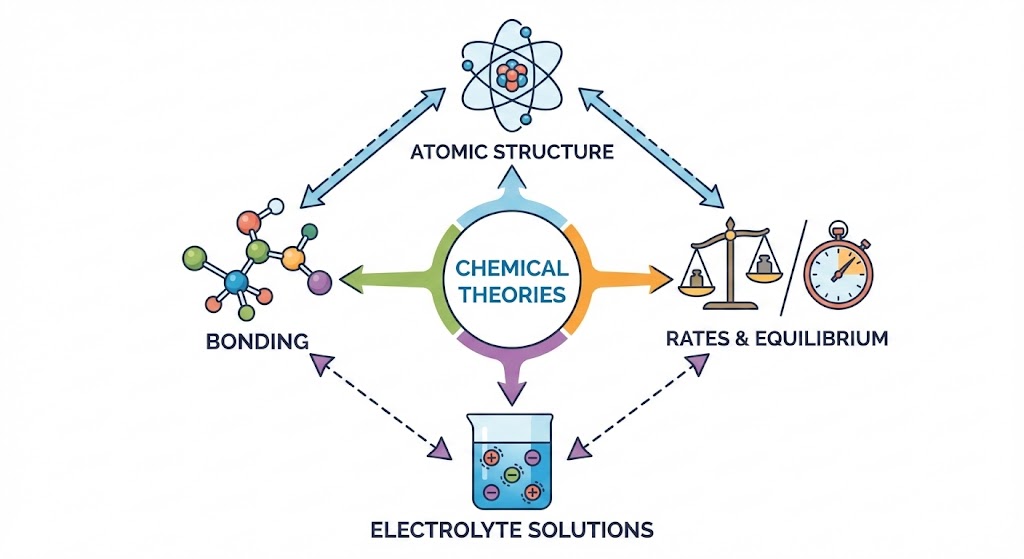 **This module encompasses four interconnected core domains:**
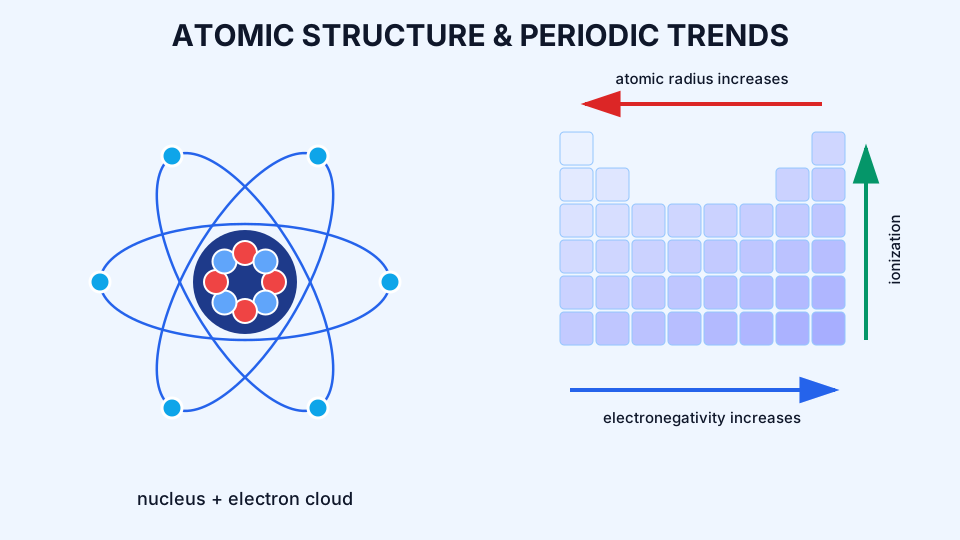
1. **Atomic Structure and Periodic Law**
* **Core Content**: Explore the microscopic building blocks of matter—atoms. Understand how the arrangement of protons, neutrons, and electrons determines the chemical properties of elements. Master the trends of the Periodic Table (e.g., radius, electronegativity), which serves as the compass for chemical prediction.
* **Key Points**: Isotopes, Electron Configuration, Periodic Trends.
 2. **Chemical Bonding and Intermolecular Forces**
* **Core Content**: How do atoms combine via ionic, covalent, or metallic bonds to form stable molecules or crystals? What forces exist between molecules (e.g., Hydrogen bonds, Van der Waals forces)?
* **Key Points**: This section explains the physical properties of matter (e.g., melting/boiling points, hardness, conductivity).
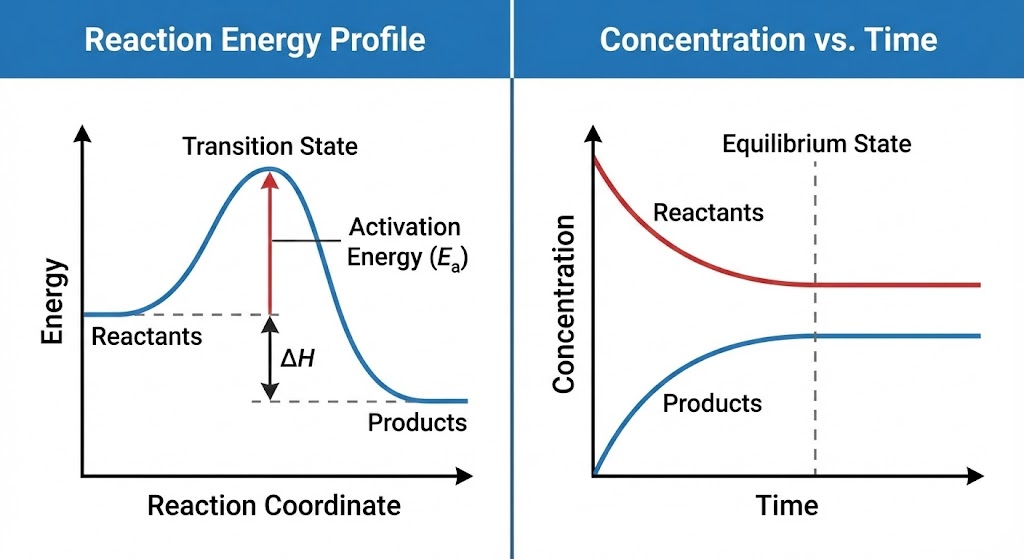
3. **Chemical Reaction Rates and Equilibrium**
* **Core Content**: Study chemical reactions from a dynamic perspective. It involves knowing not only if a reaction can occur (Thermodynamics) but also how fast it proceeds (Kinetics) and the extent of the reaction (Equilibrium).
* **Key Points**: Activation Energy, Catalysts, Le Chatelier's Principle, Equilibrium Constant ($K$).
 4. **Electrolyte Solutions and Ionic Equilibrium**
* **Core Content**: Focus on ionic behavior in aqueous solutions. This is a high-frequency topic for calculation questions in the exam, involving acid-base neutralization, precipitation, etc.
* **Key Points**: Ionization of weak electrolytes, Ion product of water ($K_w$), pH calculation, Hydrolysis of salts, Solubility Product ($K_{sp}$).
Study Advice: The "Structure Determines Properties" Mindset
Please note that these four parts are not isolated. They are connected by the core philosophy that **"Structure determines properties"**:
* **Atomic Structure** $\rightarrow$ Determines **Bond Types** and **Periodic Laws**.
* **Bond Strength** $\rightarrow$ Influences **Activation Energy** (Rate) and **Material Stability**.
* **Ionic Equilibrium in Solution** $\rightarrow$ Is the specific application of **Chemical Equilibrium** theory in aqueous systems.
When preparing for the CSCA, ensure you build these logical chains rather than memorizing fragmented facts.