Basic Organic Compounds (Hydrocarbons & Derivatives)
CSCA Basic Organic Compounds (Hydrocarbons & Derivatives) study guide organized around the publicly available CSCA syllabus. Practice Chemistry questions on aicsca.com.
Before planning this topic, check the CSCA Exam Guide 2026 for exam dates, registration, fees, and subject requirements.
Syllabus Alignment
This study guide is organized around the publicly available CSCA syllabus for international undergraduate applicants.
Who It Is For
International students preparing for CSCA Math, Physics, Chemistry, or Chinese exams.
Related Practice
CSCA Practice · Go to questions
Past papers and worked video solutions · Timed mock exams · All subject video lessons
Practice by Topic
Jump from this tutorial to filtered practice questions for the same knowledge point.
Related formulas, concepts, and glossary terms
Chemistry Formula & Concept Reference
- General Formula of Alkenes
- General Formula of Alkanes
- What is the general formula for alkenes?
- Esterification Reaction of Carboxylic Acids and Alcohols
- What is the functional group of alcohols? How is their general formula expressed?
- What is the general formula for alkynes?
- Combustion Reaction of Alcohols
- What is the general formula for benzene and its homologues?
Chemistry Exam Glossary
Tutorial Content
Basic Organic Compounds (Hydrocarbons & Derivatives)
1. Module Introduction
Organic chemistry is the study of carbon compounds. In the CSCA exam, the focus is on the core concept: **"Structure determines Properties."** We must learn to deduce the chemical properties of organic compounds based on their **Functional Groups**.
This module is divided into two parts:
1. **Hydrocarbons**: Contain only C and H (Alkanes, Alkenes, Alkynes, Benzene).
2. **Derivatives**: Contain C, H, O, etc. (Alcohols, Aldehydes, Acids, Esters).
---
2. Hydrocarbons
2.1 Aliphatic Hydrocarbons: Alkanes, Alkenes, Alkynes
Properties depend on the type of carbon-carbon bond (Single, Double, Triple).
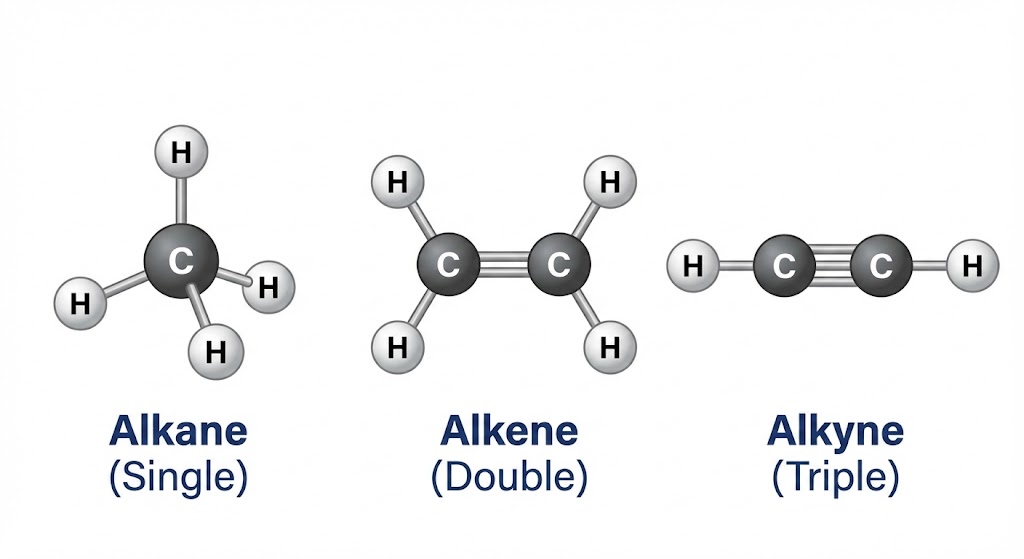
| Category | Structure | General Formula | Representative | Key Chemical Properties (Exam Focus) |
| :--- | :--- | :--- | :--- | :--- |
| **Alkanes** | $C-C$ (Single)<br>Saturated | $C_nH_{2n+2}$ | Methane ($CH_4$) | **Stable**. No reaction with acid, base, oxidizers.<br>**Substitution**: $CH_4 + Cl_2 \xrightarrow{light} CH_3Cl + HCl$ |
| **Alkenes** | $C=C$ (Double)<br>Unsaturated | $C_nH_{2n}$ | Ethene ($CH_2=CH_2$) | **Reactive**.<br>1. **Addition**: Decolorizes **Bromine Water**.<br>2. **Oxidation**: Decolorizes **Acidic $KMnO_4$**. |
| **Alkynes** | $C\equiv C$ (Triple)<br>Unsaturated | $C_nH_{2n-2}$ | Ethyne ($CH\equiv CH$) | **Reactive**. Similar to Alkenes (Addition, Oxidation). |
2.2 Aromatic Hydrocarbons: Benzene
* **Structure**: Benzene ($C_6H_6$) bonds are unique, **between single and double bonds**.
* **Chemical Properties (Special)**:
1. **Easy Substitution**: Reacts with liquid Bromine ($+ Br_2$) with $FeBr_3$ catalyst.
2. **Hard Addition**: Difficult to undergo addition (requires high temp/pressure).
3. **Does NOT decolorize Bromine Water or $KMnO_4$** (Key difference from Alkenes).
* *Note*: When Benzene is added to bromine water, the bromine water layer fades due to **Extraction (Physical change)**, not reaction.
---
3. Hydrocarbon Derivatives
Functional groups determine chemical characteristics. Memorize this table:
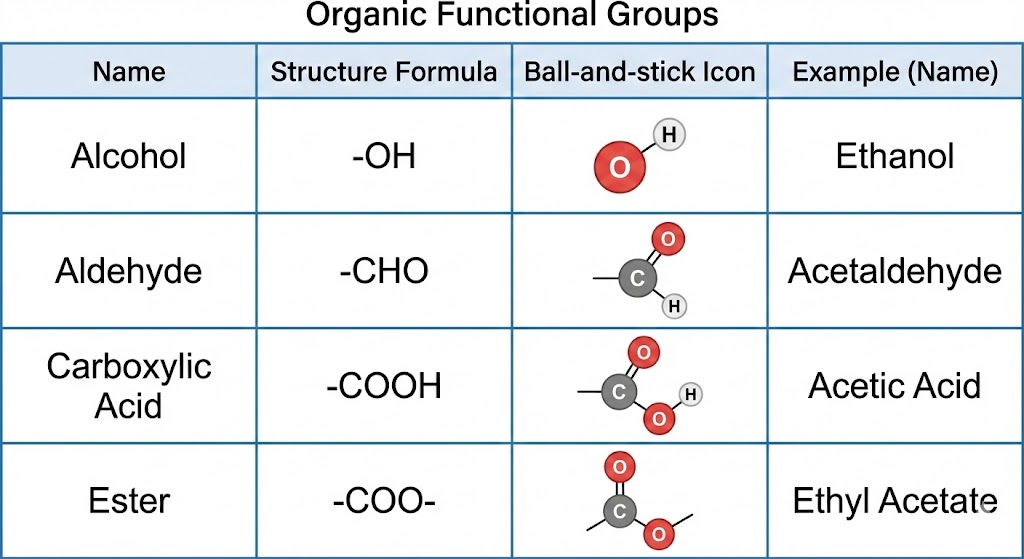
3.1 Ethanol (Alcohol)
* **Functional Group**: Hydroxyl ($-OH$)
* **Key Reactions**:
1. **With Na**: $2CH_3CH_2OH + 2Na \rightarrow 2CH_3CH_2ONa + H_2\uparrow$ (Substitution)
2. **Catalytic Oxidation**: $2CH_3CH_2OH + O_2 \xrightarrow{Cu/\Delta} 2CH_3CHO + 2H_2O$ (Forms Aldehyde)
3.2 Acetaldehyde (Aldehyde)
* **Functional Group**: Aldehyde group ($-CHO$)
* **Key Properties**: Strong **Reducing** agent.
* **Silver Mirror Test**: Reacts with Silver Ammonia solution to form Silver ($Ag$).
* **With New $Cu(OH)_2$**: Forms **Brick-red** precipitate ($Cu_2O$) upon heating.
3.3 Acetic Acid (Carboxylic Acid)
* **Functional Group**: Carboxyl ($-COOH$)
* **Key Reactions**:
1. **Acidity**: Stronger than Carbonic Acid ($2CH_3COOH + Na_2CO_3 \rightarrow 2CH_3COONa + H_2O + CO_2\uparrow$).
2. **Esterification**:
$$CH_3COOH + C_2H_5OH \xrightleftharpoons[\Delta]{Conc. H_2SO_4} CH_3COOC_2H_5 + H_2O$$
* *Note*: Concentrated Sulfuric Acid acts as **Catalyst** and **Dehydrating Agent**.
---
4. Summary of Organic Reaction Types
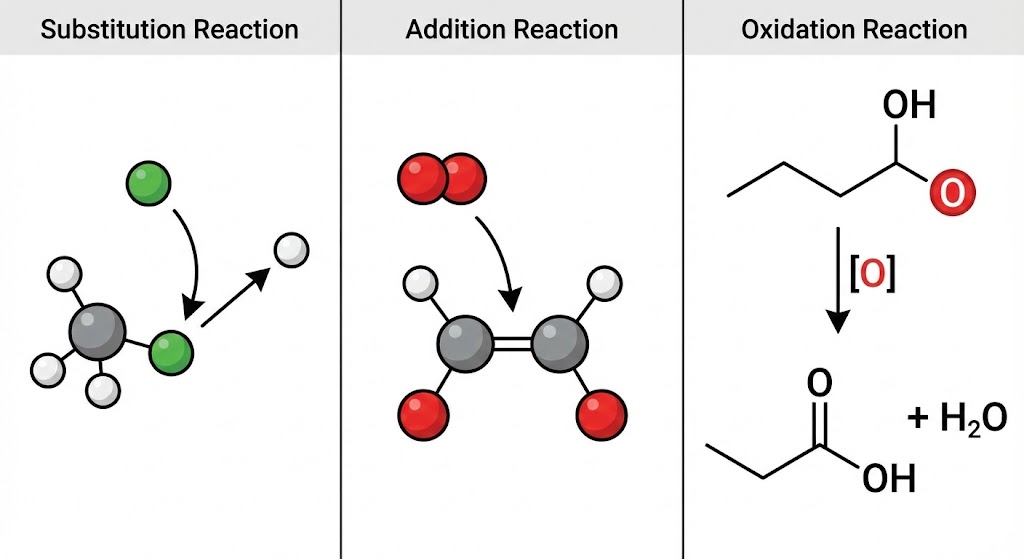
1. **Substitution**: Atom in organic molecule is "replaced" by another atom. (e.g., Alkane halogenation, Esterification).
2. **Addition**: Unsaturated bond ($C=C$) breaks to become saturated. (e.g., Ethene + Bromine).
3. **Oxidation**: Adding Oxygen or removing Hydrogen. (e.g., Combustion, Alcohol to Aldehyde).
---
5. Typical Examples
**Example 1: Identification**
How to distinguish Ethanol, Acetic Acid, Benzene, and $CCl_4$?
* **Method**: Add **Water**.
1. **Layers Form**: Benzene (Top, density < water), $CCl_4$ (Bottom, density > water).
2. **No Layers (Miscible)**: Ethanol, Acetic Acid.
* Distinguish Ethanol/Acid: Add **Litmus** or **$Na_2CO_3$** (Acid creates bubbles).
**Example 2: Deduction**
Organic substance A ($C_2H_6O$) reacts with $Na$ to produce gas but does not turn litmus red. What is A?
* **Analysis**: Contains $-OH$ (reacts with Na) but neutral (not acid).
* **Conclusion**: **Ethanol** ($CH_3CH_2OH$).