Ionic Reactions & Testing
CSCA Ionic Reactions & Testing study guide organized around the publicly available CSCA syllabus. Practice Chemistry questions on aicsca.com.
Before planning this topic, check the CSCA Exam Guide 2026 for exam dates, registration, fees, and subject requirements.
Syllabus Alignment
This study guide is organized around the publicly available CSCA syllabus for international undergraduate applicants.
Who It Is For
International students preparing for CSCA Math, Physics, Chemistry, or Chinese exams.
Related Practice
CSCA Practice · Go to questions
Past papers and worked video solutions · Timed mock exams · All subject video lessons
Practice by Topic
Jump from this tutorial to filtered practice questions for the same knowledge point.
Related formulas, concepts, and glossary terms
Chemistry Formula & Concept Reference
- Common Anion Tests ( Cl⁻, SO₄²⁻, CO₃²⁻ )
- Conditions for Determining Ion Coexistence
- Common Ion Test Method (Ammonium Ion)
- Common Ion Test Method (Carbonate Ion)
- Ionization Equations for Strong and Weak Electrolytes
- Common Ion Test Method (Sulfate Ion)
- Common Cation Tests ( NH₄⁺, Fe³⁺, Cu²⁺ )
- Common Ion Test Method (Chloride Ion)
Chemistry Exam Glossary
Tutorial Content
Ionic Reactions & Testing
1. Core Concept: Writing Ionic Equations
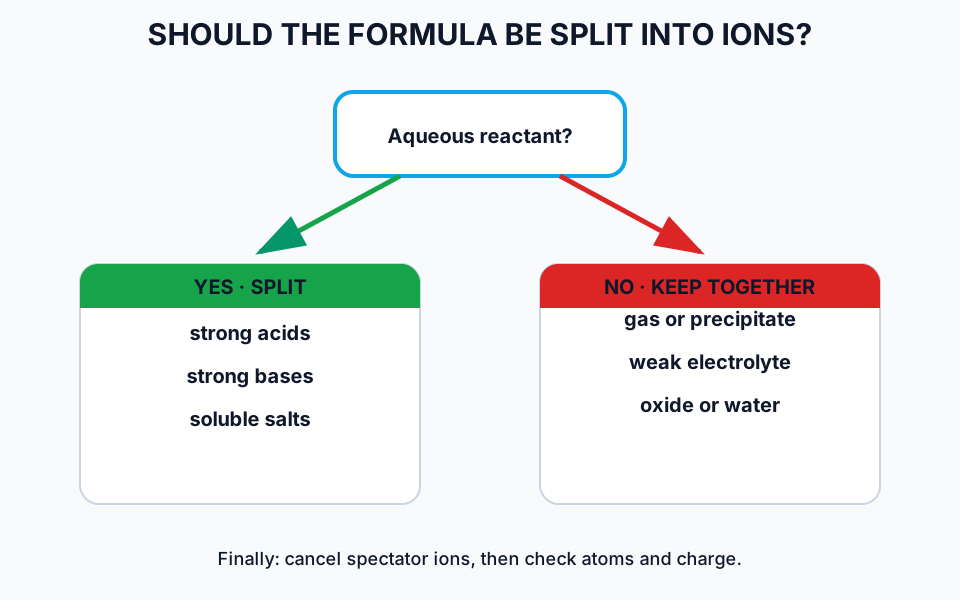
The essence of an ionic reaction is the reduction of ion concentration. In the CSCA exam, **"Split or Keep"** is the most frequent testing point for writing and judging ionic equations.
#### The "Split or Keep" Rules
1. **Write**: Write the correct chemical equation.
2. **Split**: This is the crucial step.
* **SPLIT**: **Strong Acids** ($HCl, H_2SO_4, HNO_3$), **Strong Bases** ($NaOH, KOH, Ba(OH)_2$), **Soluble Salts**.
* **KEEP (Do Not Split)**: **Weak Acids** ($CH_3COOH$), **Weak Bases** ($NH_3\cdot H_2O$), **Precipitates** ($CaCO_3, BaSO_4, AgCl$), **Gases** ($CO_2, H_2$), **Oxides** ($H_2O$).
* *Slightly Soluble Substances*: If a reactant is in a clear solution, split it; if in suspension, keep it. As a product, treat it as a precipitate and keep it (e.g., $Ca(OH)_2$).
3. **Cancel**: Remove spectator ions.
4. **Check**: Verify **Atom Balance** and **Charge Balance**.
2. Ion Coexistence
Questions often ask if ions can "coexist in large quantities." If ions react, they cannot coexist.
**5 Conditions for Non-Coexistence**:
1. **Precipitation**: $Ag^+ + Cl^-$; $Ba^{2+} + SO_4^{2-}$; $Cu^{2+} + OH^-$, etc.
2. **Gas Evolution**: $H^+ + CO_3^{2-}$; $OH^- + NH_4^+$ (heating).
3. **Formation of Water (Weak Electrolyte)**: $H^+ + OH^-$; $H^+ + CH_3COO^-$.
4. **Redox Reaction**: $Fe^{3+} + I^-$; $H^++NO_3^-$ + $Fe^{2+}$.
5. **Implied Conditions**:
* **"Colorless Solution"**: Exclude $Cu^{2+}$ (Blue), $Fe^{3+}$ (Yellow), $Fe^{2+}$ (Pale Green), $MnO_4^-$ (Purple).
* **"Acidic"**: Exclude weak acid anions and $OH^-$.
* **"Basic"**: Exclude weak base cations and $H^+$.
3. Characteristic Ion Testing
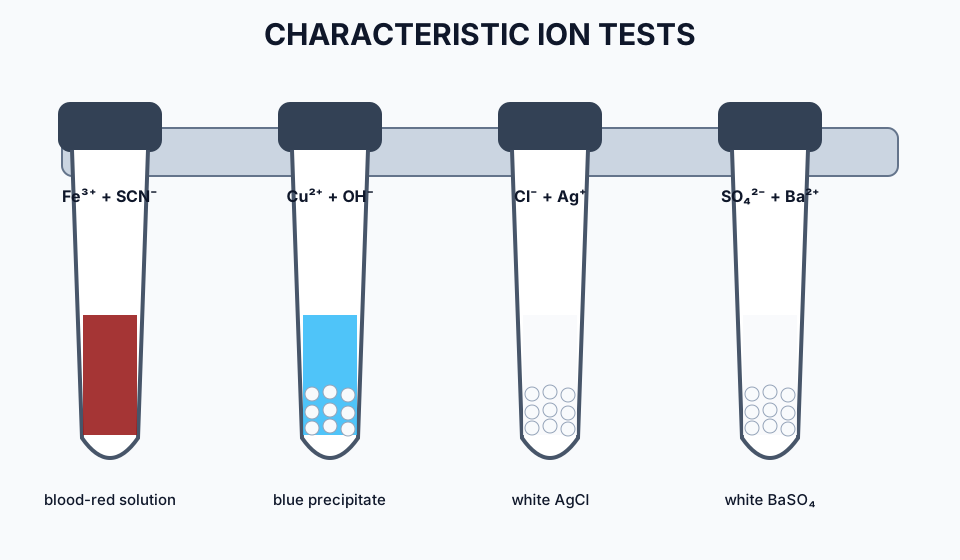
The key is **excluding interference** and identifying **special phenomena** (Color, Precipitate).
| Ion | Reagent & Operation | Phenomenon | Note |
| :--- | :--- | :--- | :--- |
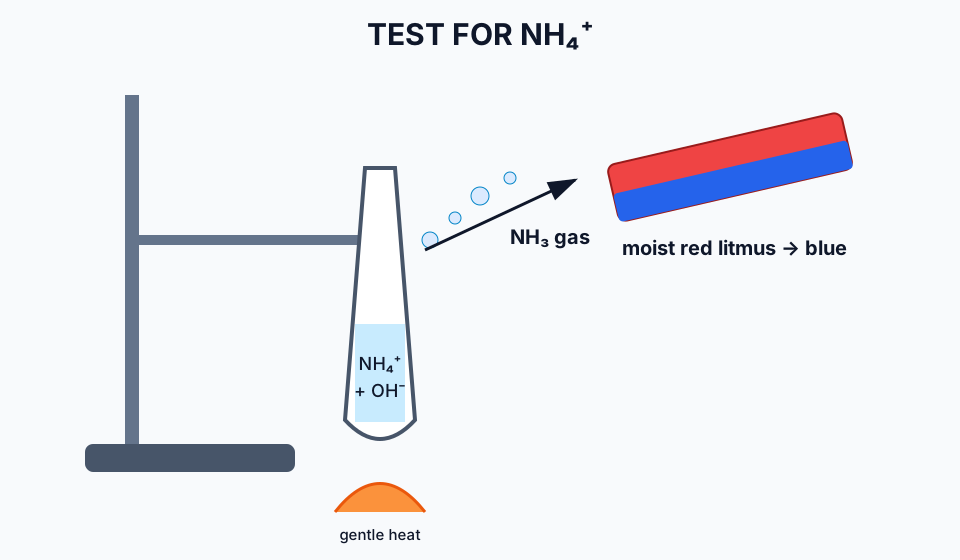
| **$NH_4^+$** | Add $NaOH$, **Heat**, damp **Red Litmus Paper** at opening | Paper turns **Blue** | Must heat; Must use damp red litmus paper |
| **$Fe^{3+}$** | ① Add **KSCN**<br>② Add $NaOH$ | ① **Blood Red** solution<br>② **Red-Brown** ppt | KSCN reaction is very sensitive |
| **$Cu^{2+}$** | Add $NaOH$ solution | **Blue** precipitate | Solution is usually blue |
| **$Cl^-$** | Add dilute $HNO_3$, then $AgNO_3$ | **White** precipitate ($AgCl$) | Nitric acid removes $CO_3^{2-}$ interference |
| **$SO_4^{2-}$**| Add dilute $HCl$, then $BaCl_2$ | **White** precipitate ($BaSO_4$) | HCl removes $CO_3^{2-}, Ag^+$ interference |
4. Typical Examples
**Example 1: Ion Coexistence**
Which group of ions can coexist in a **colorless** solution?
* A. $K^+, H^+, MnO_4^-, Cl^-$
* B. $Na^+, Cu^{2+}, NO_3^-, SO_4^{2-}$
* C. $Mg^{2+}, NH_4^+, Cl^-, OH^-$
* D. $K^+, Na^+, NO_3^-, Cl^-$
**Analysis**:
* A: $MnO_4^-$ is **Purple**.
* B: $Cu^{2+}$ is **Blue**.
* C: $Mg^{2+}$ and $NH_4^+$ react with $OH^-$.
* D: All are colorless and do not react.
**Answer: D**
**Example 2: Ionic Equation Error**
Judge: Calcium carbonate dissolving in acetic acid $CaCO_3 + 2H^+ \rightarrow Ca^{2+} + H_2O + CO_2\uparrow$
**Analysis**: **Wrong**.
* Reason: Acetic acid is a **Weak Acid** (Keep as molecule); $CaCO_3$ is a **Solid** (Keep as formula).
* Correct: $CaCO_3 + 2CH_3COOH \rightarrow Ca^{2+} + 2CH_3COO^- + H_2O + CO_2\uparrow$